CeFi vs. DeFi: Evolution of the Blockchain Wall Street
As blockchain technology matures, the frontiers of traditional finance (TradFi) are being broken. A new ecosystem known as “Blockchain Wall Street” has formed, the two most fundamental pillars of which are CeFi (Centralized Finance) versus DeFi (Decentralized Finance)。 For investors or businesses looking to participate in the digital asset market, understanding the logic and evolution of both is the first step in risk management and profitability.
Ready to start investing in crypto?
Join ZONE Wallet and get started easily with just NT$3 a day!
Download ZONE Wallet NOW!1. CeFi vs. DeFi: Who is the future of digital finance?
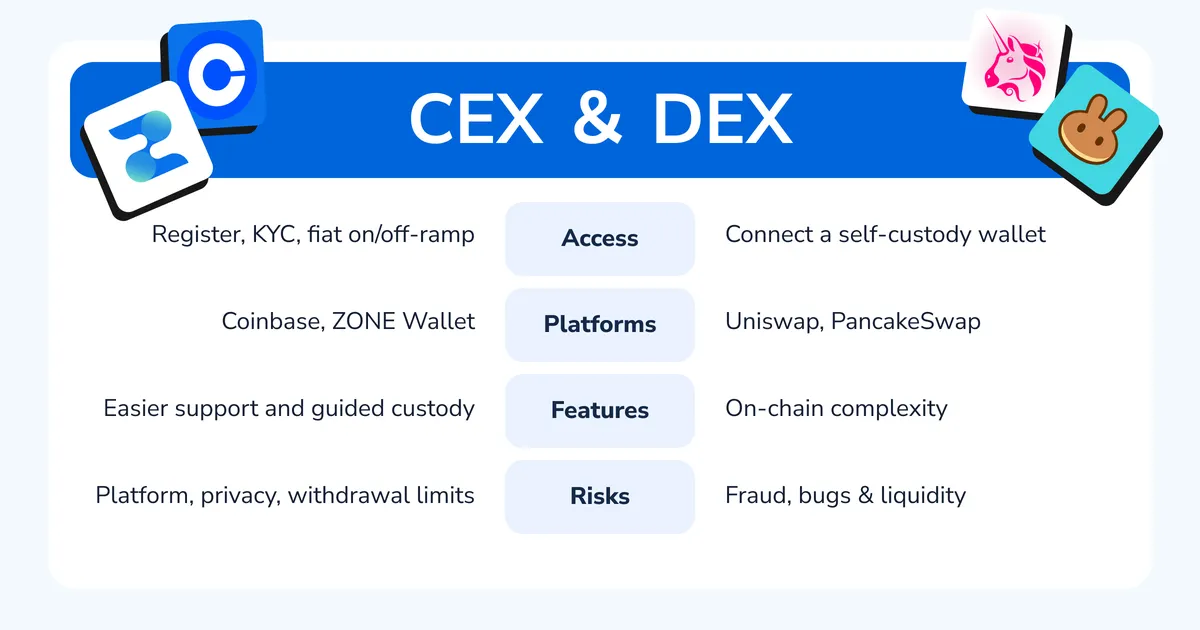
While both provide financial services such as loans, transactions, etc., there are fundamental differences in the underlying logic:
1. CeFi Centralized Finance
CeFi refers to a financial institution or agreement operated by a “centralized entity” on the blockchain. Its mode of operation is similar to traditional banking, and users need to trust the institution.
- User Restrictions: Must pass an identity verification (KYC) audit to be used.
- Control of assets: The assets are hosted by the platform (Custodial) and the user does not hold the private key.
- The foundation of trust: Trust the “people” and “businesses” that operate the platform.
2. DeFi Decentralized Finance
DeFi is a financial protocol operated by “decentralized code” on the blockchain. It replaces intermediaries with Smart Contracts.
- User Restrictions: No audit required, anyone around the world can use it as long as they have a wallet.
- Control of assets: The assets are under the user's own control (non-custodial), private key is a right.
- The foundation of trust: Trust the Procedural Code and the Blockchain Consensus Mechanism.
2. the Rise and Challenges of CeFi: From Convenience to the Crisis of Trust
The first stop for most users to enter the cryptocurrency world is usually the CeFi exchange (CEX), such as Binance or FTX, which once ranked in the top three.
Why do users choose CeFi?
- Cash Out in Legal Currency: Provides a convenient channel to convert NTD, USD into cryptocurrencies.
- Abundant Derivatives: High liquidity contract trading and leveraged instruments.
- User Experience (UX): The interface is friendly, the operation logic is no different from network banking.
Test of Trust: From FTX Breakdown to Proof of Reserve
FTX's bankruptcy in 2022 sparked a global crisis of confidence in CeFi. In order to rebuild trust, current compliant exchanges (e.g. ZONE Wallet) Begin to emphasize asset transparency, ensuring that the platform does not misappropriate user funds through Proof of Reserve and third-party audits.
3. the evolutionary history of DeFi: financial innovation from 1.0 to 3.0
The development of DeFi is a rapid experiment, every step of which is trying to solve the problem of inefficiency in traditional finance.
DeFi 1.0: Building Infrastructure
- Core Projects: Over-collateralized Lending (CDP/Lending) and Decentralized Exchanges (DEX).
- Indicator Protocol: MakerDAO (generating stablecoin DAI), Uniswap (automated marketer AMM).
DeFi 2.0: The Liquidity Revolution
- backgrounds: To solve the problem of liquidity instability in the 1.0 era.
- innovative: Introduced “Liquidity Mining 2.0” and “Liquidity as a Service (LaaS)”. This period saw the emergence of more complex Yield Aggregator and derivatives agreements.
DeFi 3.0: Fixed Income and Staking Revolution
- backgrounds: After the Luna event in 2022, the market cooled, and users turned to low-risk, sustainable stable returns.
- Liquid Staking: After Ethereum switched from PoW to PoS mechanism, protocols such as Lido emerged. Users who stake ETH receive rewards (approx. 4-6% annualized), while they can exchange liquidity tokens (such as stETH) to continue to be used in the market.
4. Risk Management: Required Courses for Businesses and Individuals
In Blockchain Wall Street, opportunities come with corresponding risks:
- CeFi Risks: Mainly derived from “Operator Risk”. If the platform is poorly managed, misappropriated, or hacked, user assets may be lost. Therefore, choose as ZONE Wallet This fulfilment of the Anti-Money Laundering Act requires a platform that complies with the declaration and assets are protected by bank trusts.
- DeFi Risk: Mainly from “Contract Vulnerability”. If the smart contract code has a bug, a hacker can empty the pool in an instant. In addition, the “Impermanent Loss” caused by strong market volatility is also a cost that liquidity providers should consider.
5. Conclusion: How to position yourself in this new world?
Blockchain Wall Street is not intended to replace existing finance, but to provide a more efficient and transparent alternative.
ForGeneral Beginners, recommended from a compliant CeFi platform (e.g. ZONE Wallet) To get started, enjoy easy NTD deposits with the help of a live consultant to establish an underlying asset allocation.
ForAdvanced Investors, you can allocate some of your funds into the DeFi ecosystem, participate in Liquid Staking or stablecoin lending for long-term stable decentralized returns.
Whichever path you choose, always remember:In the world of blockchain, information is wealth and security is life. Only on the basis of compliance and security can we navigate the tide of digital finance soundly.
What is ZONE Wallet?
ZONE Wallet is a Taiwan-based virtual asset exchange, allowing beginners to buy and sell easily with a single click. Combined with our dollar-cost averaging (DCA) feature, you can enjoy flexible, value-driven investment results!
ZONE Wallet also offers corporate account services with a fast and secure onboarding process. We help startups and enterprises leverage stablecoins to optimize cross-border payment workflows and reduce transaction costs. ZONE Wallet makes asset allocation more reliable for both personal financial management and corporate treasury strategies—helping you effortlessly navigate the future of Web3!
Start small to get comfortable with the process and risks.
Ready to dive into crypto?
[download-app]
Disclaimer: This article is for reference only. There is no investment recommendation. Investments must be risky. Virtual currencies are extremely risky investment criteria, and it is important to study your own judgment before investing.