


What is a cold wallet? Complete analysis of cold wallet types, usage and security comparisons

preamble
In the field of cryptocurrency investment,”What is a cold wallet?” It is one of the most important issues in protecting the safety of assets. As hacking attacks and stock market shutdowns become more frequent, more and more Taiwanese investors are realizing the “it's not your private key, it's not your coin.” COLD WALLETS OFFER THE HIGHEST LEVEL OF SECURITY PROTECTION, COMPLETELY ISOLATING PRIVATE KEYS FROM THE NETWORK ENVIRONMENT, SO THAT EVEN IF HACKERS ATTACK YOUR COMPUTER OR PHONE, THEY CANNOT STEAL ASSETS IN A COLD WALLET. However, there are many types of cold wallets, from hardware wallets, paper wallets to airlock computers, each with different security, convenience, and cost considerations. This article will fully analyze the definition and operation of cold wallets to help Taiwanese investors master best practices for protecting cryptocurrency assets.
What is a cold wallet? Basic Definition and Core Concepts
The core concept of cold wallet
To understand cold wallets, you first need to understand the ownership mechanism of cryptocurrencies. Unlike traditional bank accounts, cryptocurrencies are not “stored” in wallets, but recorded on the blockchain. What the wallet actually holds is a “private key” — a string of password-like combinations of numbers and letters that allow the person with the private key to control all the cryptocurrencies on the corresponding address.
Ready to start investing in crypto?
Join ZONE Wallet and get started easily with just NT$3 a day!
Download ZONE Wallet NOW!The core concept of cold walletThis is to store this critical private key in an environment that is completely isolated from the network. Just like you put cash in a safe at home instead of a bank account, cold wallets store your private keys on an offline device instead of a networked computer or phone.
Literal meaning and origin of cold wallet
Cold wallet literally comes from the concept of “cold storage,” which was originally used to describe storing important data in offline backup media. In the cryptocurrency space, “cold” refers to a state of disconnection from the network, compared to a “hot wallet” refers to a wallet with a connected state.
Why do Taiwanese investors need cold wallets?
Cryptocurrency Market Hacker Attack Incident Frequencies. There are many cases of exchanges being hacked that lead to the loss of user assets, even personal computers or mobile phones, which can lead to the theft of private keys due to viruses, trojan horses or phishing attacks.
Cold wallet for ultimate protection。 Even if your computer is fully controlled by hackers, hackers cannot steal as long as the private key is stored in an offline cold wallet. This physical isolation is a level of security that cannot be replaced by any software protection.
Cold Wallets vs Hot Wallets: Key Differences Comparison
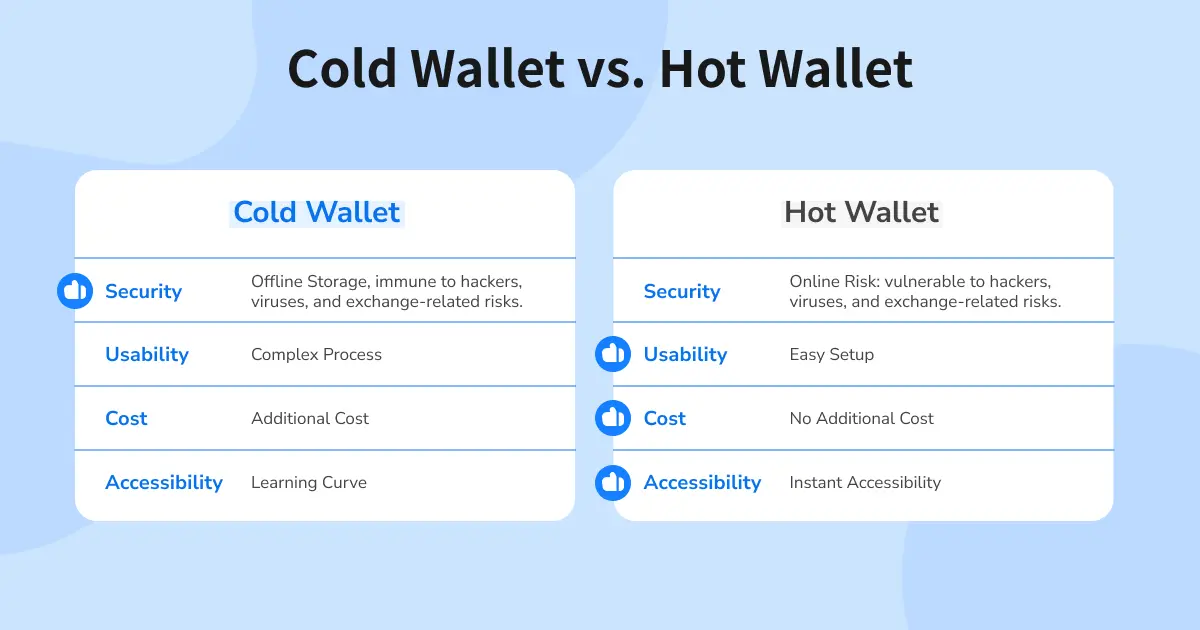
Connection Status: Core Differences
The private keys of cold wallets are stored in a completely offline environment, never having been exposed to the network. Even if you need to sign a transaction, sign it offline and transfer the signed transaction to a connected device radio via other means (such as QR Code, USB).
A hot wallet's private key is stored on a connected device, such as a mobile app, computer software, or a web wallet. Each time a transaction is made, the private key is used in a connected state, which creates a window of opportunity for hacker attacks.
Security Comparison
COLD WALLET SECURITY ADVANTAGES:
- Private keys never reach the network and hackers can't steal them through remote attacks
- Cold wallet assets are not affected even if your computer or phone is infected with a virus
- Exchange closure or hack will not affect assets in cold wallets
- Resist Phishing Sites and Malware Attacks
Hot Wallet Security Risks:
- Private keys may be stolen by hackers when connected
- Phone or computer poisoning may lead to private key leakage
- Exchange or wallet servicers closing may result in loss of assets
- Susceptible to Phishing Attacks and Social Engineering Scams
Convenience comparison
Hot Wallet Convenience Benefits:
- Fast transactions, anytime, anywhere, without additional equipment
- Suitable for frequent buying and selling or payment with cryptocurrencies
- Easy interaction with decentralized applications (DApp)
- Setup is simple and installation is complete in minutes
Cold Wallet Usage Restrictions:
- Each transaction requires connection to a cold wallet device, making the process more tedious
- Not suitable for frequent trading or real-time operations
- Hardware wallet requires additional purchase cost (about $2,000-5,000)
- The learning curve is steeper and takes time to get familiar with the first use
Hybrid Strategies: Best Practices for Taiwan Investors
Experienced Taiwanese investors often adopt a “cold and heat separation” strategy:
- Hold 80-90% of your assets in a cold wallet for a long time
- Keep 10-20% in hot wallets for daily trading
- Regularly transfer hot wallet profit to cold wallet
- Adjusting the cold & heat ratio according to market conditions
How cold wallets work: why are they safer?
The private key never leaves the device
The most basic security design of cold wallets is “the private key never leaves the device”. Whether it's a hardware wallet or a paper wallet, the private key is always stored in an offline environment, and the entire signing process is done offline, even if you need to sign a transaction.
Transaction signing process:
- Create transaction content on a connected device (computer or mobile phone)
- Send unsigned transaction information to cold wallets
- COLD WALLET SIGNS TRANSACTIONS WITH PRIVATE KEY OFFLINE
- Return Signed Transactions Back to Connected Devices
- Connected Devices Broadcast Signed Transactions to Blockchain Networks
PHYSICAL ISOLATION: THE STRONGEST PROTECTIVE WALL
The cold wallet uses the concept of “Air Gap” — physical space isolation between the device and the network. This isolation is a level of security that cannot be replaced by any software protection.
Some high-end hardware wallets even remove all wireless communication modules (WiFi, Bluetooth) and can only transfer data via a wired connection or QR Code, raising the gap protection to the highest level.
Safety chip and tamper-proof design
Mainstream hardware wallets use a bank-grade Secure Element to store private keys, which are tamper-proof:
- The private key is stored inside the chip and cannot be physically extracted
- Even if the device is disassembled, the private key is protected by the chip
- Multiple incorrect password entry triggers a self-destruct mechanism to clear the private key
Assistive word backup mechanism
COLD WALLETS TYPICALLY USE BIP39 STANDARD AUXILIARY WORDS (USUALLY TWELVE OR TWENTY-FOUR ENGLISH WORDS) AS A HUMAN-READABLE BACKUP OF THE PRIVATE KEY. These words are generated according to a specific algorithm and completely restore all private keys.
Secure Design for Assistive Words:
- Extremely high randomness, probability of guessing is close to zero
- Can be recorded completely offline on paper or metal plate
- Recovery of assets through note-taking even if the hardware wallet is damaged
COLD WALLET CATEGORY 1: HARDWARE WALLET
What is a hardware wallet?
A hardware wallet is a physical electronic device specifically designed to securely store cryptocurrency private keys, similar in appearance to a USB flash drive or a small computer. These devices have built-in security chips that store private keys in isolation so that the private key is protected from being leaked even when connected to a virus-infected computer.
Introduction of mainstream hardware wallet brands
Ledger Nano Series:
- French company Ledger sells more than 500 million units worldwide
- Nano S Plus (Starter): Supports over 5,500 cryptocurrencies
- Nano X (Advanced): Supports Bluetooth connectivity, can be paired with your phone
- Advantages: Long brand history, supported most currencies, traditional Chinese interface
Trezor Series:
- Czech company SatoshiLabs, one of the earliest hardware wallet brands
- Trezor One (Classic): Full Features but Smaller Screen
- Trezor Model T (High-end): Color touch screen, good operating experience
- Advantages: Fully Open Source, High Security Rating, Interface Intuitive
CoolWallet Series:
- Taiwan Company's CMB Technology Outputs, credit card size design
- CoolWallet Pro: Wireless Charging, Waterproof Design, Good Portability
- Advantages: Taiwan brand, full Chinese customer service, slim design
Advantages of Hardware Wallets
- The best balance of safety and convenience: Provides security close to paper wallets while maintaining the convenience of use far superior to paper wallets.
- Support multi-currency management: One hardware wallet can manage multiple cryptocurrencies at the same time.
- Firmware updates regularly: Vendors continuously update firmware to fix security vulnerabilities and add new features.
- Convenient backup recovery: With notepad backup, you can fully restore all assets even if your hardware wallet is lost or damaged.
Suggestions for purchase
Hardware Wallet Recommendations for First-Time Purchases:
- Limited budget: Ledger Nano S Plus
- Focus on the brand: Ledger Nano X or Trezor Model T
- Support for Taiwan: CoolWallet Pro (Taiwan brand with local customer service)
- Mobile users: Select Bluetooth-enabled model (Nano X, CoolWallet)
Purchase Precautions:
- Buy only from the official website or authorized resellers, never buy second-hand
- After receiving the device, check that the packaging is complete and there are no signs of unsealing
- Be sure to generate help notes from your device when you set it up
- Properly store backup of notes, better to store multiple copies in different locations
COLD WALLET TYPE 2: PAPER WALLET
What is a paper wallet?
PAPER WALLETS ARE THE MOST TRADITIONAL AND ULTIMATE FORM OF COLD WALLET THAT STORES PRIVATE AND PUBLIC KEYS DIRECTLY PRINTED ON PAPER, PROVIDING COMPLETE OFFLINE STORAGE. A paper wallet is the printing of a cryptocurrency's public key (address) and private keys in the form of text or QR Code on paper or other physical media.
How to Make a Paper Wallet Safely
Bitcoin Paper Wallet Making Process:
- Go to the paper wallet generator website
- Disconnect from the network (this is the most crucial step)
- Operating a web page while offline generating private keys and addresses
- Print or copy private key and address information
- Clear browser history and temporary files
Advantages and disadvantages of paper wallets
superiority:
- Absolute offline security: Private keys from generation to storage all the way offline
- Zero Cost: No need to purchase any hardware
- Simple Intuition: The concept is simple and easy to understand
disadvantaged:
- Extremely inconvenient to use: Manual private key is required every time you use
- Single-use feature: Private keys are exposed in a connected environment when retrieved
- Physical Damage Risk: Flammable Paper, Water Scared, Tear
- HIGH RISK OF HUMAN ERROR: IF THE PRODUCTION PROCESS IS NOT COMPLETELY OFFLINE, IT CAN LEAD TO SECURITY DISRUPTIONS
Applicable Scenes for Paper Wallets
Paper wallets are best suited for the following scenarios:
- Long-term holdings (more than several years) of assets that are not intended to be active
- As preparation for inheritance (in accordance with the description of the will)
- Physical gifts to give cryptocurrencies to others
- Users who place extreme importance on security and do not care about convenience
How to choose the right cold wallet?
Key factors to consider
- Asset Size:
- Less than NT$5000: Hot wallet or paper wallet to consider
- $5 million: Hardware wallet recommended
- Over $50 million: Hardware wallets are strongly recommended and multi-signature settings are considered
- Frequency of use:
- Trade less than 5 times a month: Hardware wallets are great
- Trade more than 20 times a month: may need to be used with a hot wallet
- Technical Familiarity:
- Beginners: Choose an easy-to-use, Chinese-supported brand
- ADVANCED USERS: CONSIDER OPEN-SOURCE PRODUCTS OR SELF-BUILT AIR VENT COMPUTERS
Exclusive advice for investors in Taiwan
Choose products that support Traditional Chinese: Ensure that the operating interface and documentation are in Chinese to reduce the threshold of use.
Consider local customer support: Hardware wallets from Taiwan brands such as CoolWallet provide local customer service, so communication is smoother when you encounter problems.
Pay attention to the safety of the purchase of pipes: Buy only through official channels, avoid buying used or unknown devices.
Cold Wallet User Tutorial: Setup and Operation Process
Hardware Wallet Initial Setup Steps
- Checking the box:
- Check packaging integrity
- Verify that the device is new and unused
- Record Device Serial Number
- Connected devices:
- Connect your computer or phone using the supplied cable
- Follow the on-screen instructions
- Configure PIN:
- Create a PIN of sufficient strength (6-8 digits)
- Confirm PIN and remember
- Backup Notes:
- The most important step
- Duplicate the 12 or 24 words displayed in sequence
- Verify that the backup is correct
- Store the help notes in a safe place
Routine of daily use
- Receive Cryptocurrencies:
- Open Wallet Management Software
- Copy the receipt address or display the QR Code
- Send assets to the address from an exchange or other wallet
- Send Cryptocurrencies:
- Create transactions in wallet software
- Connect hardware wallet to confirm transaction details
- Confirm signing transactions on a hardware wallet
- Broadcast Signed Transactions to Blockchain
Security Risks and Precautions for Cold Wallets
Major Security Risks
- Assist the risk of word leakage:
- Anyone with an assistive note can control assets
- Protection: Store properly, do not take photos or upload, make multiple backups
- Supply Chain Attack Risk:
- MALICIOUS VENDORS MAY PLANT BACKDOORS BEFORE FACTORY
- Protection: Buy only from official or authorized resellers
- Risk of physical damage:
- Loss, damage or failure of equipment
- Protection: Properly store backup of your notes
Safety Advice for Taiwan Investors
Assistive Word Backup Best Practices:
- Save with a waterproof fireproof material (such as a metal backup plate)
- Make 2-3 backups and store in different secure locations
- Avoid using cloud storage or photo uploads
- Inform trusted family backup locations as estate planning
Daily Safety Habits:
- Periodically update the hardware wallet firmware
- Disconnect safely after use
- Avoid use in public places
- Periodically check the status of assets
COLD WALLET FAQS
Q1: Where can I buy hardware wallets in Taiwan?
A: It is recommended to purchase from the official website or authorized reseller. The Taiwanese brand CoolWallet can be purchased on the official website, and international brands such as Ledger, Trezor are required through the official website or through an authorized agent.
Q2: What if the hardware wallet is lost?
A: As long as the backup of notes is properly maintained, you can purchase new equipment and restore all assets with the help notes. Assistive notes are the only way to recover assets, and be sure to keep them properly.
Q3: Do cold wallets need regular maintenance?
A: Yes, it is recommended to periodically connect the device to update the firmware to ensure that the security vulnerabilities are patched. At the same time, check the backup status regularly to ensure that the backup of the notes is complete.
Summary: The role of cold wallets in asset protection
Summary of the importance of cold wallets
What is a cold wallet? It is one of the most important tools for protecting cryptocurrency assets. For Taiwanese investors, the use of cold wallets has gradually gone from “optional” to “imperative” as the size of their assets grows.
Taiwan Investor Action Recommendations
novices:
- Start with a hot wallet and get familiar with the basics
- Consider buying a hardware wallet when assets exceed $5 million
- Choose an easy-to-use, Chinese-supported brand
Experienced Investors:
- Implementation of cold and heat separation strategy
- Consider Multiple Signatures for Increased Security
- Create a complete backup and restore process
Institutions or large investors:
- Using Multi-Signature Cold Wallets
- Establish rigorous asset management processes
- Consider Professional Hosting Services
Future Trends and Prospects
With the development of technology, cold wallets will become more popular and easy to use. Taiwan brands have performed well in hardware wallets, allowing investors to support local products while enjoying better local services.
Most importantly, you should build the right security awareness no matter which cold wallet you choose. Technology tools provide protection, but user safety habits are the ultimate defense. KEEP YOUR NOTES PROPERLY, REGULARLY UPDATE, AND STAY ALERT TO EFFECTIVELY PROTECT YOUR ASSETS WHILE ENJOYING CRYPTOCURRENCY INVESTMENT OPPORTUNITIES.
What is ZONE Wallet?
ZONE Wallet is a Taiwan-based virtual asset exchange, allowing beginners to buy and sell easily with a single click. Combined with our dollar-cost averaging (DCA) feature, you can enjoy flexible, value-driven investment results!
ZONE Wallet also offers corporate account services with a fast and secure onboarding process. We help startups and enterprises leverage stablecoins to optimize cross-border payment workflows and reduce transaction costs. ZONE Wallet makes asset allocation more reliable for both personal financial management and corporate treasury strategies—helping you effortlessly navigate the future of Web3!
Start small to get comfortable with the process and risks.
Ready to dive into crypto?
[download-app]
Risk Warning Statement:
Investing in cryptocurrencies is risky and the price fluctuates sharply, which can lead to a loss of capital. While cold wallets improve asset security, they cannot eliminate market risk. This article is for educational reference only and does not constitute any investment advice or guarantee of safety. When using cold wallets, do your own research and responsibility for safekeeping. Keep your notes and backups properly. “Virtual assets are non-currency, high-risk transactions and investors should use caution,” the HKMA reminds.

.png)


