Difference Between Short-Term and Long-Term Cryptocurrency Trading | How to Choose the Right Trading Strategy for You
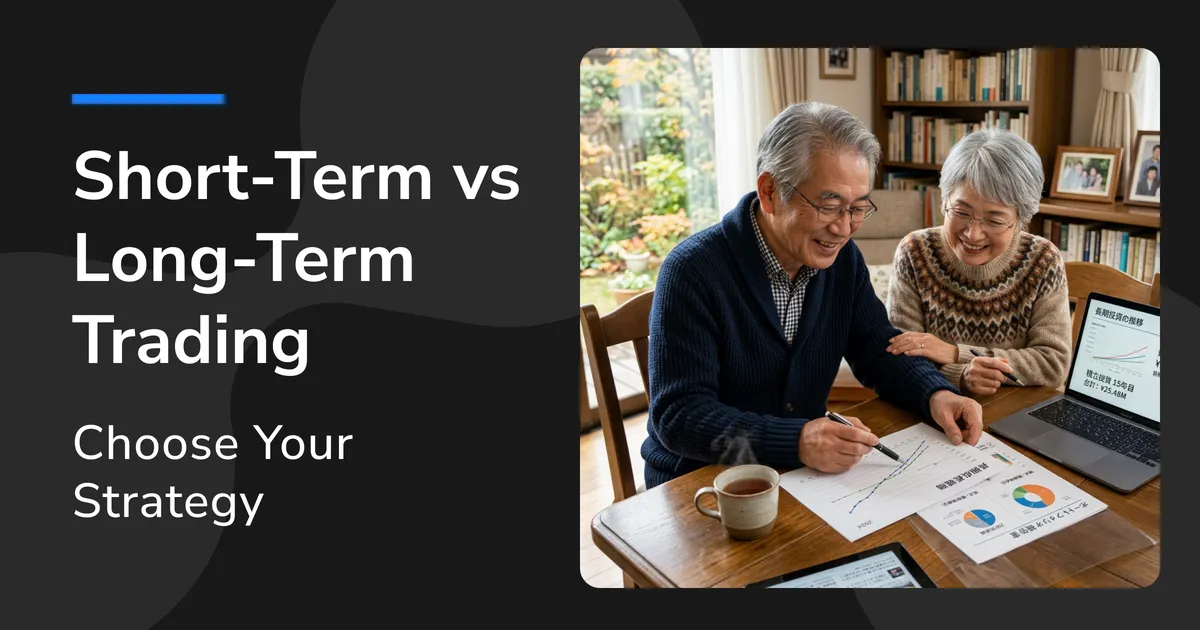
In the cryptocurrency market, two distinct investment worlds exist. On one side are short-term traders who tirelessly monitor candlestick charts, chasing every price fluctuation. They might execute dozens of trades a day, seeking profits from minute-by-minute or hourly movements. On the other side are investors who leisurely make regular purchases and hold for the long term. They might check their portfolios only a few times a year, trusting in the long-term growth potential of cryptocurrencies. While both approaches operate in the same market, they represent entirely different mindsets, strategies, and risk tolerances.
Many new cryptocurrency investors are often confused: Should I trade short-term or hold long-term? Can short-term trading really make more money? Is long-term investing truly safer? The answer isn't simple, as both strategies have their pros and cons. The key is to find an approach that suits your personal circumstances, risk tolerance, and lifestyle. This article will delve into the fundamental differences between short-term and long-term cryptocurrency operations to help you make a more informed choice.
Definition and Characteristics of Short-Term Trading
What is Short-Term Trading?
Short-term trading typically refers to trading methods where assets are held for a period ranging from a few minutes to several weeks. Depending on the holding duration, short-term trading can be further categorized into:
Day TradingThis refers to buying and selling operations completed within the same trading day. Traders may execute multiple trades a day, attempting to profit from price fluctuations in each transaction. Bitcoin might fluctuate 3-5% in a day, and Ethereum 5-8%; day traders aim to capture these movements.
Swing TradingThe holding period is slightly longer, typically from a few days to several weeks. Swing traders attempt to capture the upward or downward trend of a "market wave." For example, identifying that Bitcoin might rise 10-20% within the next week and then entering and exiting at the appropriate times.
Frequent TradingThis falls between the two, potentially involving multiple trades per week, with each position held for anywhere from a few hours to several days.
Core Characteristics of Short-Term Trading
The fundamental logic of short-term trading is "exchanging time for profit"—short-term traders believe that by frequently entering and exiting the market, they can identify and capitalize on opportunities arising from price inefficiencies in various market conditions. The high volatility of the cryptocurrency market offers abundant opportunities for short-term trading. Bitcoin might fluctuate 2-3% within an hour, and an experienced short-term trader believes they can profit from these movements through precise entry and exit timing.
Short-term trading requires a significant investment of time and energy—traders need to regularly monitor the market, analyze technical indicators, develop trading plans, execute trades, and manage positions. Many professional short-term traders treat it as a full-time job, dedicating 6-8 hours or more daily.
Short-term trading also relies on technical analysis—short-term traders use various technical indicators, such as moving averages, Relative Strength Index (RSI), and Bollinger Bands, to try and predict short-term price movements. While the effectiveness of technical analysis has always been debated in the market, many short-term traders believe these tools help them make better decisions.
Definition and Characteristics of Long-Term Trading
What is Long-Term Trading?
Long-term investing typically refers to investment methods with a holding period ranging from several months to several years. This includes the "Dollar Cost Averaging" strategy, where investors automatically purchase a fixed amount of cryptocurrency each month, regardless of market price fluctuations. It also includes the "Buy and Hold" strategy, where investors make a one-time purchase and hold it long-term, waiting for asset appreciation.
Key Characteristics of Long-term Investing
The fundamental logic of long-term investing is a "belief in growth"—long-term investors believe the long-term value of cryptocurrencies will rise, and historical evidence seems to support this. Since its inception in 2009, Bitcoin has experienced multiple bear markets, yet its long-term trend remains upward, with annualized returns exceeding 100%.
Long-term investing requires relatively less time and effort—investors might check the market only once a week, or even once a month. For busy professionals, long-term investing only requires a few minutes each month to execute a dollar-cost averaging plan.
Long-term investing relies on fundamental analysis rather than technical analysis—investors are concerned with long-term factors such as cryptocurrency adoption rates, technological advancements, and the regulatory environment, rather than daily price fluctuations.
Long-term investing demands different psychological requirements—investors need to remain unfazed during market downturns (sometimes exceeding 50%), believing the market will eventually recover and reach new highs. This psychological resilience is a challenge for many.
Return Potential Comparison
Return Potential of Short-term Trading
Theoretically, the return potential of short-term trading is enormous. If a short-term trader earns an average of 2% daily, with 250 trading days in a year, the annualized return could reach (1.02)^250 = 1.2 × 10^108, an astronomical figure. But this is, of course, unrealistic.
In reality, according to various studies, 95% of short-term traders ultimately lose money. In the cryptocurrency market, this proportion might be even higher. One study indicates that in cryptocurrency trading, only about 5% of day traders achieve positive returns. Why is the success rate so low?
Firstly, transaction fees erode profits—day traders might execute 10-20 trades daily, each incurring a 0.1-0.5% transaction fee. Cumulatively, fees can reach 1-2%, enough to offset many small profits.
Secondly, slippage costs—the actual execution price often differs from the expected price, especially during periods of high market volatility. A trade expected to yield 1% profit might turn into a 0.5% loss due to slippage.
Thirdly, emotional decision-making—even with a good trading plan, short-term traders can easily deviate from their plans due to fear or greed, leading to losses. A single significant loss can wipe out months of profits.
Return Potential of Long-term Investing
The return potential of long-term investing is relatively predictable and quantifiable—according to historical data, Bitcoin's annualized return over the past decade has been over 100% (despite including multiple drops of over 50%). Ethereum's performance is similar. An investor who bought $10,000 worth of Bitcoin in 2010 and held it until today now possesses tens of millions of dollars in assets.
Dollar-cost averaging is easier to predict—if cryptocurrencies rise by an average of 10% annually, a dollar-cost averaging plan investing 5,000 NTD per month will see assets grow to over 1.2-1.5 million NTD after ten years.
The advantage of long-term investing lies in compound growth—time is the best friend. The long-term trend of the cryptocurrency market is upward, and as long as one persists in investing, profit is almost inevitable. Anyone who entered the cryptocurrency market in the past decade and held their assets until now has made a profit.
Risk Comparison
Risks of Short-term Trading
The risks faced by short-term trading are multi-dimensional.
First, there's market risk—cryptocurrency prices can fluctuate wildly in a short period, triggering stop-losses for short-term traders and leading to losses. When FTX collapsed in November 2022, Bitcoin dropped 20% in just a few hours. Many short-term traders holding short positions were liquidated as a result, suffering heavy losses.
Second, there's leverage risk—many short-term traders use leverage to amplify gains. However, leverage also amplifies losses. A trader using 10x leverage on a long position would be liquidated with a 10% loss, losing their entire principal. Historically, countless traders have gone bankrupt due to excessive leverage.
Third, there's psychological risk—consecutive losses can be a huge blow to a trader's psyche. Many short-term traders make irrational decisions after a series of losses, attempting to quickly recover, only to lose even more. This loss of psychological control is why many short-term traders ultimately fail.
Fourth, there's liquidity risk—under extreme market conditions, liquidity can evaporate quickly. Bitcoin you expect to sell for $95,000 might only actually sell for $90,000. Slippage costs can erode profits.
Risks of Long-Term Investing
The main risk of long-term investing is systemic risk—if the entire cryptocurrency industry collapses, Bitcoin adoption stagnates, or regulations completely ban cryptocurrencies, then long-term investors' assets would significantly shrink. However, many consider this a low-probability event. Bitcoin has existed for 15 years, with continuously increasing adoption and liquidity, making the likelihood of these extreme risks relatively low.
Long-term investing also faces timing risk—if you bought Bitcoin at the peak of the 2017 bull market for $19,000 and were then forced to sell it for $4,000 during the 2018 bear market (perhaps due to an urgent need for funds), you would have lost 79%. However, if you held on until 2021, you would have gained 1,500%. This illustrates the importance of timing, but holding long-term helps balance this risk.
Long-term investing also involves opportunity cost—if the cryptocurrency market falls while the stock market rises, you might miss out on opportunities to profit in the stock market. However, this is not a risk unique to long-term cryptocurrency investing.
Time and Effort Costs
Time Cost of Short-Term Trading
The time cost of short-term trading is extremely high; professional short-term traders typically need to spend 6-12 hours daily monitoring the market, analyzing charts, executing trades, and managing risk. This is equivalent to a full-time job, or even more demanding.
Furthermore, short-term trading consumes significant mental bandwidth; even when not actively monitoring, a trader's mind constantly focuses on the market, leading to continuous psychological pressure and anxiety. This significantly impacts quality of life.
For office workers, part-time short-term trading is almost impossible—you can't trade frequently during work hours, and after work, traditional markets might be closed (although cryptocurrencies trade 24/7, North American working hours are often night or early morning for Asian traders).
Time Cost of Long-Term Investing
The time cost of long-term investing is very low—you can spend a few minutes each month setting up an automated dollar-cost averaging plan and then largely forget about it. Even if you check your portfolio only once a month, it takes no more than 5 minutes.
Long-term investing also has a much smaller impact on mental health—you don't need to constantly monitor the market or deal with emotional fluctuations caused by short-term volatility. This allows you to focus on your work and life.
For office workers, long-term investing is entirely feasible. You can complete your investment plan outside of work with minimal time and effort.
Psychological and Discipline Requirements
Psychological Challenges of Short-Term Trading
Short-term trading is a high-risk, high-pressure activity—traders must make decisions in a rapidly changing market, and the correctness of these decisions directly impacts profits and losses. This leads to continuous psychological stress.
Short-term traders require extreme discipline. Even with a good trading plan, temptations often arise during execution. The market might appear to be moving in a certain direction, and while a trader should cut losses, their psychology might make them hold on, hoping for a market reversal. This psychological struggle can lead to poor decision-making.
Short-term trading also requires the ability to cope with frequent losses. Even if a trader has a 60% win rate, they will still experience consecutive losing days. Many people cannot psychologically withstand the blow of continuous losses.
Psychological Challenges of Long-Term Investing
Long-term investing also presents psychological challenges, but of a different kind. The main challenge is dealing with significant short-term losses. During the 2022 bear market, Bitcoin fell by 65%. Someone who invested 1 million NTD would see their investment shrink to 350,000. Many people cannot psychologically bear such losses and choose to sell at the bottom.
However, long-term investing is also easier to stick with because investors don't need to make frequent decisions. When facing losses, a simple approach is sufficient: ignore it and continue dollar-cost averaging. Historical experience shows that sticking to this approach ultimately leads to success.
Suitability Analysis
Who is short-term trading for?
Short-term trading is suitable for individuals who possess the following characteristics:
They have ample time – short-term trading requires several hours each day. If you have a 9-to-5 job, short-term trading is almost impossible.
They have a high risk tolerance – short-term trading can lead to short-term losses or even significant loss of principal. Only those who can bear these losses without affecting their livelihood should attempt it.
They have a proven trading system – successful short-term traders don't rely on intuition and luck, but on repeatedly tested, statistically-based trading systems.
They possess exceptional psychological fortitude – capable of handling continuous uncertainty, losses, and stress, and maintaining rational judgment amidst these adversities.
In reality, even if all the above conditions are met, the probability of success still does not exceed 5%.
Who is long-term investing for?
Long-term investing is suitable for most people, especially:
Office workers – they don't have time for short-term trading but can easily engage in dollar-cost averaging.
Risk-averse individuals – the risks of long-term investing are much lower than short-term trading.
Those who believe in the future of cryptocurrencies – if you believe in the long-term prospects of cryptocurrencies, holding long-term is a rational choice.
Those without significant short-term capital needs – long-term investing requires you to be able to withstand short-term losses without being forced to sell prematurely.
Practical Advice
Success Factors for Short-Term Trading
If you decide to try short-term trading, here are some tips to increase your chances of success:
First, start small. Don't invest large sums right away. Test your trading system with paper trading or small real trades using $1,000-$5,000.
Second, develop a clear trading plan and risk management rules. This includes stop-loss points, take-profit points, position sizes, and more for each trade. Strictly adhere to these rules and do not deviate under emotional influence.
Third, use appropriate leverage or no leverage at all. Leverage is the primary reason short-term traders lose money quickly. If you decide to use leverage, be very cautious and use no more than 2-3x.
Fourth, keep a trading journal. Record the entry and exit points, reasons, and results of each trade. Review it regularly to identify mistakes and make improvements.
Finally, be mentally prepared. Understand that 95% of short-term traders lose money. If you incur losses, it's normal, not a personal failure.
Success Factors for Long-Term Investing
If you choose long-term investing, here are the keys to ensuring success:
First, choose a compliant exchange. In Taiwan, choose an exchange that has completed VASP registration with the FSC, such as ZONE Wallet, to ensure security.
ZONE Wallet is a local Taiwanese virtual asset exchange that supports NTD transactions, allowing crypto newcomers to easily buy and sell with one click. With its dollar-cost averaging trading model, you can enjoy more flexible value investment results!
ZONE Wallet also offers virtual currency services for corporate clients, with fast and secure account opening, powerfully assisting startups and enterprises in optimizing cross-border payment processes and reducing capital flow costs using stablecoins. Coupled with top-tier cybersecurity protection, whether for personal finance or corporate asset allocation, choosing ZONE Wallet makes asset allocation more robust, allowing you to easily plan for the Web3 future!
Second, set up automatic dollar-cost averaging. Let the system automatically deduct funds to purchase virtual currency, eliminating timing risk and psychological temptation.
Third, develop a long-term holding plan. Decide if your investment horizon is 5, 10, or 20 years, and stick to that plan.
Fourth, continue investing when the market is down. This is the hardest part. When Bitcoin drops by 50%, continue with your dollar-cost averaging purchases. Buying cheap Bitcoin at this time yields the highest long-term returns.
Finally, educate yourself regularly. Understand the technological developments, regulatory environment, and market conditions of virtual currencies to strengthen your confidence in long-term growth.
Conclusion: Choose Your Path
Short-term and long-term strategies for virtual currencies are two entirely different paths. Short-term trading promises quick riches, but statistics show that most people lose money. Long-term investing may seem boring, but historical data indicates that with persistence, it almost inevitably leads to profit.
The ideal approach might be a middle ground: keep most of your assets (70-80%) in long-term, dollar-cost averaging investments, and use a small portion of funds (20-30%) for short-term trading experiments. This way, you can participate in the long-term growth of cryptocurrencies, satisfy the thrill of trading, and keep your risk relatively manageable.
However, if you must choose one path, statistically, long-term investing is the wiser choice. It requires less time, less technical expertise, and less risk, yet offers more stable and higher-probability returns.
Whichever path you choose, remember: the cryptocurrency market is a marathon, not a sprint. Patience and discipline are far more important than haste and luck.
What is ZONE Wallet?
Are you looking for a fully compliant, user-friendly cryptocurrency platform? ZONE Wallet is a Taiwan-based virtual asset exchange that supports TWD transactions, allowing crypto beginners to buy and sell easily with a single click. Combined with our dollar-cost averaging (DCA) feature, you can enjoy flexible, value-driven investment results!
ZONE Wallet also offers corporate account services with a fast and secure onboarding process. We help startups and enterprises leverage stablecoins to optimize cross-border payment workflows and reduce transaction costs. Backed by top-tier security standards, ZONE Wallet makes asset allocation more reliable for both personal financial management and corporate treasury strategies—helping you effortlessly navigate the future of Web3!
Disclaimer: The content of this article is for educational and informational purposes only and does not constitute investment advice. Cryptocurrency trading involves high risk, and short-term trading carries particularly extreme risks, potentially leading to the complete loss of principal. Investors should evaluate their personal financial situation, risk tolerance, and available time and effort, investing only funds they can afford to lose. Past performance is not indicative of future results.