What Is an ETF Premium or Discount? NAV, Market Price, and Risk
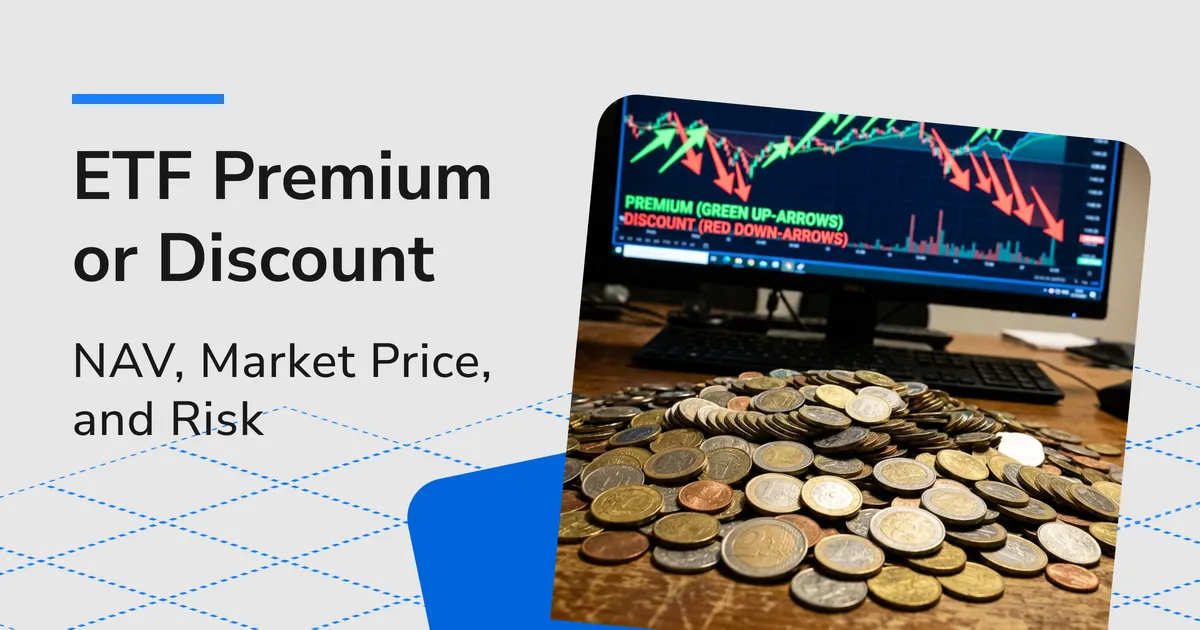
An ETF premium or discount is the gap between an ETF's market price and its net asset value (NAV). A market price above NAV is a premium; a price below NAV is a discount. The gap is not a guaranteed buy or sell signal. It is a transaction check that shows whether investors are paying more or less than the reported value of the fund's assets.
A discount does not automatically mean a bargain, and a premium does not automatically make an ETF unsuitable. First identify which prices you are comparing, why the gap exists, and what could happen if it narrows.
Looking to diversify your portfolio?
You can start small to explore crypto assets—get started easily with just NT$10 a day!
Download ZONE Wallet NOW!Three ETF prices to distinguish
Market price
This is the price at which investors actually trade on an exchange. Demand, supply, order-book depth, and short-term sentiment can move it away from the value of the underlying portfolio.
Net asset value (NAV)
NAV reflects the value of the ETF's holdings after expenses and liabilities. Official NAV is calculated at a specified time and may not capture every intraday market move.
Intraday indicative NAV (iNAV)
iNAV estimates portfolio value during the trading day. It is useful but not final. Overseas market closures, currency movements, and hard-to-price assets can make it differ from final NAV.
How is an ETF premium or discount calculated?
Premium/discount rate = (market price ÷ NAV − 1) × 100%
If NAV is 20 and the ETF trades at 20.60, the premium is about 3%. If it trades at 19.60, the discount is about -2%. The number describes the current gap; it does not prove NAV will rise or that a discount will close.
Use comparable timestamps. Comparing an intraday market price with yesterday's closing NAV can create a misleading result.
Why can the gap widen?
- Sudden demand or selling pressure: popular themes can be bid up, while panic selling can produce discounts.
- Different market hours: a locally traded overseas ETF may move while its underlying market is closed.
- Creation limits: if new ETF units cannot be created promptly, arbitrage may not increase supply fast enough.
- Illiquid holdings: bonds, commodities, derivatives, or special markets can be difficult to value and trade.
- Currency and news shocks: exchange rates and major events can affect market expectations before official valuation catches up.
Why do creation and market making not remove every gap?
Creation, redemption, and liquidity-provider mechanisms can encourage prices to move toward NAV. However, arbitrage has costs: fees, taxes, bid-ask spreads, market impact, creation limits, and liquidity risk. These frictions mean convergence is neither instant nor guaranteed.
The two risks of buying at a large premium
An investor can face both a change in the underlying assets and a change in the premium. Even if the holdings do not fall, the ETF market price can decline when an unusually high premium returns toward NAV.
A discount can also reflect real concerns, including selling pressure, weak liquidity, delayed valuation, or expectations about the next trading session. A negative number alone does not prove undervaluation.
A six-step ETF order check
- Compare market price, NAV, and iNAV using compatible timestamps.
- Look at the premium or discount, not only the daily percentage move.
- Check trading volume and the bid-ask spread.
- Understand the underlying asset and whether its home market is open.
- Read issuer and exchange announcements for creation restrictions or warnings.
- Consider a limit order to control the maximum or minimum execution price.
Read the premium and bid-ask spread together
The premium or discount compares market price with NAV; the bid-ask spread measures the distance between the best quoted buy and sell prices. Even when an ETF trades near NAV, a thin order book and wide spread can raise the real execution cost. Check quoted depth, volume, and the price of your order instead of treating a small premium as proof that any execution price is reasonable.
For basic ETF mechanics, read What Is an ETF?. Premiums and discounts are transaction-price issues; management fees and other holding costs are separate questions.
ETF premium and discount FAQ
How much premium is too much?
There is no universal safe percentage. Compare the ETF with its own history, underlying market hours, liquidity, and current announcements.
Does every discount close?
No. Market mechanisms can encourage convergence, but costs, limits, or difficult valuation can keep a discount open.
Is iNAV the same as final NAV?
No. It is an estimate and can be less reliable when overseas markets are closed or assets are hard to price.
What if market price rises but NAV does not?
The premium may be expanding, which means investors are paying more without a matching increase in portfolio value.
Is premium/discount the same as tracking error?
No. Premium/discount compares market price with NAV. Tracking error compares the ETF's return with the return of its target index.
References
Taiwan Stock Exchange: ETF Premium and Discount Risk
Taiwan Stock Exchange ETF information portal
What is ZONE Wallet?
ZONE Wallet is a Taiwan-based virtual asset exchange, allowing beginners to buy and sell easily with a single click. Combined with our dollar-cost averaging (DCA) feature, you can enjoy flexible, value-driven investment results!
ZONE Wallet also offers corporate account services with a fast and secure onboarding process. We help startups and enterprises leverage stablecoins to optimize cross-border payment workflows and reduce transaction costs. ZONE Wallet makes asset allocation more reliable for both personal financial management and corporate treasury strategies—helping you effortlessly navigate the future of Web3!
Start small to get comfortable with the process and risks.
Ready to dive into crypto?
[download-app]
Disclaimer: This article is for general information and education only and does not constitute investment, tax, or legal advice. Rules and personal circumstances can change; verify current information with the relevant authority, payer, or qualified professional.