What is Liquidation? The Ultimate Risk Management Guide for Crypto Investors
1. What is forced closing? White Speech Full Explanation
Forced Liquidation, often referred to in the cryptocurrency space as”Blast”, which means that when investors trade using leverage, the trading platform is further expanded to prevent losses due to market price swings to the downside, resulting in the margin in the account being below the “Hold Margin” requirement,Automatically force the sale of investors' positionsMechanism.
Ready to start investing in crypto?
Join ZONE Wallet and get started easily with just NT$10 a day!
Download ZONE Wallet NOW!Simple parable: It's like buying a house on your own
Imagine that you want to buy a house of 1 million, make a deposit of 100 million (top 10% of the term), and a bank loan of 900 million. The bank requires that you maintain the condition of “room price not lower than 950 million” at all times, otherwise you will be required to pay back or force repayment of the house.
If the house price drops to 920,000, and your own funds (rights) are only 20 thousand, less than the bank's required 50 million maintenance margin, the bank willForced Auction of Your HouseTo collect the loan - this is “forced closing”.
Clarification of Core Concepts
| Term | Explanation |
|---|---|
| Leverage | Using a small amount of margin to control a larger position value (e.g., 10x leverage = controlling a $100,000 position with $10,000) |
| Margin | Your own funds deposited as collateral for trading |
| Maintenance Margin | The minimum fund level the platform requires you to "always maintain" in your account |
| Liquidation | When margin falls below the maintenance requirement, the platform forcibly closes your position |
| Blow Up / Getting Wiped Out | Colloquial term, usually refers to situations where liquidation leads to substantial loss of principal |
2. how does forced closing occur? Three major triggers
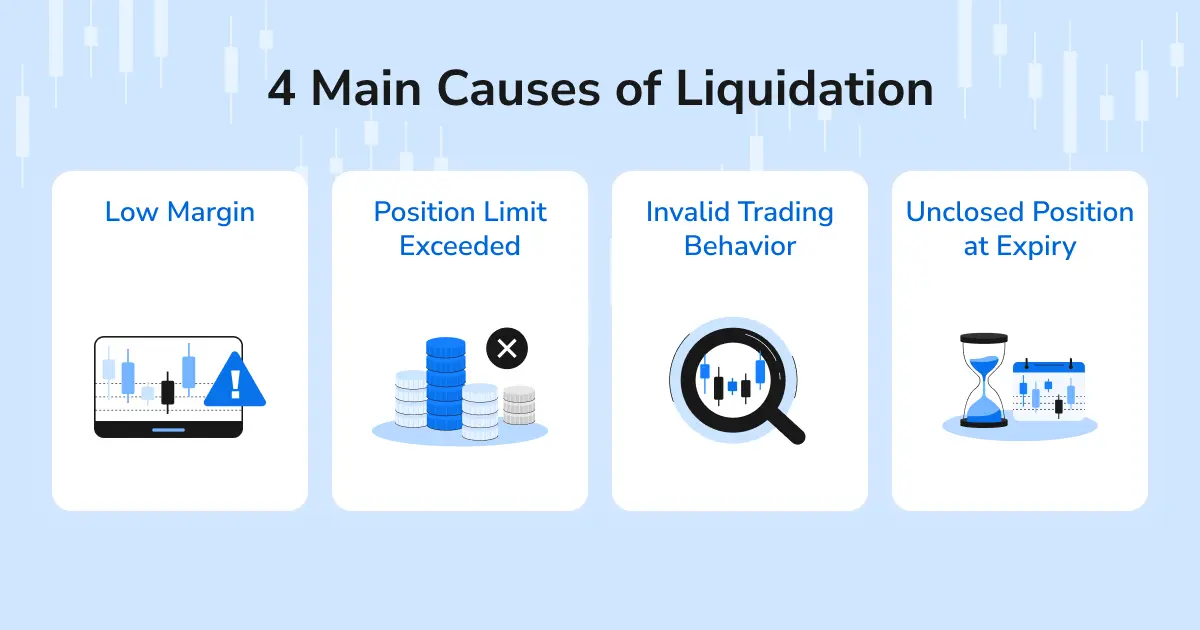
Case 1: Insufficient margin (most common)
This is the main and most easily overlooked trigger.
Actual case:
- You buy Bitcoin with 10x leverage, invest $1,000 margin, control $10,000 portion
- Bitcoin Price Drops 5% (From $30,000 to $28,500)
- Your part lost $500 and the margin was $500 left
- The maintenance margin required by the platform is $600 → Below the standard, triggering forced closing
Key numbers:
- 10X Leverage: Price swings back 10% and may burst
- 20X LEVER: PRICE FLUCTUATES BACKWARDS BY 5%, A BREAKOUT IS POSSIBLE
- 50x Leverage: A 2% upside price movement is likely to break
Case 2: Over-holding limit
The trading platform has position limits for users of different levels. The platform reserves the right to force the closing of the excess portion when you hold a portion over the specified limit and you do not divest yourself within the time limit.
Case 3: Violating Transactions
INCLUDING MARKET MANIPULATION, EXPLOITATION OF SOFTWARE VULNERABILITIES, SUSPECTED MONEY LAUNDERING, ETC., THE PLATFORM CONDUCTS ENFORCED CLEARANCE OF INFRINGED ACCOUNTS IN ORDER TO MAINTAIN OVERALL MARKET ORDER.
Case 4: Contract Expiration or Not Prepared Before Delivery
For futures contracts with an expiry date, if investors do not close their own positions prior to delivery, the platform will perform a forced closing on the uncleared position.
3. the mechanism of operation of forced closing of positions
1. Strong Price vs Bankruptcy Price
In leveraged trading, there are two key prices to understand:
Liquidation Price
- Price points that trigger forced closing
- When the market price reaches this price, the platform launches a strong leveling process
Bankruptcy Price
- Theoretical price of the margin at zero
- Represents all your principal losses
2. Mark Price Mechanism
In order to avoid unnecessary levels due to short-term market anomalies such as lack of liquidity, price manipulation, most platforms adopt”Marked Price” Instead of “Latest Trading Price” to calculate whether or not it is strong.
Marked PriceThe index prices of multiple exchanges, which are often aggregated, fluctuate relatively smoothly, and can effectively reduce false positions caused by “pin” trades.
3. Strong Smoothing Process
When the system determines that it is necessary to force a closing, it is executed in the following order:
- Revocation of Order: Cancellation of all outstanding hold orders on the account (including stop and loss orders)
- Stair Reduction: Some platforms will settle some positions first, and stop if margin requirements can be restored
- All-round strength: If the requirements are still not met, force the closing of all positions at the break-even price
4. the consequences and effects of forced closing
Economic losses
This is the most direct impact. Forced closing of positions usually occurs at the most unfavorable moment in the market, and you may:
- Sell at below-market prices (multiple positions are strengthened)
- Insist on greater losses than expected
- Lost opportunities to wait for a market rebound
Credit impact
Frequent forced closing may result in:
- The platform increases your margin requirements
- Restricted Trading Privileges
- Listed as a high-risk user, impacting future trading conditions
Psychological shock
For many investors, the psychological blow of forced closing often outweighs economic losses, which can result in:
- Emotional Pursuit to “Earn Back”
- Losing confidence in the market
- Make Irrational Follow-up Decisions
5. How to avoid being forced to close the position? Five Practical Strategies
Strategy 1: Reasonably control leverage multipliers
This is the most basic preventive measure:
| User Type | Recommended Leverage |
|---|---|
| Beginner | Leverage not recommended at all, stick to spot trading |
| General Investor | Within 3x |
| Experienced Trader | Within 5x |
| Professional Trader | Within 10x (with low per-trade allocation) |
Strategy 2: Pay close attention to the margin ratio
Most platforms display Margin Ratio or Burst Risk Rate. As an example of CoinEx, when the risk of a blowout reaches 70%, the platform sends a warning notification. At this point you should:
- Additional Margin
- Decrease leverage multiplier
- Reduces Risk Exposure to Partial Clearance
Strategy 3: Set Up Stop Loss Orders
Stop loss orders are orders that automatically close positions when the price reaches a certain level and is an important tool to prevent forced closing.
Setting Policies:
- Stop Loss Points Should Be Set Before Strong Midterms
- Reserve enough buffer space (e.g. strong bid at 28,500, stop loss set at 29,000)
- Do not move the stop point arbitrarily due to emotions
Strategy 4: Disperse risk and avoid a single position in the entire warehouse
- Don't squeeze all your funds into a single currency or in a single direction
- Multi-space two-way configuration reduces overall risk
- Separate management of spot and contract funds
Strategy 5: Choose “Disposal” instead of “Full Stock” mode
| Mode | Description | Risk Characteristics |
|---|---|---|
| Isolated Margin | Margin for each position is calculated independently | Liquidation of one position does not affect others |
| Cross Margin | Shares all available margin in the account | Losses from one position could deplete all funds |
6. Common questions about forced closing
Q1: Will the money return to zero after the forced closing of the position?
Not necessarily. Mandatory closing is carried out at the “bankruptcy price” and usually all margin is deducted, but there may be a small amount left if market liquidity is good. But in the event of a “rollover” (negative balance), some platforms have risk hedging fund underwriting.
Q2: WILL THE PLATFORM NOTIFY ME THAT I AM ABOUT TO BE STRENGTHENED?
Most platforms have early warning mechanisms. For example, CoinEx sends emails and APP notifications when the risk of a blowout reaches 70%. butIt is not recommended to wait for notification, should be actively monitored.
Q3: How are the processing fees charged for forced closing?
Strengthened positions will still be charged a transaction fee, and some platforms will also charge an additional “Strong Clearance Fees”.
Q4: Why am I setting a stop loss or being leveled?
It may be because:
- The stop loss point is too close to be swept away by a short fluctuation
- The market fluctuates sharply, stop loss orders cannot be traded at the set price (slippage)
- The platform is calculated using marked prices, and your stop loss is based on the latest price
7. Practical advice to Taiwan investors
🔴 Risk Awareness First
Forced closing of positions is not “bad luck”, butRisk Management FailureThe result of. In this highly volatile cryptocurrency market, leveraged trading should be viewed as a “professional tool” rather than a “quick get rich shortcut”.
🟢 Beginners start from the stock
For Taiwanese investors who are just getting into cryptocurrency, the most sound approach is to:
- infiltratedZONE WalletThis type of legal compliance platform to buy spot Bitcoin or Ether directly with NTD
- Make the most of itRegular Fixed RateFunctional Dispersion of Entry Risk
- After a thorough understanding of the market, evaluate whether you are exposed to leveraged trades
🟡 If you want to try leverage, be sure to follow the “Three No Principles”
- No more than: Leverage not more than 3x
- No Gambling Home: Only funds that can bear the full loss
- Do not pursue orders: Calm down for 24 hours after the explosion and make a decision
Conclusion: Respect the market, manage risk
FORCED CLOSING IS AN INEVITABLE RISK MECHANISM IN LEVERAGED TRADING THAT EXISTS TO PROTECT THE PLATFORM AND THE MARKET AS A WHOLE AND PREVENT A SINGLE TRADER'S LOSS OF CONTROL FROM ESCALATING INTO SYSTEMIC RISK.
For investors, understanding how forced closing works is not to “challenge the limit”, but toA clearer understanding of the double-edged nature of leverage。 While pursuing potentially high rewards, never forget:The market is always right, staying alive is more important than short-term profiteering。
For most Taiwanese investors, spot investing, fixed rates, and banking services through a secure compliance platform such as ZONE Wallet may be a more robust and sustainable way to engage crypto assets than high-leverage trading.
Disclaimer
This article is for educational and informational purposes only and does not constitute any form of investment advice, legal advice or tax advice. Cryptocurrencies and virtual assets are highly volatile investment vehicles whose prices can fluctuate dramatically and investors may face the risk of losing part or all of their principal.
Leveraged trading and contract trading are high-risk investing practices that may result in investors losing more than the original margin. A forced closing mechanism is a risk control measure, but it does not guarantee investors loss. Before trading with leverage, be sure to fully understand the risks involved and invest only funds that can bear the full loss.
“Virtual assets are non-currency, high-risk transactions and investors should use caution,” the HKMA reminds.
The data and regulatory information referred to in this article have been tried to ensure accuracy to date, but relevant regulations and market conditions are subject to change at any time. Readers are advised to check with regulatory authorities or professionals for updates on their own.
Investing is risky. Please be careful before making a decision.
What is ZONE Wallet?
ZONE Wallet is a Taiwan-based virtual asset exchange, allowing beginners to buy and sell easily with a single click. Combined with our dollar-cost averaging (DCA) feature, you can enjoy flexible, value-driven investment results!
ZONE Wallet also offers corporate account services with a fast and secure onboarding process. We help startups and enterprises leverage stablecoins to optimize cross-border payment workflows and reduce transaction costs. ZONE Wallet makes asset allocation more reliable for both personal financial management and corporate treasury strategies—helping you effortlessly navigate the future of Web3!
Start small to get comfortable with the process and risks.
Ready to dive into crypto?
[download-app]