The Anchor of Digital Finance: A Complete Guide to Stablecoin Rise, Risks, and Future
In a volatile and volatile cryptocurrency market, what investors need most is not the next “$100,” but a haven where assets can safely dock. This was the beginning of the birth of the Stablecoin. As a pricing unit and capital buffer for the cryptocurrency market, stablecoins have become an indispensable infrastructure in blockchain Wallstreet.
1. What is stablecoin? Why do we need it?
A stablecoin is a cryptocurrency that is tied 1:1 to a specific asset, usually a fiat currency such as the US dollar. IT COMBINES CRYPTOCURRENCY'S “FAST, DECENTRALIZED, 24-HOUR OPERATION” TRAITS WHILE OVERCOMING THE DEATH TOLL OF “EXTREME PRICE VOLATILITY” OF ASSETS SUCH AS BITCOIN, ETHEREUM.
Core values for different roles:
- For beginners: It is a relay station for slow entry into the cryptocurrency market. Investors can exchange Taiwan dollars for stablecoins before finding a suitable entry point to purchase other assets.
- For senior investors:
- Pricing Units: Enable the two parties to the transaction to reach a price consensus.
- Risk prevention: When the market fluctuates, it is possible to quickly exchange stablecoins as a temporary mooring of funds to avoid asset shrinkage.
- Reduce costs: The cost of currency transactions is usually lower than deposit in francs, making trading more convenient.
Second, the four main categories of stablecoins: the logic behind stability

Not all stablecoins are “stable” in the same way. Based on their collateralized assets and operating mechanisms, they can be divided into four main categories:
1. Fiat-Collateralized Currency
This is the type with the highest market share and the most mainstream today. Each token has an equivalent franc (such as the US dollar) behind it in the bank's bank vault.
- Representative Project:USDT(TEDA),USDC。
- pros: Simple logic and easy to understand in traditional finance.
2. Crypto-Collateralized
Using other cryptocurrencies as collateral often requires “excess collateral” to cope with currency price fluctuations.
- Representative Project:DAI。
- mechanisms: For example, $150 worth of ETH secured to lend a $100 DAI.
3. Commodity-Collateralized
Hook physical assets such as gold, real estate or precious metals.
- Representative Project:PAXG(Hook gold).
4. Algorithmic Stablecoins
Do not rely on physical collateral, but by algorithmically adjusting the supply to maintain prices.
- History Lessons: Terra (Luna)'s UST used to be such a representative, but a “death spiral” occurred in 2022, ultimately zeroing in, demonstrating the vulnerability of purely algorithmic mechanisms.
Third, the market dominator: the competition of USDT and USDC
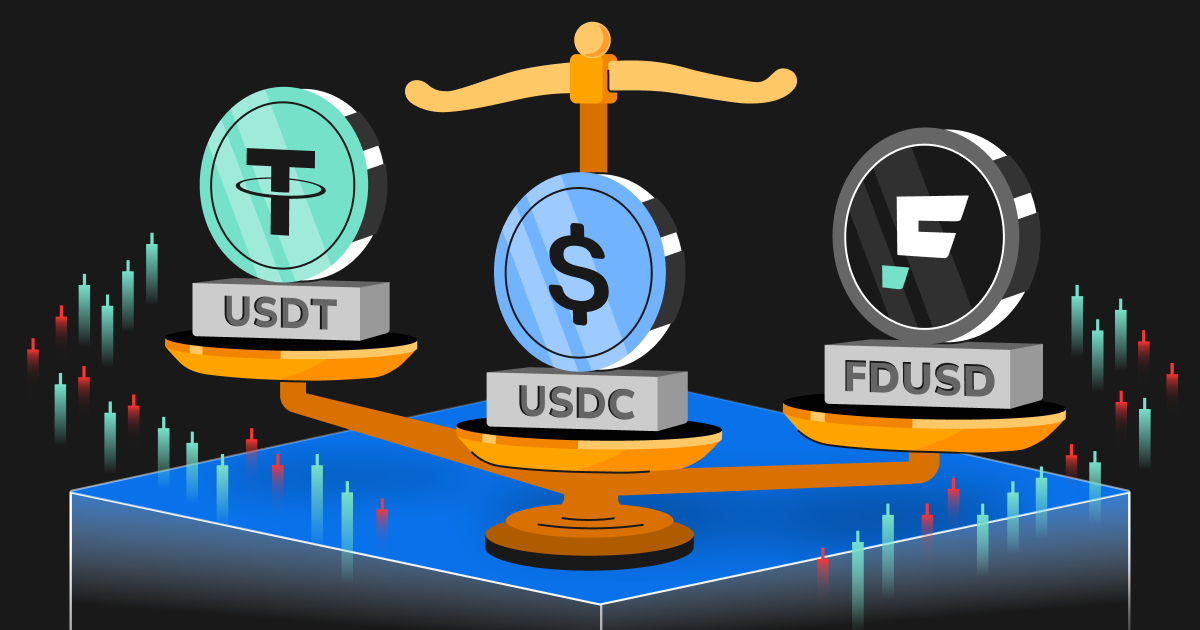
In the world of stablecoins, USDT and USDC occupy the vast majority of the chart, but the two differ in character:
1. First stablecoin: USDT (Tether)
Issued in 2014, it is the most liquid stablecoin on the market.
- superiority: Start early and trade heavily.
- qualms: The transparency of reserves has been questioned by the market for a long time, triggering FUD (fear, doubt, doubt) due to inaccurate audit reports.
2. Compliance Benchmark: USDC (Circle)
Published by Circle, it emphasizes transparency and compliance.
- superiority: Publish third-party audit reports regularly and have good relations with regulatory authorities.
- ordeal: There was a brief disconnection due to the Silicon Valley Bank (SVB) shutdown in March 2023.
Fourth, is stablecoin really stable? A Look Back at the Historical “Uncoupling” Crisis
“Stability” is not absolute, and the history of stablecoins has been filled with shocking crises.
1. May 2022: Terra Crash and Algorithm Nightmare
When UST loses the hook, its arbitrage mechanism fails, triggering massive capital flight, eventually causing billions of dollars to evaporate across the ecosystem and causing markets to lose confidence in unsecured stablecoins.
2. MARCH 2023: USDC DECOUPLING EVENT
- Causes: Silicon Valley Bank (SVB) closed after revealing a loss on its accounts, and USDC issuer Circle has some reserves stored in the bank.
- process: Panic caused a large number of users to convert USDC to USDT or French currency, and USDC price once fell below $0.9.
- Transformer: The Fed issued a statement to help SVB recover its assets, and Circle later announced that it would recoup the loss until the price returned to $1.
5. Entry of enterprises and legal entities: practical application of stablecoins
For businesses, stablecoins are more than just a financial tool, but also a tool for cross-border payments.
- Reduce Cross-Border Fees: Compared to the combined cost of a traditional wire transfer of 10-12%, the handling fees for stablecoin transfers are almost negligible.
- Accelerated Settlement: Shortened from the bank's T+3/T+5 to T+0 and even instant receipt.
- Receipt of Idle Funds: via ZONE Wallet Banking services that deposit US dollar stablecoins with annualized returns tend to be better than traditional bank deposits (about 4.5%).
6. Conclusions and Regulatory Outlook: Towards the Regulatory Era
The stablecoin has moved from its early “wild growth” to “institutionalized regulation”. Currently, governments, including the Taiwan Financial Council, are actively developing stable-currency legislation requiring issuers to have adequate reserves and high transparency.
ZONE Wallet As a platform for deepening compliance in Taiwan, we advise investors to:
- Dispersion risk: Do not concentrate all assets in a single stablecoin.
- Choosing a Compliance Platform: Prioritize a platform that completes the HKUST declaration and funds are secured by bank trusts to ensure that your digital assets are “stable and secure”.
Stabilization may not be the craziest technology on the blockchain, but it is the most solid cog that makes the digital economy work.
Disclaimer
There is still a risk of issuer default, black swan disengagement, and legal changes; recommended ZONE Wallet Such as operating local compliance platforms and carefully allocating assets within personal risk tolerance.