Is USDT Legal? A Comprehensive Analysis of Its Legal Status, Controversies, and Regulatory Landscape
“Is USDT legal?”
This is one of the most common questions asked by many people who have just come into contact with cryptocurrencies. Tether, USDT, as the world's largest stablecoin by market capitalization, has a daily trading volume of more than $500 billion and is supported by almost all cryptocurrency exchanges, but its legality has been controversial.
Ready to start investing in crypto?
Join ZONE Wallet and get started easily with just NT$3 a day!
Download ZONE Wallet NOW!Some say it's a “grey zone,” some say it's “legal but controversial,” and some worry “one day the government won't suddenly ban it.” In fact,USDT'S LEGALITY ISSUES ARE MORE COMPLEX THAN IMAGINED— It is not simply “legal” or “illegal”, but “different legal status in different countries”.
This article will give you a full breakdown of USDT's legal status in Taiwan and around the world, historical disputes, regulatory status, and compliance risks to be aware of when using it.
1. What is Tidal Coin (USDT)? Basic knowledge
Before discussing legality, first understand the nature of USDT.
Basic information about USDT
Tether, USDT is a “stablecoin”, the price is anchored to the US dollar, 1 USDT = 1 USD.
Core Features:
- Issuer: Tether Limited (Registered in the British Virgin Islands)
- Release date: 2014 (original name Realcoin)
- Market capitalization: approximately $1,100 billion (No. 1 in the global stablecoin market in February 2025)
- Major Blockchains: Ethereum (ERC-20), Wave Field (TRC-20), Binance Smart Chain (BEP-20)
Main uses:
- Trading medium of cryptocurrency exchanges
- Cross-border payments and remittances
- The Bridge Between French and Cryptocurrencies
- Fundamental Assets in the DeFi Ecosystem
USDT Operation Logic
Tether claims that for every 1 USDT issued, it holds $1 of equivalent value (or equivalent assets) as reserves. Users can:
- Deposit USD into Tether Corporation and get equivalent USDT
- Trade in the market with USDT
- Redeem USDT for USD when needed
In theory, this mechanism guarantees USDT's 1:1 anchoring relationship with the US dollar. But in practice,THE TRANSPARENCY AND AUTHENTICITY OF RESERVES HAS BEEN THE MOST CONTENTIOUS。
2. the legal status of USDT in Taiwan
Taiwan Government's Regulatory Attitude to Cryptocurrencies
In Taiwan, the legal status of cryptocurrencies (including USDT) is:“Not illegal, but not legal currency”。
Key Regulatory Frameworks:
① Anti-Money Laundering Act (2021 Amendment)
- Virtual Asset Service Providers (VASP) are required to report to the HKMA
- KYC (Real Name Certification) is required for trading
- Large Transactions Required to be Reported
- Anti-Money Laundering (AML) Regulations Apply
② HKBU Attitude
- 2017: EXPLICITLY STATING “BITCOIN IS NOT A CURRENCY”
- 2021: Inclusion of virtual assets under the Anti-Money Laundering Act
- 2023: Continued Promotion of the Monopoly Legislation (not yet passed)
③ Central Bank Stand
- Virtual assets are not legal currencies
- Not covered by deposit insurance
- The risk is borne by the user
Is USDT legal in Taiwan?
Answer: Legal possession and use, but not legal currency.
In Taiwan, you can:
- ✅ Legally buy and hold USDT
- ✅ Trade USDT on a compliant exchange
- ✅ Cross-border transfers with USDT
- ✅ Pay with USDT at accepted merchants
But be aware:
- ❌ USDT is not a legal currency, traders can refuse
- ❌ Transaction disputes are not fully covered by the Consumer Protection Act
- ❌ PRICE FLUCTUATIONS OR DISENGAGEMENT RISKS ARE AT YOUR OWN RISK
- ❌ Self-declaration of income and tax payment is required
Tax processing:
- Profits generated by trading USDT are subject to tax
- Belongs to “Property Exchange Proceeds”
- Inclusion of comprehensive income tax return
- Undeclared Possible Actions
3. the global legal status of USDT
The legal status of USDT varies widely in different countries, ranging from “fully legal” to “prohibited use”.
United States: Legal but constantly disputed
Regulatory framework:
- A stablecoin is not a security, it is a “commodity” or a “means of payment”
- Regulated by the Commodity Futures Trading Commission (CFTC) and the New York State Financial Services Administration (NYDFS)
- Tether must comply with anti-money laundering regulations
Historical Disputes:
2021: New York State Attorney General and Resolution
- Tether accused of misappropriating $8.5 billion in reserves
- Accusing Tether of not properly disclosing reserve composition
- In Final Settlement, Tether Pays $1,850M Fines
- Banned from operating in New York
2023: CFTC Fines
- Accusing Tether of Misdirecting Reserve Status
- A fine of $4100 million
- Requests for improved transparency
Despite these legal disputes,USDT is still legal in the US, just strictly regulated and questioned.
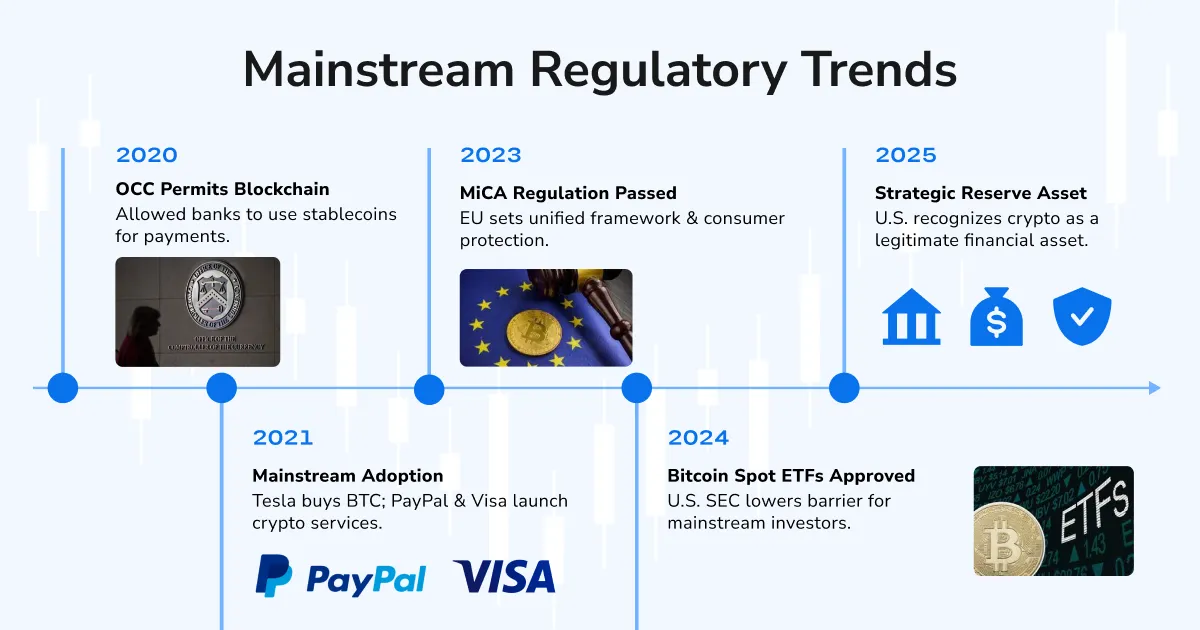
EU: MiCA Regulation Brings New Challenges
The MiCA Regulations come into force in 2024:
The EU Crypto Asset Market Regulation Act (MiCA) sets strict requirements for stablecoins:
- Issuer must obtain a license
- The reserve must be 100% and held in an EU bank
- Regular Audit and Transparency Reports
- Capital Requirement: At least EUR 200 million
Response to Tether:
- Not yet fully compliant with MiCA requirements
- Some European Exchanges Have Downgraded USDT
- Tether is applying for a license, but the process is slow
USDT is still legal in the EU, butMay face greater limitations in the future。
China: Total Prohibition
September 2021: China bans cryptocurrency trading altogether
- All virtual currency transactions are defined as “illegal financial activities”
- All cryptocurrencies including USDT are banned
- Exchanges must stop serving Chinese users
In China,It is illegal to hold or trade USDT。
Other countries
Japan:
- Legal, but subject to the Payment Services Act
- Exchanges need to obtain a Financial Institution (FSA) license
Singapore:
- Legally regulated by the HKMA
- Considered a “digital payment token”
United Kingdom:
- Legal, but regulatory framework still in place
- From 2024, stablecoins will be required to obtain an FCA license
Hong Kong:
- Introduction of “Stable Currency Issuer Regulatory System” in 2024
- Tether needs to apply for a license to operate
4. the five historical controversies of USDT
“Legal” for USDT does not mean “no problem”. It has always been accompanied by various controversies.
Dispute 1: Reserve Ambidities
Core issues: Does Tether really hold enough reserves?
2017-2019: Completely opaque
- Tether Claims 100% USD Reserves, but Never Provides Audit Report
- Exploded in 2019, the reserve is only 74%
2019—2021: Step-by-step improvement but still insufficient
- Recognized reserve is not 100% USD cash
- Including commercial notes, loans, other assets
- “Poor quality assets” overrepresented
After 2021: Partial Transparency
- Commence regular publication of reserve fund composition
- 2024 data show: Approx. 85% cash and equivalents, 15% other assets
- However, the full independent audit report is not available
Dispute 2: Reimbursement of reserve
2018-2019: Bitfinex Default Case
- Tether's sister company Bitfinex loses $8.5 billion
- Tether Borrowed Reserve Funds to Bitfinex for Redemption
- Violation of the promise of “there is $1 support for every USDT”
- Finally Settled with New York State Attorney and fined $1,850M
This case proves that Tether did indeed overspend reserves, seriously hitting trust.
Controversy 3: Manipulating Bitcoin Prices
2017-2018: Accusations of Academic Research
- STUDY BY UNIVERSITY OF TEXAS SCHOLARS POINTS OUT THAT BITCOIN SURGE IN 2017 IS RELATED TO USDT SURGE HIGHS
- Doubting Tether with Blank Banknotes, Pushing Bitcoin Price Up
- Tether denied, but could not fully clarify
The dispute has not been settled until now, but one questions the impact of USDT on the market.
Controversy 4: Lack of Independent Auditing
Core issues: Why isn't Tether looking for four major accounting firms to do independent audits?
- Formerly partnered with Friedman LLP in 2018, but ended in mid-term
- Cooperated with BDO Italia since 2021, but only provides a “proof report”, not a full audit
- Not one of the four major accounting firms (PWC, Deloitte, KPMG, EY) is willing to audit Tether
The lack of independent auditing has left outsiders doubting the veracity of reserves.
Dispute 5: Used for Money Laundering and Illegal Activities
Question: USDT's anonymity and cross-border properties are abused
- 2023 UN report: North Korean hackers launder money with USDT
- Multiple Ransomware Cases Require USDT to Pay Ransom
- Underground economy, illegal trading heavily uses USDT
Tether emphasizes that KYC/AML measures have been strengthened, but the problem is difficult to eradicate.
5. the five main risks of using USDT
Even though USDT is legal in most countries, there are risks when used.
Risk 1: The risk of getting unhooked
USDT is theoretically priced at $1, but has briefly broken off the hook several times in history:
- May 2022: USDT Drops Once to $0.95 During Luna Crash
- MARCH 2023: SILICON VALLEY BANK SHUTDOWN SPARKS PANIC, USDT BRIEFLY FALLS BELOW $0.98
If a massive disengagement occurs, the holder could lose a lot.
Risk 2: Regulatory risk
Increasingly stringent regulation by country, USDT may face:
- Required to stand down (such as some European stock exchanges)
- Prohibited use (e.g. in China)
- Enforced Requests for Greater Transparency
- Sudden drop in liquidity
Risk 3: Issuer Risk
If Tether:
- Bankruptcy or closure
- Reserves are frozen
- Forced closure by the government
The holder may not be able to redeem the USD, and the USDT becomes scrap paper.
Risk 4: Technical Risk
- Smart Contract Vulnerability
- Blockchain network congestion
- Wallets attacked by hackers
- Loss of private key
Risk 5: Unprotected in Legal Disputes
USDT is not a legal currency and is subject to limited legal protection when used:
- Not protected by deposit insurance
- Difficult to recover from transaction disputes
- Difficulty in recovering fraud cases
6. How to use USDT safely?
If you decide to use USDT, the following recommendations can reduce the risk:
Tip 1: Choose a compliant exchange
In Taiwan, the priority options are:
- Exchanges that have completed Anti-Money Laundering Compliance Statements
- A platform with a trust mechanism that works with banks
- Provides full KYC certification services
such as:ZONE Wallet cryptocurrency trading platform
Tip 2: Don't hold large amounts for a long time, choose the right stablecoin
Different stablecoins are suitable for different purposes:
Short-term trading: USDT
- Best liquidity, supported by all exchanges
- Suitable for frequent trading of cryptocurrencies
Long-term holding: USDC or USAT
- USDC: High transparency, suitable for general investors
- USAT: HIGHEST COMPLIANCE FOR CORPORATE USERS AND INVESTORS WHO VALUE REGULATION
Amount of funds: Priority franc
- Over NT$100M Recommended Deposit Banks
- Or use regulated stablecoins (USAT, USDC)
Tip 3: Disperse stablecoin risk
Don't put all your money in USDT, spread it out according to the use:
Option 1: Transaction driven
- 60% USDT (Best Liquidity)
- 30% USDC (High Transparency)
- 10% DAI (DECENTRALIZED)
Option 2: Corporate Use or Emphasis on Compliance
- 50% USAT (Maximum Compliance)
- 30% USDC (High Transparency)
- 20% USDT (Liquidity Supplement)
Tip 4: Keep an eye on market dynamics
Regular Checks:
- Whether USDT is off the hook
- Will Tether issue a major announcement
- Whether regulatory policy changes
- Whether Exchanges Are Lowering USDT
TIP 5: DO A GOOD TAX RETURN
Legal use of USDT requires:
- Record all transaction details
- Calculation of Capital Gains
- Timely Filing of Comprehensive Income Tax
- Retention of transaction documentation
7. Alternatives to USDT
If you are worried about the risk of USDT, there are other options:
USDC(USD Coin)
Advantage:
- High transparency of reserves
- Publication of Audit Reports on a monthly basis
- Regulated in the United States, strong compliance
Weaknesses:
- Liquidity slightly below USDT
- Was briefly unhooked in 2023
USAT(US Anytime Token)
What is USAT?
USAT (US Anytime Token) is issued by Paxos Trust CompanyUS-regulated US dollar stablecoins, designed for enterprise-grade applications. Paxos is a trust company licensed by the New York State Financial Services Administration (NYDFS) and is heavily regulated.
USAT'S CORE ADVANTAGES:
① Fully compliant regulatory framework
- Issued by Paxos Trust Company, licensed in the United States
- Directly regulated by the New York State Financial Services Authority (NYDFS)
- Compliant with federal and state financial regulations
- Publication of audit reports of independent accountants every month
② 100% USD Reserve Support
- Each USAT is fully supported by USD equivalent or USD equivalent
- Reserves held in FDIC-insured US banks
- Highly transparent, full reserve reports are published every month
- Redeem USD 1:1 at any time
③ Enterprise-grade security and compliance
- Suitable for businesses requiring high compliance standards
- Complete KYC/AML process
- Complies with FATF (Special Organization for Financial Action against Money Laundering) standards
- Transaction traceability to meet corporate financial audit needs
④ Efficient cross-border payment solutions
- Works 24/7 without bank hours
- Cross-border transfer completed in minutes
- Fees are much lower than traditional wire transfers (usually less than 0.1%)
- Suitable for business cross-border trade settlement
USAT vs USDT comparison:
| Comparison Item | USAT | USDT |
|---|---|---|
| Issuer | Paxos Trust Company (US-regulated trust company) | Tether Limited (British Virgin Islands) |
| Regulatory Status | Directly regulated by NYDFS | Less regulated, more controversial |
| Reserve Transparency | Monthly independent audits, fully transparent | Periodic reports, lacks full audit |
| Compliance | Fully compliant, suitable for enterprise use | Lower compliance, suitable for trading |
| Liquidity | Medium, primarily used in enterprise scenarios | Extremely high, supported globally |
| Suitable For | Enterprises, institutional investors, compliance-focused users | General traders, those seeking liquidity |
Who is suitable for USAT?
- Businesses requiring cross-border trade settlement
- Institutional investors requiring high compliance standards
- Investors who value reserve transparency and security
- Companies that need to meet corporate financial audit requirements
- Users looking to avoid USDT regulatory risks
USAT Limits:
- Liquidity other than USDT, not supported by some small exchanges
- Mainly used in corporate scenarios, used less by retail customers
- Need to go through a more rigorous KYC process
Important Reminder:
For business users in Taiwan, if you need to use stablecoin for cross-border payments or trade settlements,USAT offers higher compliance and transparency than USDT。 Although liquidity is slightly lower, it is a safer option for businesses that value risk management and compliance.
DAI (DECENTRALIZED STABLECOIN)
Advantage:
- Fully Decentralized
- Reserves managed by smart contracts
- Extremely high transparency
Weaknesses:
- High complexity, difficult for beginners to understand
- Lower liquidity
CNY (NTD, USD)
The safest option:
- Do not participate in the cryptocurrency market
- Or deposit only in fiat currency on a compliant exchange
- Avoid holding stablecoins
summed
Is Tether (USDT) Legal in Taiwan?
✅ Yes, USDT is legal in Taiwan. You can legally buy, hold, and trade USDT.
But note:
- ⚠️ USDT is not a legal currency, traders can refuse
- ⚠️ Not covered by deposit insurance, risk is at your own risk
- ⚠️ Self-declaration of income and tax payment is required
- ⚠️ Limited legal protection for trade disputes
Global Regulatory Trends:
- Most countries adopt a “legal but strictly regulated” attitude
- Completely banned in China
- Europe and the US demand greater transparency
- Regulation will only get stricter
Suggestions for use:
- Choosing a Compliant Exchange
- Do not hold large amounts for a long time
- Diversified stablecoin risk
- Follow market dynamics
- Do a good tax return
The most important cognition:
“Legal” for USDT does not equate to “safe” or “no problem”. It has a history of controversy, reserve concerns, and regulatory risks. In use, you need to understand these risks and take appropriate risk management measures.
If you only trade small amounts, USDT is a convenient tool; but for large amounts of money, it is recommended to give preference to USDC, which is more transparent, or use fiat currency directly.
When investing in cryptocurrencies, remember: Legality does not mean security, caution is always the first rule.
Disclaimer: This article is for educational and informational purposes only and does not constitute any legal or investment advice. Please refer to the latest official announcements as regulations continue to change in each country. Before using USDT, be fully aware of the risks and consult a professional legal or financial advisor if necessary.
What is ZONE Wallet?
ZONE Wallet is a Taiwan-based virtual asset exchange, allowing beginners to buy and sell easily with a single click. Combined with our dollar-cost averaging (DCA) feature, you can enjoy flexible, value-driven investment results!
ZONE Wallet also offers corporate account services with a fast and secure onboarding process. We help startups and enterprises leverage stablecoins to optimize cross-border payment workflows and reduce transaction costs. ZONE Wallet makes asset allocation more reliable for both personal financial management and corporate treasury strategies—helping you effortlessly navigate the future of Web3!
Start small to get comfortable with the process and risks.
Ready to dive into crypto?
[download-app]