What does leverage trading mean? A Complete Guide to Leverage Multiplier and Risk
Preface: Increase profit or increase risk?
“Open leverage” is a common operation in cryptocurrency trading,
Newbies often hear terms like “10x leverage” and “100x leverage”, but don't necessarily fully understand their meaning and risks.
This article will explain the principles, multipliers and potential risks of leveraged trading in the whitest way possible to help you make informed trading decisions.
Chapter 1: What is “open leverage”? White Speech Explanation
1.1 Core Concept: Augmented Operation with Borrowed Funds
OPEN LEVER, simply put”Borrowing and investing“。
You use a portion of your own funds (margin) as collateral, lending more money to an exchange or platform to expand your trading scale.
Ready to start investing in crypto?
Join ZONE Wallet and get started easily with just NT$10 a day!
Download ZONE Wallet NOW!1.2 Everyday Life Parables
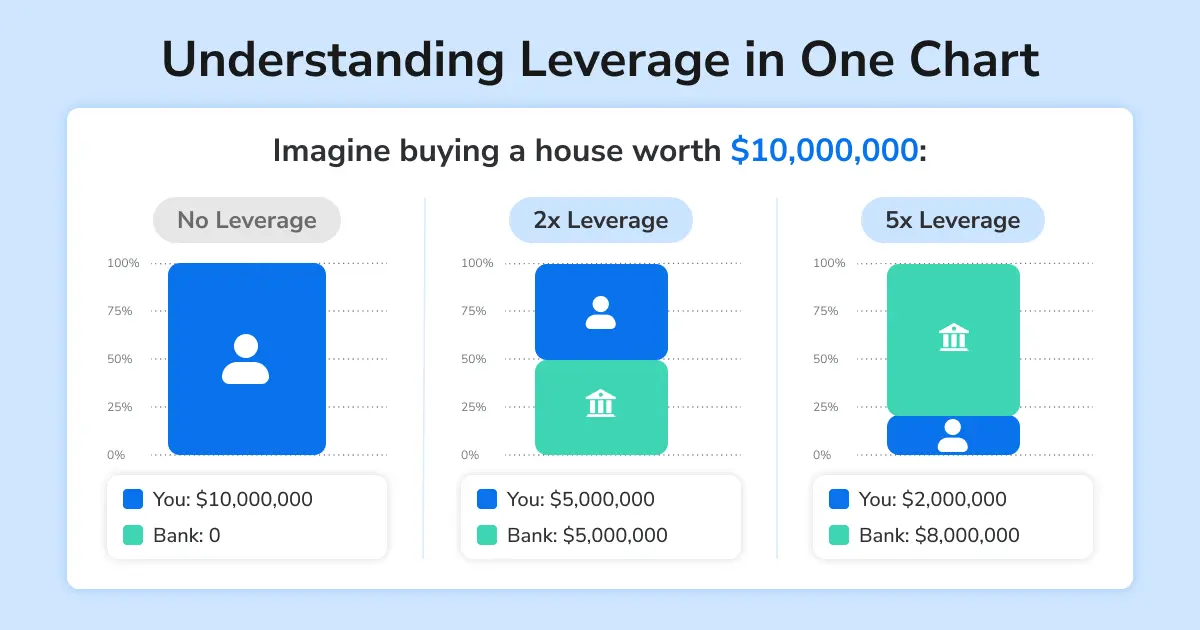
Imagine you want to buy a house for $1 million:
- Do not open leverage: Take out a full $1,000,000 purchase yourself
- Open 2x Leverage: Take out 500 million dollars on your own, bank loan 500 million dollars
- Open 5x leverage: Take out $200 million on your own, bank loan $800 million
In the investment market, this concept of “loan investment” is leveraged trading.
1.3 Cryptocurrency Leveraged Trading Examples
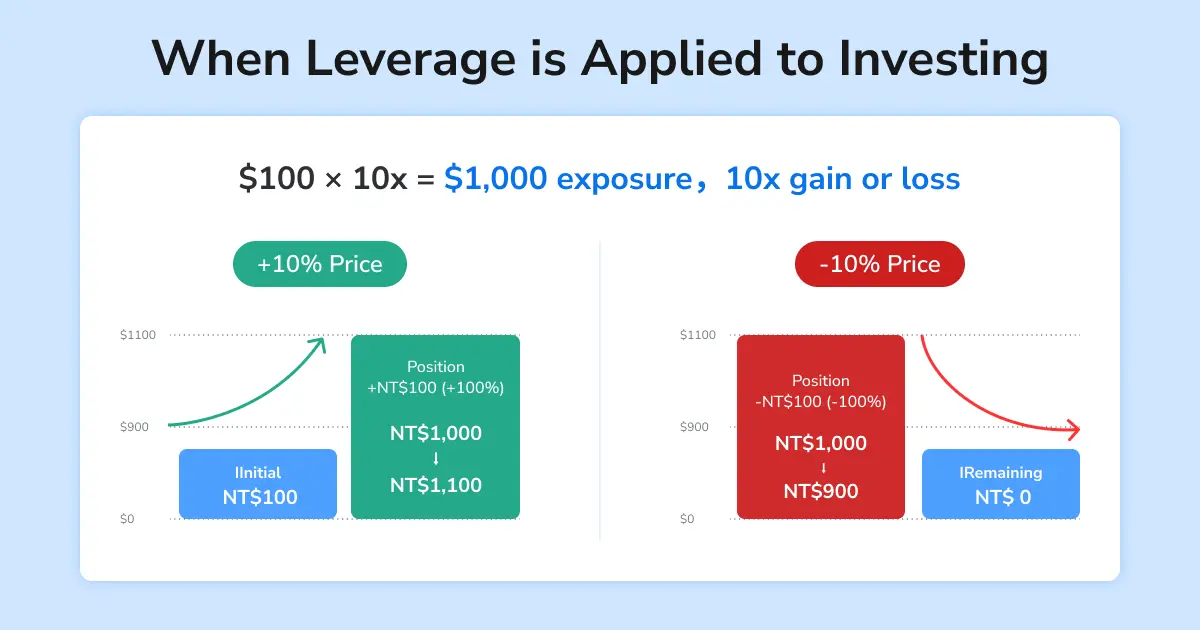
Suppose you have 1,000 USDT and think Bitcoin will go up:
- Spot Trading: Buy Equivalent Bitcoin with 1,000 USDT → Increase 10% Earn 100 USDT
- Open 10x Leverage: Borrow 9,000 USDT with 1,000 USDT as margin → Total trades 10,000 USDT worth Bitcoin → Gain 10% to earn 1,000 USDT
The same market fluctuates and yields are magnified 10xAnd this is the attraction of leverage.
Chapter 2: Detailed Analysis of Leverage Multipliers
2.1 Leverage Multiplier Calculation Formula
texto
Leverage Multiplier = Total Transaction Amount ÷ Own Funds (Margin)
- 10 times leverage = $10 total to operate with $1 of equity
- 20 times leverage = $20 total to operate with $1 of equity
- 100x Leverage = $100 Total Operating with $1 of Own Capital
2.2 Margin requirements for multiple leverage
Leverage Multiplier Total Trade Required Margin Ratio Per 1,000 USDT Operable
5x 5,000 USDT 20% 5,000 USDT
10x 10,000 USDT 10% 10,000 USDT
20x 20,000 USDT 5% 20,000 USDT
50x 50,000 USDT 2% 50,000 USDT
100x 100,000 USDT 1% 100,000 USDT
2.3 Application Scenarios of Different Multiples
Low multiplier leverage (3-10x)
- Suitable for medium to long term trend trading
- Lower volatility tolerance
- Beginner's Suggestions Start Here
Medium Multiplier Leverage (10-20x)
- Short-term band operation
- Traders with some experience
- Need to monitor the market closely
High multiplier leverage (20-100x or more)
- Very short line trading (minutes to hours)
- Used by Professional Traders
- The risk is very high and it is not recommended for beginners to try
Chapter 3: What is the Leverage Ratio? In-depth understanding
3.1 Definition of leverage ratio
Leverage RatioAn important indicator to measure the level of risk of your position, the formula is calculated as:
Leverage Ratio = Total Liabilities ÷ Equity
In trading, this usually represents a proportional relationship between the size of your position and the margin.
3.2 Maintenance of Margin and Mandatory Closing
Exchanges set two key levels to control risk:
Maintain Margin Rate(Maintenance Margin)
- Minimum Margin Ratio to Maintain
- Usually 50%-80% of the initial margin
- Additional margin notification will be received below this level
Forced Closing Line(Liquidation Price)
- When losses result in margin below a certain level
- The system will automatically sell your position (strong)
- Avoid losing more than your margin
3.3 Actual calculation examples
Let's say you trade multiple bitcoins with 1,000 USDT leveraged 10x:
- Initial Margin:1,000 USDT
- Total Position Value:10,000 USDT
- Borrowing Amount:9,000 USDT
- Maintain Margin Rate: Set to 0.5% (varies by exchange)
- Forced Closing Line: When the margin is below 0.5% of the total position = 50 USDT
Calculate Strong Affordable Prices:
If the price of Bitcoin falls, your losses will be deducted from the margin. When the 1,000 USDT margin is lost until only 50 USDT is left, the position will be forced to close.
Chapter 4: The Four Risks of Leveraging
4.1 Risk 1: Accelerated loss (double-sided edge effect)
Leverage not only magnifies gains, it also magnifies losses:
- Market Reverse Fluctuation at 10x Leverage = 100% Margin Loss
- Market Reverse Volatility 5% = 100% Margin Loss Under 20x Leverage
- Market Reverse Volatility 1% = 100% Margin Loss Under 100x Leverage
Real case:
On May 19, 2021, Bitcoin fell 30% in a single day, with the entire number of traders using double leverage being forced to close their positions, losing heavily.
4.2 Risk 2: Forced closing (burst)
When the price reaches a strong level, the system will automatically sell your position at market price, which may result in:
- Total Margin Loss:The remaining funds after consolidation may be zero
- Collision risk: Under extreme volatility, strong prices are out of reach and may owe money to the exchange
- Emotional Strikes: Instantaneous psychological shock to zero
4.3 Risk 3: Cost of Capital Expenditure
Leveraged trading typically involves:
- Borrowing Interest: Calculated by hours or days, annualization can reach 15%-30%
- Capital Fee(Perpetual contract): Settlement once every 8 hours, free to pay each other
- Transaction Fee: Generally higher than spot trading
The cost of holding a leveraged position for a long time is staggering:
Assume 100x leverage, daily interest of 0.05%, annual interest of about 18%, almost eating up most of the potential returns.
4.4 Risk 4: Liquidity and slippage risks
- When there is a lack of liquidity: May not be able to close the position at the ideal price
- When extreme behavior: Buy and sell spreads widen, actual strong price may be worse than expected
- System Risk: Exchange Server Unable to Operate During Downtime
Chapter 5: Practical Strategies and Risk Control for Leveraged Trading
5.1 Beginner's Safety Operating Guide
Step 1: Start with demo trading
- Using the Exchange's Simulation Trading Features
- The Feeling of Practicing Different Multiplier Leverages
- Experience the process of forced closing of positions (with virtual funds)
Step 2: Very Low Multiplier Start
- Recommended leverage of no more than 3x for the first live stock
- Test with a small amount of money (the amount you can bear the loss)
- Record profit and loss on each trade
Step 3: Set Strict Risk Parameters
- Maximum single loss: No more than 2-5% of the margin
- Maximum Daily Loss: Reach and Stop Trading
- Use Stop Loss Orders: Never operate naked
5.2 Advanced Risk Management Techniques
Batch Leverage:
- Unfilled positions more than once
- Market proof the direction is correct after replenishment
- Lower Average Leverage Multiplier
Dynamic Leverage Adjustment:
- Reduce leverage when market volatility is high
- Moderate increase when trend is clear
- Adjusting according to volatility indicators
Hedging strategy:
- Holding both spot and reverse leveraged positions
- Using options to protect leveraged positions
- Cross-market hedging (such as stocks and cryptocurrencies)
5.3 Common Mistakes to Avoid
❌ Mistake 1: Full position high leverage
- “All in” mentality is especially dangerous in leveraged trading
- A mistake can go wrong.
❌ Mistake 2: No-Stop Trading
- Expecting market reversal and heavy losses
- The result is often forced closing at the lowest point
❌ Mistake 3: Emotional Overload
- Want to quickly reverse after a loss and increase leverage
- “Gambler Mindset” Leads to a Vicious Cycle
❌ Mistake 4: Ignore the cost of ownership
- Long term leveraged position, interest rate eating profit
- Funding rates may be unfavorable for your direction
Chapter 6: Practical Calculations — Understanding Your Risk Tolerance
6.1 Quick Calculation of Leverage Multiplier and Strong Price
formulation:
Strong Average Price (Do More) = Opening Price × (1 - 1/Number of Props × (1 - Maintenance Margin Rate))
Easy Edition(Ignore the Maintenance Margin Rate):
Strong Average Price ≈ Opening Price × (1 - 1/Leverage Multiplier)
Example:
- Bitcoin Price: 50,000 USDT
- Do more than 10 times leverage: strong average ≈ 50,000 × (1 - 1/10) = 45,000 USDT
- A 10% drop in price triggers a strong plateau
6.2 Survival space under different levers
| Leverage | Multiplier Market Reverse Volatility Will Lose All Margin |
|---|---|
| 2倍 | 50% |
| 5倍 | 20% |
| 10倍 | 10% |
| 20倍 | 5% |
| 50倍 | 2% |
| 100倍 | 1% |
Common Single Day Fluctuations in Cryptocurrency Markets:
- Ordinary day: ± 3-5%
- Big news day: ± 10-20%
- Extreme events: ± 30% or more
From this it can be seen,More than 20x leverage is very dangerous in the crypto market。
Chapter 7: Alternatives to Leveraged Trading
7.1 SPOT TRADING+PATIENCE
- No risk of forced closing
- Can be held indefinitely
- Suitable for long-term investors
7.2 LOW COVERETF/ETN
- HOW TO 3MAKE MORE/BUY BITCOIN ETN
- Rebalancing managed by professional bodies
- There are still some cost and tracking errors
7.3 Options Strategy
- Buy Bull/Fall Options
- Maximum loss is royalty
- No need to worry about forced closing
7.4 Grid Trading
- Automatic low and high sell within the set range
- Earn Volatile Income
- Suitable for turbulent markets
Conclusion: Leverage is a tool, not magic
Key Highlights Recap:
- Leverage is a borrowing investment: Drive bigger positions with margin
- The higher the multiplier, the greater the risk: 100x leverage with only 1% reverse volatility to break a position
- Forced closing of positions is the greatest risk: May result in loss of all margin
- Costs can not be ignored: Interest and capital rates erode profits
- Risk management at the top: Always set stop loss, control position size
Advice for different traders:
NOVICE TRADER:
- Get a full grasp of spot trading first
- If you need to try leverage, start from 2-3 times
- Entertainment funds only (the amount that can be covered by the full loss)
Experienced Traders:
- Dynamically adjust leverage based on market volatility
- Create a complete risk management system
- Avoid using high leverage in extreme trades
All traders should remember:
“There are old traders in the market, and there are brave traders, but there are very few old and brave traders.”
Leveraged trading is a double-edged sword that can generate amazing returns in the short term and destroy capital just as quickly.
The key to successful use of leverage is not in the pursuit of maximum multipliers, but in precise risk control and timing.
Final Conscience Advice:
Before you truly understand and bear the risks of leveraged trading, treat it as a “risky tool” rather than a “get-rich shortcut.”
Starting with low multipliers, practicing with small amounts of money, building your own trading discipline is the cornerstone of long-term survival in the crypto market.
What is ZONE Wallet?
ZONE Wallet is a Taiwan-based virtual asset exchange, allowing beginners to buy and sell easily with a single click. Combined with our dollar-cost averaging (DCA) feature, you can enjoy flexible, value-driven investment results!
ZONE Wallet also offers corporate account services with a fast and secure onboarding process. We help startups and enterprises leverage stablecoins to optimize cross-border payment workflows and reduce transaction costs. ZONE Wallet makes asset allocation more reliable for both personal financial management and corporate treasury strategies—helping you effortlessly navigate the future of Web3!
Start small to get comfortable with the process and risks.
Ready to dive into crypto?
[download-app]
Disclaimer: This article is for educational purposes only and does not constitute investment advice.
Leveraged trading risks are extremely high and can lead to the loss of all funds.
Please make careful decisions based on your ability to bear your own risk and consult a professional financial advisor if necessary.
Past performance does not mean future results, the cryptocurrency market fluctuates wildly, so be sure to study for yourself before investing.