Stock-Bond Allocation: How to Set a Mix for Your Goals and Risk
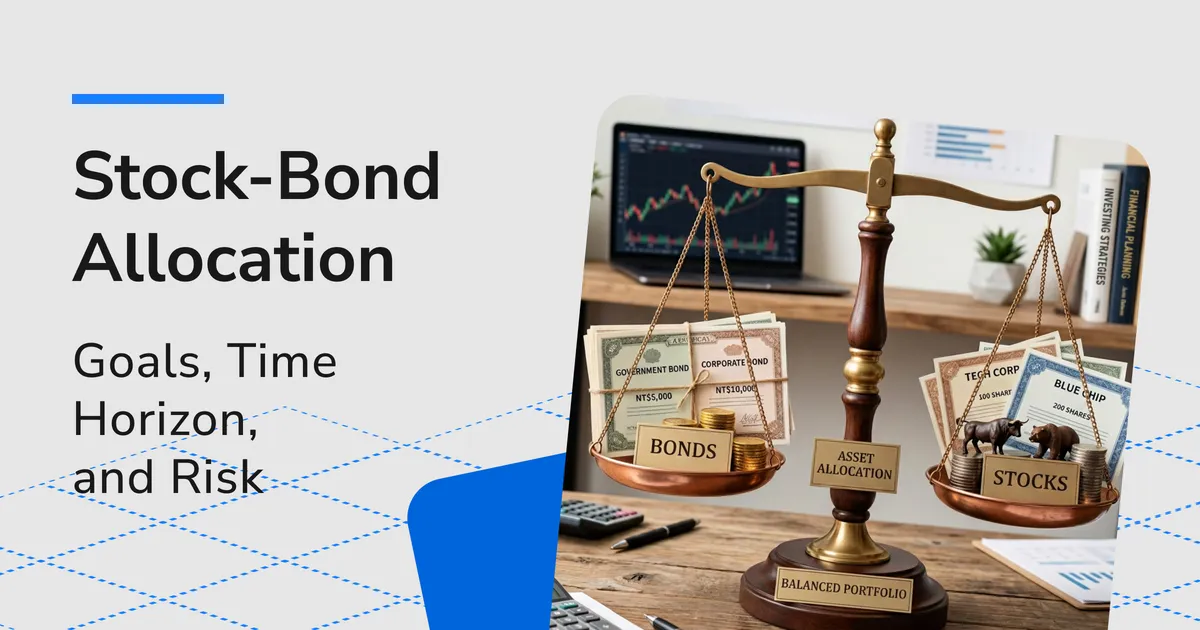
There is no stock-bond ratio that fits everyone. Start with the job the money must do, when it will be needed, how much volatility is financially manageable, and whether you can stay invested during a decline—not with age alone or a copied 60/40 rule.
Stocks usually carry more growth potential and price volatility. Bonds can provide contractual cash flows and different risk drivers, but they still carry interest-rate, credit, liquidity, and currency risks. Combining them aims to assign different roles, not to guarantee that the portfolio cannot lose money.
Looking to diversify your portfolio?
You can start small to explore crypto assets—get started easily with just NT$10 a day!
Download ZONE Wallet NOW!What is stock-bond allocation?
It is the division of investment money among asset categories. Allocation determines the portfolio's broad exposure to growth, interest-rate, and credit risks. Choosing an individual stock or bond happens within those categories.
A portfolio can still be concentrated even when its headline ratio looks diversified—for example, if all stocks are in one industry and all bonds come from one issuer.
The roles of stocks, bonds, and cash
Stocks: business growth and market volatility
Stocks participate in changes in company value and earnings. They may provide long-term growth and dividends, but short-term prices can swing sharply and may be unsuitable for money required soon.
Bonds: contractual cash flow, not guaranteed stability
Bonds typically define interest and repayment terms. Their prices can still fall when rates rise, issuers can deteriorate or default, and overseas bonds add currency risk.
Cash: preserving flexibility
Emergency savings and near-term spending do not need to pursue the highest expected return. Cash reduces the chance of being forced to sell investments during a downturn.
Four layers to decide before choosing a mix
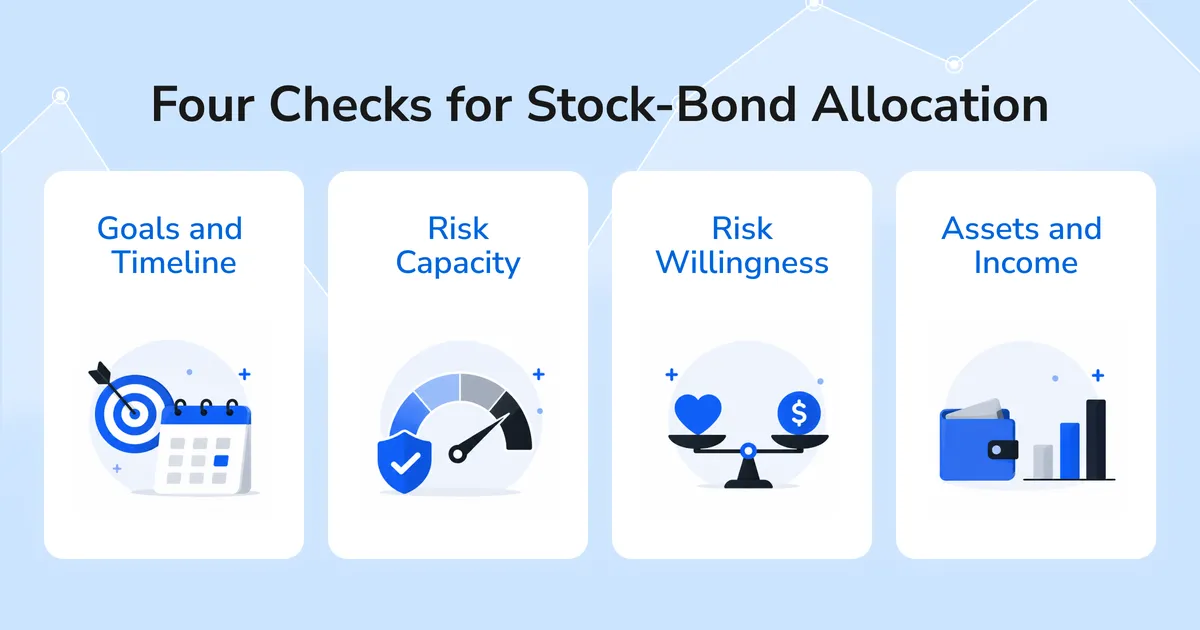
Goal and time horizon
Retirement, a home purchase, education, and general wealth building should not automatically share one allocation.
Risk capacity
Income stability, debt, insurance, emergency savings, family obligations, and future spending determine the loss you can financially absorb.
Risk willingness
If a decline leads to panic selling or constant strategy changes, a theoretically long horizon may not make a highly volatile mix workable.
Total financial exposure
Property, employer stock, pensions, foreign currency, and the economic sensitivity of your job all affect risk. A technology worker with technology-heavy investments may be more concentrated than the brokerage account alone suggests.
Three goals require three different conversations
Money needed soon
The priority is being able to use it on time. Separate essential amounts from market volatility before investing the remainder.
Long-term accumulation
A longer horizon may provide more room for volatility, but only if intermediate cash needs do not force a sale. Ongoing contributions and periodic review matter.
A need for portfolio income
Do not compare only dividend yields or bond coupons. Consider stability, price risk, maturity, credit quality, and inflation.
Turn the answers into an allocation
- Separate emergency and near-term money.
- Give each goal its own time horizon.
- Test the allocation against a realistic decline and your likely behavior.
- Choose broadly diversified holdings where appropriate.
- Set a review and rebalancing rule.
Why several ETFs may still be concentrated
Multiple ETFs can own the same large companies, industries, or bond issuers. Diversification depends on underlying holdings, sectors, regions, credit quality, and maturity—not the number of tickers. For ETF basics, read What Is an ETF?; for bond fundamentals, see What Are Bonds?.
Common stock-bond allocation mistakes
- Using age as the only input.
- Treating bonds like bank deposits.
- Changing the mix after every market decline.
- Ignoring fees, taxes, and currency effects.
- Sacrificing diversification to pursue high distributions.
How often should the allocation be reviewed?
The purpose is not to watch performance every day. Review whether the goal, time horizon, finances, and weights changed. Market drift may call for rebalancing; a life change may call for a new allocation.
If crypto is included, treat it as a high-volatility asset and define a maximum acceptable role, custody plan, and exit conditions. ZONE Wallet supports spot crypto trading with New Taiwan dollars for users who want to learn with a smaller amount they can afford to risk.
Stock-bond allocation FAQ
Should young investors always hold more stocks?
No. A longer horizon is only one factor; income, debt, family obligations, and behavior also matter.
Are bonds always safer?
No. Interest-rate, credit, liquidity, and currency risks depend on the product and holding method.
Is 60/40 still valid?
It can be a discussion point, not a universal prescription.
Does allocation fail when stocks and bonds both fall?
No strategy guarantees opposite movements at all times. Allocation manages different risk sources and concentration.
How often should the target change?
Use rebalancing for market drift. Change the target when goals or financial circumstances materially change.
References
Investor.gov: Asset Allocation and Diversification
Investor.gov: Beginners' Guide to Asset Allocation, Diversification, and Rebalancing
What is ZONE Wallet?
ZONE Wallet is a Taiwan-based virtual asset exchange, allowing beginners to buy and sell easily with a single click. Combined with our dollar-cost averaging (DCA) feature, you can enjoy flexible, value-driven investment results!
ZONE Wallet also offers corporate account services with a fast and secure onboarding process. We help startups and enterprises leverage stablecoins to optimize cross-border payment workflows and reduce transaction costs. ZONE Wallet makes asset allocation more reliable for both personal financial management and corporate treasury strategies—helping you effortlessly navigate the future of Web3!
Start small to get comfortable with the process and risks.
Ready to dive into crypto?
[download-app]
Disclaimer: This article is for general information and education only and does not constitute investment, tax, or legal advice. Rules and personal circumstances can change; verify current information with the relevant authority, payer, or qualified professional.