


Choosing Your First Investment: Stocks or Crypto? The Beginner’s Guide
“I want to start investing, but don't know if I want to buy stocks or cryptocurrencies?”
This is probably the most common issue in the minds of every person who is just getting into investing. Stocks feel more formal and secure; cryptocurrencies feel stimulating, but afraid of being scammed, afraid of losing money.
In fact, there is no absolute good or bad for these two tools, but for beginners with absolutely no investment experience,Understand their differences to find the best starting point for you. This article will help you in the whitest way possible and tell you how to safely take the first step if you want to start with cryptocurrency.
1. What is a stock? Make it clear in one word
Buying a stock is buying a small part ownership of a company.
For example, if you buy TSMC shares, you are one of TSMC's shareholders. The company makes money, which you can divide into dividends; the company grows, the share price rises, and the shares you hold increase in value.
The value of stocks is supported by actual company performance. There are reports, revenues, and profits to be referenced, and relative “fundamentals” can be judged. A common investment method in Taiwan is to buy a single stock directly or to hold a basket of stocks through an ETF (index fund), such as the well-known 0050.
2. What is cryptocurrency? A new world stranger than stocks
Cryptocurrencies are digital assets built on blockchain technology that are not issued by any country or company, nor do they exist physically. The most famous isBitcoin (BTC), the second isEthereum (ETH), there are thousands of different cryptocurrencies in the world today.
Its biggest feature isdecentralisation: No government, no bank can control it, transaction records are maintained jointly by computers around the world, open and transparent and difficult to tamper with.
Cryptocurrency has no company performance to reference, and its value comes from market demand, application of technology, and user trust. Because of this, it has a lot more volatility than stocks, but comparatively, there is also greater potential room for payback.
3. Stocks vs cryptocurrencies: seven dimensions are clear at once
| Comparison Dimension | Stocks | Cryptocurrency |
|---|---|---|
| Risk Level | Medium to medium-high, relatively predictable | High to extremely high, volatile |
| Entry Barrier | Taiwan stocks: ~NT$1,000 to tens of thousands per board lot | As low as NT$100, can buy fractional units |
| Trading Hours | Weekdays during market hours | 24/7, 365 days a year |
| Value Foundation | Company performance, earnings, dividends | Market supply/demand, technological application |
| Regulatory Protection | Governed by financial regulations | Regulations still developing |
| Potential Returns | Stable, long-term annualized ~7-12% | High, but with high risk |
| Learning Difficulty | Medium, requires research on companies and industries | Medium, requires basic blockchain knowledge |
💡 Beginner Highlights: Stocks and cryptocurrencies are not “second choice”. MANY EXPERIENCED INVESTORS WILL HOLD BOTH AT THE SAME TIME, BUILDING A FOUNDATION WITH STOCKS AND STRIVING FOR HIGHER GROWTH SPACE WITH CRYPTOCURRENCIES.
Stress-free investing for beginners!
Effortlessly build your assets with crypto starting at just NT$10 a day.
Download ZONE Wallet NOW!4. WHY CAN ZERO FOUNDATION NEWBIES ALSO START WITH CRYPTOCURRENCIES?
Many people think that cryptocurrencies are complex and difficult to get started, in fact, with this “start investing” thing, the threshold for cryptocurrencies is even lower than stocks. Here are a few reasons:
① Get started with a few hundred dollars, no money pressure
It takes at least a few thousand to several million dollars to buy a stock in Taiwan stocks, but cryptocurrencies can be bought with a very small amount (for example, $100 buys a small portion of Bitcoin). This allows beginners with absolutely no investment experience to start with a “practice mindset” without losing or straining their bones.
② Relative intuition to get started without researching financial reports
Investing in stocks requires looking at financial reports, understanding industry competition, researching company moats, and learning the curve steeper for people who have absolutely no foundation. And getting started with cryptocurrencies just needs to understand “what is bitcoin” and “how to use exchanges” and get down to business faster.
③ 24-hour market, don't be afraid to rush to open
The stock market is open only on Mondays through Fridays, so there is little room for workers to watch. Cryptocurrencies can be traded 24 hours a year and can be operated after work, before bed, and on weekends, with absolutely no time limits.
④ It's becoming mainstream and now it's not too late to find out
In 2024, the United States officially approved the listing of the Bitcoin Spot ETF, and BlackRock (the world's largest asset management company) also stepped in. This means that cryptocurrencies have entered the mainstream financial system from a “niche topic” and are now starting to understand that the time is really good.
5. Cryptocurrency newbies: Get started in four steps
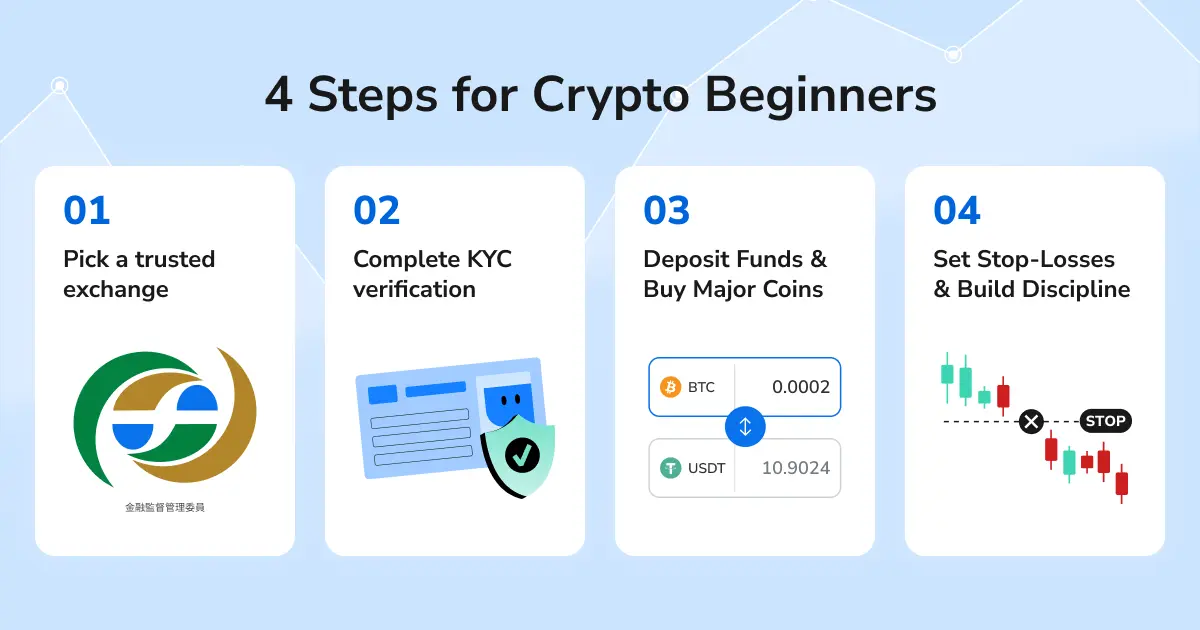
See here if you want to give it a try, here's the most practical way to get started:
Step 1: Choose a legitimate exchange
In Taiwan, cryptocurrencies need to be traded through exchanges. Beginners are advised to choose platforms with legal registration that support NTD withdrawals, such as MAX or ACE. If you want to use an international platform, Binance is one of the most choices for users worldwide.
Note when choosing: whether the platform has a Chinese interface, whether it requires real name authentication (which is a basic requirement for a legitimate platform).
Step 2: Complete Real Name Certification (KYC)
After registration, you need to upload your ID and take a photo verification, which is a compliance procedure required by the government and can usually be completed within 1~3 days. You will only be able to use the Taiwan Dollar Deposit feature after completion.
Do not use a platform that skips real name authentication, such platforms are often illegal and the risk is very high.
Step 3: Deposit and buy mainstream currencies
The first time it is recommended to start with a small amount, $500 to $1,000 will suffice. Preferred CurrencyBitcoin (BTC) or Ethereum (ETH)Both are the largest, most stable, and most liquid options on the market, so don't go after popular coins or unfamiliar items at first.
Step 4: Establish a good stop and develop discipline
Before buying, think about “how much you can afford to lose”, for example, drop more than 20% to make a bet. This is not pessimism, but a basic function of protecting oneself. THE CRYPTOCURRENCY MARKET IS VOLATILE AND DISCIPLINED TALENT CAN GO THE LONG WAY.
6. Risk should be considered, but without excessive fear
When it comes to cryptocurrencies, the first reaction of many people is “very dangerous” and “easy to be deceived”. These concerns are not unfounded, but most risks are manageable as long as you master a few basic principles:
Invest only with idle money, no borrowing, no living expensesThis is iron. Cryptocurrencies can fluctuate significantly in the short term, and only money that is “lost and does not affect life” can remain calm in judgment.
Far from unknown investment recommendationsMysterious currencies recommended by friends, ads that promise high returns on social media, “exclusive projects” actively introduced by strangers, are generally untouchable. Regular cryptocurrency investments don't require anyone to “bring you in.”
Regularly set a quota to avoid overchargingDon't try to guess the lowest point of a Soho. Switch to a fixed amount of weekly or monthly purchases and let time help you average the cost, which is the best way to do it for beginners.
Learn first, learn while doingYou don't need to be an expert to get started, but at least know “what I buy and why it's worth it.” The more you know, the easier it is to be carried away by market sentiment.
⚠️ Special Reminder: The market is flooded with cryptocurrency scams, and common practices include counterfeiting famous currencies, fake exchanges, guaranteed profits, and more. As long as someone tells you to “make a profit”, it must be a scam, please refuse directly.
7. Stocks vs cryptocurrencies, which one is better for you?
Depending on your situation, you can refer to the following judgments:
Comparisons are good to start with stocks first, if you...
- Abundant funds and do not care about investment thresholds
- Get used to basic research to make decisions
- Prefer an investment environment with regulatory protection
- Hope to accumulate wealth in the long term and not pursue short-term wealth
Comparisons are suitable for starting with cryptocurrencies first, if you...
- Want to start with a small amount and invest while studying
- Curious about new technologies and new trends
- Can accept higher fluctuations, strong psychological tolerance
- Hope to be flexible at any time
summed
Equities are backed by actual company performance and are ideal for solid long-term investments; decentralized cryptocurrencies, 24/7 trading, extremely low thresholds, are more suitable for newcomers who want to start small and get a feel for the market quickly.
For those who are completely inexperienced in investing, cryptocurrency is instead aLow thresholds, highly flexible entry-level options— Start with idle money, choose a legitimate platform, and start with mainstream currencies, and risk is completely within your control.
The hardest thing to invest is not choosing a target, butTake the first step。 Starting today, using the amount you can afford and learning is the most effective way to build up your investment capacity.
Disclaimer: This article is for educational and informational purposes only and does not constitute any investment advice. Investing in cryptocurrencies involves high risks and investors may lose all their capital. Please make a careful assessment based on your personal financial situation and consult a professional financial advisor if necessary.
What is ZONE Wallet?
ZONE Wallet is a Taiwan-based virtual asset exchange, allowing beginners to buy and sell easily with a single click. Combined with our dollar-cost averaging (DCA) feature, you can enjoy flexible, value-driven investment results!
ZONE Wallet also offers corporate account services with a fast and secure onboarding process. We help startups and enterprises leverage stablecoins to optimize cross-border payment workflows and reduce transaction costs. ZONE Wallet makes asset allocation more reliable for both personal financial management and corporate treasury strategies—helping you effortlessly navigate the future of Web3!
Start small to get comfortable with the process and risks.
Ready to dive into crypto?
[download-app]
.jpg)


