History of Stocks: From 400 Years of Maritime Trade to Modern Investing
Have you ever wondered how this “stocks” thing came about?
Today we think of stocks as a natural investment tool that can be bought and sold with the flick of a finger on a mobile phone, but 400 years ago, stocks didn't exist at all. It took humans hundreds of years to develop this system of “cut companies into pieces and get everyone to invest together.”
Looking to diversify your portfolio?
You can start small to explore crypto assets—get started easily with just NT$3 a day!
Download ZONE Wallet NOW!This article takes you back to the moment the stock was born, understand why it was invented, what problems it solved, and what it means to us today.
1. Before the birth of stocks: exclusive games for rich people
Before stocks appear, there are only two ways to do business:
Method one: spend your own money and do it yourself
You have 100 million and open a bakery. The money you earn belongs to you, and the loss is yours. The problem is that if you want to do a bigger business (such as building an ocean trading ship), 100 million is not enough at all.
Method 2: Find a partner to spend money together
You get 10 friends, spend 100 million each and collect 1 million to build a ship. Earned points for everyone and lost together. Sounds good, but there's a big problem:You cannot exit halfway.
Suppose you have made 100 million, the ship has not returned, you urgently need money and want to sell your “shares” to someone else, but no one can take it, your money is stuck.
This is the dilemma before stocks are born:Large investments require a lot of money, but investors' money is locked away for a long time and cannot be used flexibly.
2. 1602: Birth of the world's first joint stock company
Duration: 1602
Venue: Amsterdam, Netherlands
Protagonist: Dutch East India Company (VOC)
In 17th century Europe, ocean trade was the most profitable business. Shipping back spices, silks, porcelain from Asia, and profits can be as high as 400%. But the problem is that the risk is also extremely high:
- Build a ship that costs 100,000 Dutch Ships
- Duration of 2 to 3 years
- May encounter pirates, storms, shipwrecks
- You may be bloodless on a cruise
No one can take this risk alone, but what if you spread the risk out to 100 people, 1,000 people?
Innovations for Dutch East India Companies: Issue Stocks
The Dutch East India Company has done an unprecedented thing:
- Divided the company into 6,800 shares, each share has a fixed price
- Anyone can buyWhether you're a noble or a commoner.
- Can be resold after purchaseNo need to wait for the boat to come back
- Companies make money and distribute dividendsLoss of money is a claim
That's it.The world's first joint stock company, alsoOrigin of stocks。
What's more, Amsterdam was foundedThe world's first stock exchange, allowing stocks to be traded freely. Investors don't have to wait 3 years to get their money back. They can sell shares to others at any time.
💡 This invention changed the world: From then on, large businesses can raise huge amounts of money, and investors have the flexibility to use the funds. Stocks are the most important cornerstone of modern capitalism.
3. What problems do stocks solve? Three Core Functions
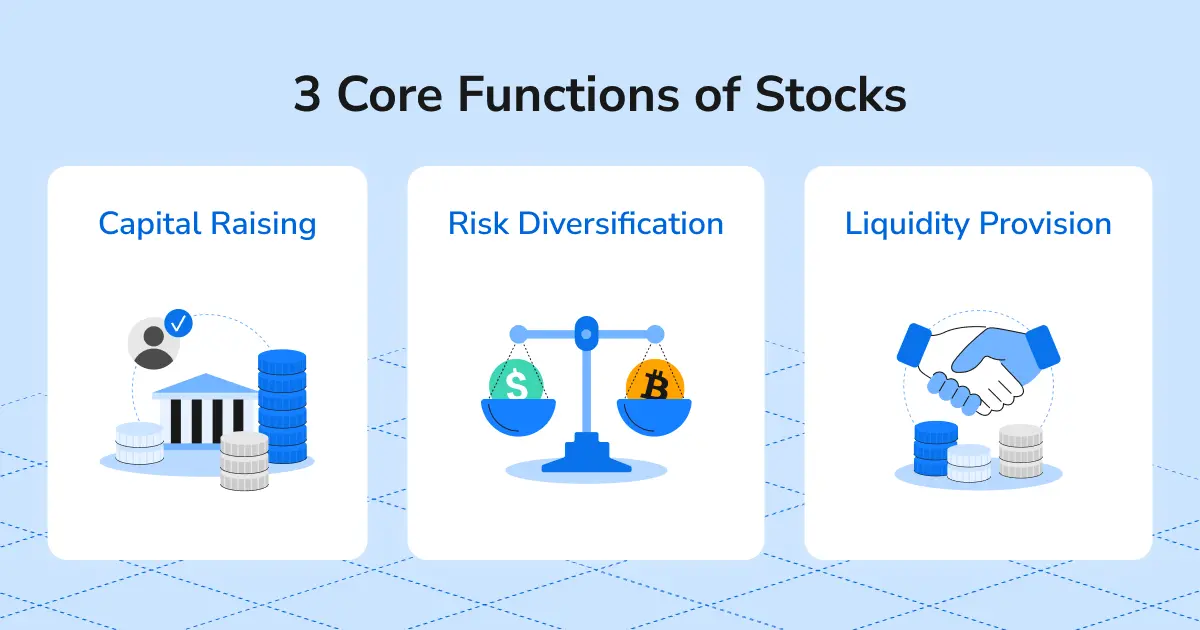
After understanding the origin of stocks, let's see what it actually solves:
FEATURE 1: ENABLING LARGE BUSINESSES TO RAISE FUNDS
Shipbuilding, railroads, mining fields, factories, these activities require millions and tens of millions of dollars, and it is difficult for a single rich person to afford. Stocks allow companies to raise funds for the public and concentrate money to do great things.
Modern example:
- TSMC Wafer Factory Costs $200 Billion
- TESLA BUILT BATTERY PLANT COSTS $50 BILLION
- This money is raised by issuing shares to investors
Feature 2: Disperse risk and get more people involved
In the past, only nobles could do business, and the common people had no money and no roads. Stocks allow ordinary people to participate in large businesses with small amounts of money and share in the dividends of business growth.
Modern example:
- You can buy TSMC shares for as little as $1,000 and become a TSMC shareholder
- The company makes money making dividends, you can split it
- Share price rises, so do your assets
Feature 3: Provides liquidity, funds do not freeze
This is the most important invention of stocks:You can sell stocks for cash at any timeNo need to wait for the company to close or distribute the surplus.
Modern example:
- You buy Apple stock, you need money for a while, and you can sell it on the market in seconds
- This makes investors willing to put money into long-term business, knowing they can quit at any time
4. The essence of stocks: you are the “little boss” of the company
Many people think of stocks as “numbers that go up and down” and forget what stocks really mean:You are a shareholder of the company and own a part of the company.
What does it mean to hold a stock?
① You own a small part of the company
Buy 1 TSMC stock (1,000 shares) and you own 0.000004% of TSMC. Although the percentage is small, you are indeed a shareholder.
② You have the right to share company profits
The company earns money and the board may decide to issue dividends (cash dividends) or stock dividends to shareholders. You have the right to split the shares.
③ You have the right to vote (but not usually available)
In theory, shareholders can vote at the general meeting to decide important matters for the company. But the proportion of retail holdings is too small to have limited real influence.
④ The company grows, and your assets also increase in value
If the company performs well and looks good in the future, the stock price rises, and the value of the shares you hold increases.
💡 Remember: Buying stocks is not gambling, it is investing in the future of a company. Companies are good, stocks are good; companies are bad, stocks are bad.
5. From Dutch East India Company to Today: Evolution of Stocks
Over 400 years, the stock system has been evolving:
1602: Dutch East India Company
The world's first joint stock company, handwritten stock certificates, trading on artificial records.
1792: The New York Stock Exchange was founded
The American financial center was born, creating trading rules to make the markets more orderly.
1971: NASDAQ ELECTRONIC TRADING SYSTEM
No longer need to bid in the exchange lobby, the computer automatically matches trades.
2000's: The Popularity of Online Vouchers
Ordinary people can buy stocks on their home computers, not through a salesperson.
2020: MOBILE ORDERS, ZERO-SHARE TRADING
The mobile phone can buy a stock and buy 1 share, and the threshold is reduced to an all-time low.
Stocks went from being a “nobleman's game” to an “investment vehicle in which everyone can participate,” the biggest change in 400 years.
6. The purpose of stocks today: the investor's point of view
For modern investors, stocks have three main uses:
Purpose 1: Long-term investment, accumulation of wealth
Buy high-quality company stocks, hold for a long time, and build wealth through stock price increases and dividends.
Classic case:
- Purchased TSMC in 1997 and holds more than 100 times the return today
- BUFFETT HAS LONG HELD STOCKS IN COCA-COLA, APPLE, AND BECOMES ONE OF THE WORLD'S RICHEST
Use 2: Short line trading to earn spreads
Observe technical line charts, message sides, buy low and sell to earn short term spreads.
Features:
- It takes time to watch
- Higher risk, but also high potential payoff
- Suitable for those who have time and are interested in researching the market
Purpose 3: Invest passively, follow the big deal
Buy an ETF (such as 0050) without picking a stock, and follow the overall market growth.
Features:
- Save time without researching individual stocks
- Risk dispersion, long-term stability
- Suitable for those who have no time and are looking for stability
7. Stocks vs cryptocurrencies: a new option after 400 years
The stock system has been in operation for 400 years, but something new has emerged in the last 15 years:cryptocurrency。
It is somewhat similar to stocks, but completely different in nature:
| Comparison Item | Stocks | Cryptocurrency |
|---|---|---|
| What It Represents | Ownership in a company | Decentralized asset / technology protocol |
| Value Foundation | Company performance, earnings | Market supply/demand, technological application |
| Trading Hours | Weekdays during market hours | 24/7, 365 days a year |
| Investment Threshold | Medium (thousands of NTD+) | Extremely low (as low as NT$100) |
| Regulatory Protection | Well established | Still developing |
| Suitable For | Conservative investors | Those willing to tolerate high volatility |
Advantages of Cryptocurrencies: Lower Thresholds, Greater Flexibility
① Extremely low threshold
A single stock usually costs several million dollars (even zero shares cost a few thousand dollars), but cryptocurrencies can start at $100.
② Trading around the clock
No need to wait for the opening, buy, buy, sell.
③ Global Circulation
Stocks are limited by borders and cryptocurrencies can be traded anywhere in the world.
④ Suitable for active investment learning
High volatility, transparent and 24-hour operation, ideal for beginners who want to learn investment judgment.
But the risk is higher
- No corporate performance support, pure market confidence
- Prices fluctuate sharply, a one-day increase and a drop of 20% is normal
- Imperfect regulation, higher risk of fraud
💡 For young investors: Stocks and cryptocurrencies are not second-choice, but can coexist. Building a solid foundation with stocks and pursuing growth with cryptocurrencies, both work best.
8. To summarize: understand the stock to make the most of it
Stocks didn't come out of thin air, they were a system that humans spent 400 years constantly improving to solve the problem of “how to get more people involved in big business.”
Core Value of Stocks:
- Enabling large businesses to raise funds
- Enabling ordinary people to invest and share in business growth
- Provides liquidity so that funds do not stagnate
The real meaning of stocks:
- You are a shareholder of the company and have a small share of ownership
- Your company grows and your wealth grows.
- It's not gambling, it's the future of investing in businesses
Today, we have more investment options than 400 years ago: stocks, ETFs, funds, bonds, real estate, cryptocurrencies. Each tool has its purpose and a suitable family.
The key is to understand them, choose the right one for you, and take the first step.
What is ZONE Wallet?
ZONE Wallet is a Taiwan-based virtual asset exchange, allowing beginners to buy and sell easily with a single click. Combined with our dollar-cost averaging (DCA) feature, you can enjoy flexible, value-driven investment results!
ZONE Wallet also offers corporate account services with a fast and secure onboarding process. We help startups and enterprises leverage stablecoins to optimize cross-border payment workflows and reduce transaction costs. ZONE Wallet makes asset allocation more reliable for both personal financial management and corporate treasury strategies—helping you effortlessly navigate the future of Web3!
Start small to get comfortable with the process and risks.
Ready to dive into crypto?
[download-app]
Disclaimer: This article is for educational and informational purposes only and does not constitute any investment advice. Investing in stocks involves risks and investors may lose principal. Please make a careful assessment based on your personal financial situation and consult a professional financial advisor if necessary.