Can AI Help You Invest? Uses, Limitations, and Scam Risks Explained
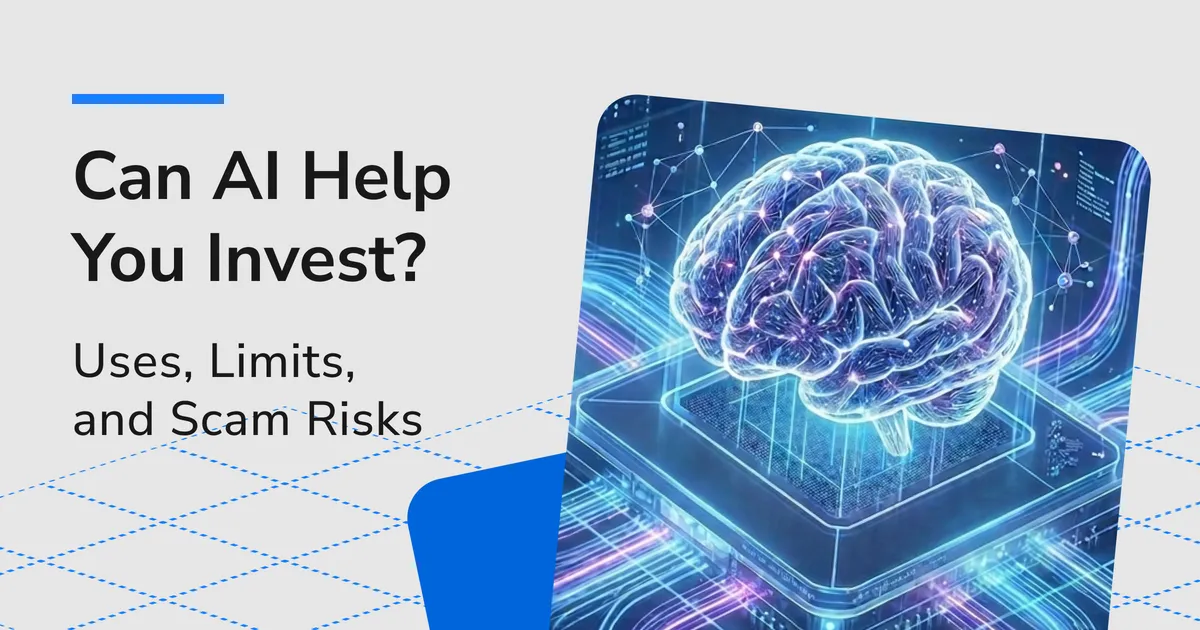
AI can support investment research, but it cannot guarantee returns and should not be the only reason for a trade. It is useful for organizing large amounts of text, comparing known data, building screens, and checking a research process. Yet the underlying information can be stale or wrong, and a model can produce confident language about facts that do not exist. The most practical role is research assistant and checklist—not a market-predicting profit machine.
Before using any tool, separate three questions: what data the system can actually access, whether its claims can be traced to primary sources, and whether the provider can access or trade through your account. If someone uses the label “AI” to promise profits, rush a deposit, or direct money to an unfamiliar platform, stop before sending even a small test payment.
Stress-free investing for beginners!
Effortlessly build your assets with crypto starting at just NT$10 a day.
Download ZONE Wallet NOW!Four practical ways AI can help an investor
1. Turn a broad idea into a verifiable research list
For a company, ETF, bond, or crypto asset, AI can organize questions about the business model, return drivers, fees, liquidity, regulation, and data dates. Its value is reducing missed questions, not issuing a one-word buy or sell order.
2. Summarize public documents while preserving source links
AI can assist with annual reports, prospectuses, exchange notices, and regulatory documents. Every important figure still needs to be checked against the original document, period, and context—especially distributions, expenses, debt, litigation, and risk disclosures.
3. Compare scenarios and run simple stress tests
A model can apply the same assumptions to changes in interest rates, currencies, revenue, or asset prices. For example, convert a 10%, 20%, or 30% decline on NT$500,000 into money and ask whether the loss would disrupt the original goal.
4. Build a repeatable investment record
AI can format a research log with the thesis, contrary evidence, major risks, sources, position limit, monitoring indicators, and reassessment triggers. This makes it easier to distinguish the original plan from a new story invented after the market moves.
Five things AI cannot do for you
It cannot guarantee a market forecast
Prices respond to unexpected events, policy, liquidity, and human behavior. A model that performed well on historical data can fail when the market regime changes. A strong backtest is not a promise of future profit.
It does not automatically know your full financial situation
A product can look reasonable and still be unsuitable for money needed soon, a person with expensive debt, or someone without emergency reserves. Without goals, horizon, cash flow, and risk tolerance, an allocation answer is missing essential inputs.
It cannot replace source verification or professional responsibility
AI may cite a nonexistent study, combine figures from different periods, or describe correlation as causation. For legal, tax, medical, or personalized investment questions, check current official sources and seek a qualified professional when necessary.
It cannot remove data and model bias
Training data may overrepresent popular markets or selected periods. Backtests can be overfit, omit trading costs, or contain survivorship bias. Attractive historical results are not automatically repeatable.
It cannot absorb the result of your trade
The investor remains responsible for execution, holding, and losses. Handing control to a chatbot or unfamiliar auto-trading service does not transfer risk; it can simply automate a mistake.
Why can AI be confidently wrong?
Generative AI predicts useful responses from data and language patterns; it does not independently fact-check every sentence. When a prompt omits the date, jurisdiction, product, or data range, the model may fill the gap. Poor source material can also be repackaged into fluent but inaccurate language.
Do not rely on asking, “Are you sure?” Require primary sources, publication dates, calculation steps, uncertainties, and contrary evidence. If a statement cannot be traced to a credible source, treat it as a lead to investigate rather than a conclusion.
A practical AI-assisted investment research workflow
- Define the question: specify market, date, currency, and decision. Avoid starting with “pick a stock that will rise.”
- Demand evidence: request a primary source, period, and link for each important figure.
- Open the source: verify the company, issuer, exchange, or regulator page yourself.
- Build the bear case: list thesis-breaking conditions, key risks, and evidence that would overturn the conclusion.
- Convert percentages into money: estimate expenses and drawdowns against an affordable loss limit.
- Protect execution permissions: a research tool does not need withdrawal credentials, authentication codes, seed phrases, or remote-control access.
- Save a decision log: record the data and assumptions so future changes can be separated from emotion.
Seven AI investment scam red flags
- Guaranteed profits or no-loss claims: “100% AI win rate” and low-risk fixed high returns contradict basic investment risk.
- An unverifiable auto-trading platform: it recruits through ads, messages, or group chats but provides no independently verifiable firm, personnel, or regulatory information.
- Celebrity or expert deepfakes: realistic video and audio do not prove an endorsement. Confirm through the person's or institution's official channel.
- Pressure to deposit now: limited spots, secret information, and fear of missing out are used to prevent research.
- Payment to a personal account or unfamiliar wallet: extra caution is needed when the promoter demands crypto, repeated top-ups, or secrecy from family.
- Visible profits but blocked withdrawals: demands for another tax, margin payment, or unlock fee can be part of a fake account interface.
- Requests for sensitive data or remote control: never share passwords, authentication codes, seed phrases, private keys, or control of your device.
The SEC, FINRA, and other regulators have warned that fraudsters use AI hype to promote unregistered platforms, guaranteed returns, AI stock-picking claims, and deepfakes. FINRA has separately warned that unregistered auto-trading services may exaggerate their AI capabilities. New technology does not change the need to verify identity, risk disclosures, and where the money goes.
What should you do if you suspect a scam?
- Stop sending money or crypto, stop adding funds, and do not pay another withdrawal fee or tax.
- Preserve messages, URLs, receiving accounts, wallet addresses, transaction records, and advertisements.
- Contact the relevant bank, broker, or crypto platform immediately and ask whether the transfer can be flagged or stopped.
- Change passwords, end unfamiliar device sessions, and enable multi-factor authentication. If a seed phrase or private key was exposed, follow guidance from a trusted provider.
- In Taiwan, contact the National Police Agency's 165 Anti-Fraud Hotline or use the official 165 website to verify and report suspicious activity.
A 30-second check before placing a trade
- Is this a primary source or an AI summary?
- Do the date, currency, and calculation method match?
- Can I explain the strongest contrary evidence?
- Would a 20% decline disrupt essential spending or force a sale?
- Can the platform and recipient be verified through an independent official channel?
- Is anyone using guarantees, urgency, or secrecy to push the decision?
AI investing FAQ
Can I trade directly from an AI stock or ETF recommendation?
That is not advisable. Verify primary sources, product documents, dates, and personal constraints. Treat the output as a research lead, not a personalized instruction.
Does a high AI backtest win rate predict future success?
No. A backtest can be overfit, selectively sampled, affected by survivorship bias, or calculated without realistic costs and regime changes.
Is a paid AI tool automatically more reliable?
No. Price does not replace transparent sources, methods, privacy protections, provider verification, and independent testing.
Is it safe to paste portfolio data into an AI tool?
Review the service's privacy and data-use policies first. Remove names, account numbers, identity documents, authentication codes, seed phrases, and private keys.
How can I verify an AI investment platform?
Do not use a link inside the advertisement to verify the advertisement. Independently locate the regulator, firm's official website, and public contact information. If identity and authorization cannot be confirmed, do not transfer money.
References
Investor.gov: Artificial Intelligence and Investment Fraud
FINRA: Know the Risks of Auto-Trading Services Offered by Unregistered Entities
Taiwan National Police Agency: 165 Anti-Fraud
What is ZONE Wallet?
ZONE Wallet is a Taiwan-based virtual asset exchange, allowing beginners to buy and sell easily with a single click. Combined with our dollar-cost averaging (DCA) feature, you can enjoy flexible, value-driven investment results!
ZONE Wallet also offers corporate account services with a fast and secure onboarding process. We help startups and enterprises leverage stablecoins to optimize cross-border payment workflows and reduce transaction costs. ZONE Wallet makes asset allocation more reliable for both personal financial management and corporate treasury strategies—helping you effortlessly navigate the future of Web3!
Start small to get comfortable with the process and risks.
Ready to dive into crypto?
[download-app]
Disclaimer: This article is for general information and education only and does not constitute investment advice. Investing involves risk. Product information and personal circumstances can change, so verify current details with regulators, exchanges, and the relevant prospectus.