What is a smart contract? Complete analysis of smart contract advantages, disadvantages, and operating principles
What is a smart contract? From concept to practical application
A Smart Contract is an automated program that runs on a blockchain that automatically performs the corresponding operation when the default conditions are met, without the need for third- party intervention. Simply put, a smart contract is like a “vending machine” — by putting in the right amount, choosing an item, the machine will automatically give you the goods, without the need for store staff to intervene.
Key Features of Smart Contracts
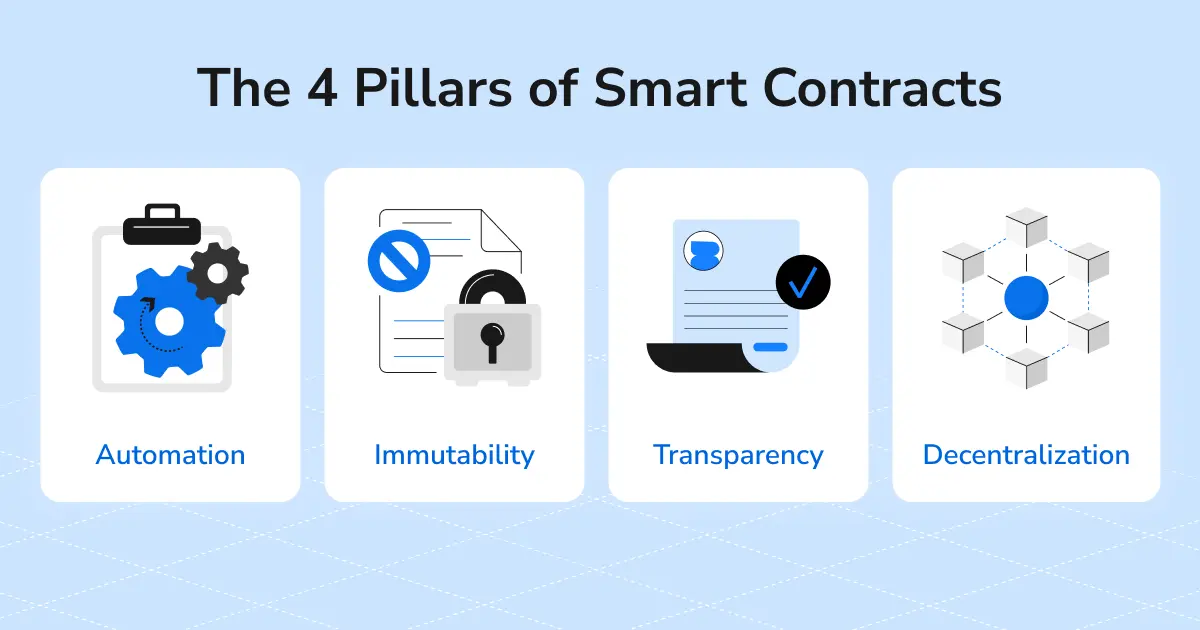
Automated Execution
The biggest feature of smart contracts is automation. Once deployed to the blockchain, the code runs automatically as long as the conditions are met, with no need for artificial intervention or auditing.
Ready to start investing in crypto?
Join ZONE Wallet and get started easily with just NT$3 a day!
Download ZONE Wallet NOW!Immutable
Once a smart contract is deployed on a blockchain, its code cannot be modified or deleted. This ensures that the performance of the contract is not altered by any party on its own.
Transparency
Vous pouvez ver les logbores de execution de código et sécurité intelligente, ensuring public transparency of the transaction process and increasing trust.
decentralização
Smart contracts run on a distributed blockchain network, without the control of any single entity, avoiding the potential single point failures or abuse of power issues of centralized sistemas.
The Historical Development of Smart Contracts
Il concepto di contratto intelligente è prima progetto da cryptographer Nick Szabo nel 1994, ma non è un'avuto il lançamento del blockchain Ethereum in 2015, che contri intelligente sono veramente realizado y popularizado. Ethereum offre Solidity, la lingua Turing, che consente di sviluppatori per scrivere complexi applicazioni smart contract.
Today, smart contracts have become one of the core applications of blockchain technology, seeing the shadow of smart contracts from decentralized finance (DeFi), NFT trading, supply chain management of gaming entertainment.
The Benefits of Smart Contracts: Why Can It Change the World?
1. Eliminate intermediaries, reduce costs
Tradicional tradicional oftener necessários como lawyers, bancos, notários, y otras para segura execução do contracto, que not only increases costs, but also extends transaction hour. Smart contracts are executed through automated execution, completely saving brokerage fees.
Current houses:
- Tradicional real estate transactions may require an intermediary fee of 3-5%
- Use Smart Contracts to Reduce Costs to Less Than 1%
- Trade time reduced from weeks to minutes
2. Improve efficiency and execute in real time
Il contracto intelligente operazione o 24 ore giorno, e poco il condizioni è stato non necessario di waitare per la processore manuale o di azienda.
Efficiency-enhancing performance:
- Cross-border payments reduced from 3-5 days to minutes
- Automated insurance claims for immediate claims on condition
- Supply Chain Payment Completed Immediately After Confirmation of Goods
3. High transparency, builds trust
Alle transactionsrecords en contractsverter worden worden op de blockchain, en kunnen kan query voor verificatie, greatly reducing the risk of fraud.
Transparency Advantage:
- Charitable donation flow is fully traceable
- Election voting results cannot be falsified
- Full traceability of product origin
4th. Safe and reliable to prevent tampering
Blockchain's encryption technology and decentralized features make smart contracts almost impossible to be hacked or modified unilaterally.
Mechanism de seguridad:
- Encryption Algorithms Protect Data Security
- Distributed node authentication prevents counterfeiting
- Irreversible Transactions to Avoid Fraud
5. Precise execution to avoid disputes
Smart contracts run strictly according to code logic, without people misunderstanding or deliberately distorting the terms of the contract.
Accuracy embodied:
- Criterion judgment is completely objective
- Predictable Execution Results
- Reduction of Contract Disputes
6. No need to trust, reduce risk
Vi.
Application Scenario:
- P2P lending senza guarantor
- No Credit Survey Required for Cross-Country Transactions
- Automated Fund Management for Crowdfunding
Smart Contract Disadvantages: Challenges to Watch Out For
1. Code Vulnerability Risk
La proprietà “non tamper-proof” di contratto intelligente è double-edged — once a flaw in the code exists, it cannot be fixed, which can lead to significant losses.
Eventos famosos:
- 2016 The DAO Incident, Hackers Exploited $5000 Million in Ethereum Using a Smart Contract Vulnerability
- Poly Network chairs $6 billion in 2021 (later returned)
Risk factors:
- Programming errors
- Logical Vulnerability
- Unexpected Boundary Conditions
- TECHNICAL VULNERABILITIES SUCH AS REENTRY ATTACKS
2. Unmodifiable, lack of flexibility
Once deployed, smart contracts cannot be modified. It is also not possible to adjust flexibly if the market environment changes or the contract terms are found to be unreasonable.
Aktuelle domande:
- Le modifiche regulativa non può essere mappato in tempo reale
- Changes in business conditions need to be redeployed
- Error-terminer kan ikke
- Difficult and costly to upgrade
3. Oracle Issues: External Data Dependence
Smart contracts themselves cannot access information outside the blockchain (such as weather, stock prices, sports results) and must rely on Oracle to provide external data, which can be a vulnerability de seguridad.
Oracle Challenges:
- Data Source Reliability
- Data Transfer Delay
- Single point failure risk
- Possibility of data manipulation
4th. Legal status unclear
Na temu,, a of a dispute.
Legal questions:
- Contract Validity Recognition
- Jurisdictions
- Misattribução de responsabilidad
- Regulatory uncertainty
5. High Technology Threshold
Writing and deploying smart contracts requires professional programming knowledge that is difficult for ordinary users to use directly, limiting the speed of adoption.
Barriers to use:
- Needs to learn programming languages such as Solidity
- Gas Cost Calculation Complicated
- Difficulty setting up your wallet
- Error operation cannot be undone
6. High execution costs
Execution of smart contracts on blockchains such as Ethereum requires Gas fees, which can be very expensive when network congestion occurs.
Cost issues:
- Gas Fees Fluctuate
- High cost of complex contracts
- Small amount transactions are not discounted
- Costs surge in network congestion
7. Environmental Impact Considerations
Some blockchains, such as early Ethereum, use a workload proof mechanism, which consumes a lot of energy and poses a burden on the environment.
Environmental Disputes:
- High energy consumption
- Carbon Emission Issues
- Questionnaire
- The need for green transformation
How Smart Contracts Work: Technical Decryption
Basic Operating Process
Step 1: Write a ContractSviluppatori utilizzati jezici programma come Solidity per scrivere codice di contratto intelligente, definiti condizioni di contracto e eseguire logica.
Ejemplos: Simple Payment Agreement
If (buyer pays X amount) and (seller confirms shipment)
(Automatically transfer the money to the seller)
Step 2: Deploy to BlockchainDeploy well-written contracts to a blockchain network such as Ethereum and each contract gets a unique address.
Step 3: Trigger ExecutionWhen someone sends a qualifying transaction to a contract address, the contract automatically checks whether the conditions are met.
Step 4: Automate ExecutionOnce the conditions are met, the contract automatically performs the intended actions (such as transferring funds, updating status, etc.).
Step 5: Record the UpchainExecution results are permanently logged on the blockchain, publicly transparent and untampered with.
Composição tecnico
1. Layers de code
- Write in Solidity, Vyper, etc.
- Defining contract logic and state variables
- Contains function and event definitions
2. Virtual Machine Layer (EVM - Ethereum Virtual Machine)
- Environment for executing smart contract code
- Ensure that contracts run consistently across all nodes
- Provide sandbox isolation protection
3. Blockchain Layer
- Save contract code and status
- Record all transaction history
- Ensure data consistency through consensus mechanism
4th. Gas Mechanism
- Prevent Infinite Circulation and Abuse
- Incentivize Miner/Verifier Processing Transactions
- Charges based on compute complexity
Smart Contract Execution Environment
Ethereum Virtual Machine (EVM)
- The most widely used smart contract platform
- Supports complex program logic
- With a huge developer ecosystem
Altri platformi
- Binance Smart Chain: Lower transaction fees
- Solana: High Speed Execution
- Cardano: Focus on Security and Formal Verification
- Polkadot: Cross-Chain Interoperability
Aktuelle Operationsscenari
Case 1: Decentralized Exchange (DEX)
- User A wants to buy Ethereum with 100 USDT
- Smart Contract Automatically Matches Seller B's Quote
- Contractual Locking of Mutual Assets
- Automatically execute exchanges after price confirmation
- A obtener Ethereum, B obtener USDT
- The whole process does not require the intervention of the exchange staff
Case 2: DeFi Lending
- Users deposit cryptocurrencies as collateral
- Smart contract calculation of the loan amount (usually 50-80% of the value of the collateral)
- Users borrow money and start paying interest
- If the value of the collateral falls to the alert line, the contract is automatically cleared
- Contract automatically calculates interest upon repayment and unlocks collateral
Case 3: NFT Trading
- Creators mint NFTs, define royalty rate (like 5%)
- Buyer A buys NFTs, transfers ownership of smart contracts
- When A is resold to B, the contract automatically deducts 5% royalties to the creator
- Records of change of ownership are permanently stored on the blockchain
Future trends in smart contracts
Technology innovation direction
1. Layer 2 Expansion
- Reduces transaction costs
- Improves processing speed
- Staying safe
2. Cross-chain Interaction
- SMART CONTRACT INTERACTIONS BETWEEN DIFFERENT BLOCKCHAINS
- Cross-Chain Transfer of Assets
- Unified Development Standards
3. Formal Verification
- Mathematical Methods for Proving Contract Correct
- Reduce Code Vulnerabilities
- Enhanced security
4th. Upgradeable contracts
- Retain flexibility to correct errors
- AGENT MODE AND MODULAR DESIGN
- Balancing Immutability and Usability
Application Scenario Expansion
Financiële
- Automated insurance claims
- Decentralized Lending and Transactions
- Asset Tokenization
- Derivatives Trading
Supply Chain Management
- Produkttraceabiliteit
- Automated Payment Settlement
- Kvaliteterung
- Logistiksporing
Digitale Identities
- Decentralized Identity System
- Validation certificaat
- Privacyza
Giochi e divertissement
- Play-to-earn games
- Virtuelle Asset Transactions
- Digitale collectibles
- Creatoreconomie
Law & Governance
- E-Voting
- Decentralized Autonomous Organizations (DAO)
- Digital Wills
- Copyrightmanagement/
How to use Smart Contracts safely?
User Considerations
1. Validate Contract Code
- Check if the contract has been audited
- View community reviews and discussions
- Utilizzare il Browser Blockchain per visualizzare la historia del contracto
2. Understand the risks
- Do not invest more than the amount you can bear the loss
- Notice the lockout period of the contract
- Understand the potential risks of smart contracts
3. Using Trusted Platforms
- Choose a well-known DeFi protocol
- View TVL (Total Lock Stock Value) and Number of Users
- Focus on the project team background
4th. Keep your wallet safe
- Stort stor antal med en hardware-wallet
- It's not easy to license contract permissions
- Check Authorized Contracts Regularly
Developer Best Practices
1. Sicherheit Development
- Adhere to smart contract development standards
- Conducting a full test
- Implement code review
2. Auditorias de Third Party
- Hire a professional audit firm
- Public Audit Report
- Fixing issues found
3. Vulnerability Bounty Scheme
- Encouraging White Hat Hackers to Find Vulnerabilities
- Provide reasonable rewards
- Create a quick response mechanism
4th. Progressive Deployment
- Test Network Verification First
- Small-scale trial
- Slowly expand the scope of use
Conclusion: Opportunities and Challenges of Smart Contracting
As a core application of blockchain technology, smart contracts redefine the way to trust, transact and collaborate. ITS AUTOMATED, TRANSPARENT AND DECENTRALIZED PROPERTIES HAVE REVOLUTIONIZED MANY AREAS OF FINANCE, LAW, SUPPLY CHAIN, AND MORE.
However, smart contracts are not perfect either. Problemas como vulnerabilitaciones de código, no flexibilidad, estado legal no estado legal también requiere tiempo y progreso tecnico para resolver. Para usuários, comprar os advantados y dispositivos de contractos smartes y encontrar como funcionar para participar más seguro y effectivamente en este revolución decentralizado.
With the continuous maturation of technology and the gradual improvement of the regulatory framework, the application of smart contracts will be broader and deeper. Whether investors, developers, or ordinary users, now is the best time to learn and understand smart contracts. Be cautious while embracing innovation and prioritizing security while pursuing efficiency to truly grasp the opportunities of smart contracts.
What is ZONE Wallet?
ZONE Wallet is a Taiwan-based virtual asset exchange, allowing beginners to buy and sell easily with a single click. Combined with our dollar-cost averaging (DCA) feature, you can enjoy flexible, value-driven investment results!
ZONE Wallet also offers corporate account services with a fast and secure onboarding process. We help startups and enterprises leverage stablecoins to optimize cross-border payment workflows and reduce transaction costs. ZONE Wallet makes asset allocation more reliable for both personal financial management and corporate treasury strategies—helping you effortlessly navigate the future of Web3!
Start small to get comfortable with the process and risks.
Ready to dive into crypto?
[download-app]
Disclaimer: This article is for educational and informational purposes only and does not constitute investment advice. Smart contracts involve technical and financial risks, so be well informed and carefully evaluated before use.

.jpg)