Where Do ETF Distributions Come From? Yield, Income Equalization, and Total Return Explained
Yield, Income Equalization, and Total Return Explained
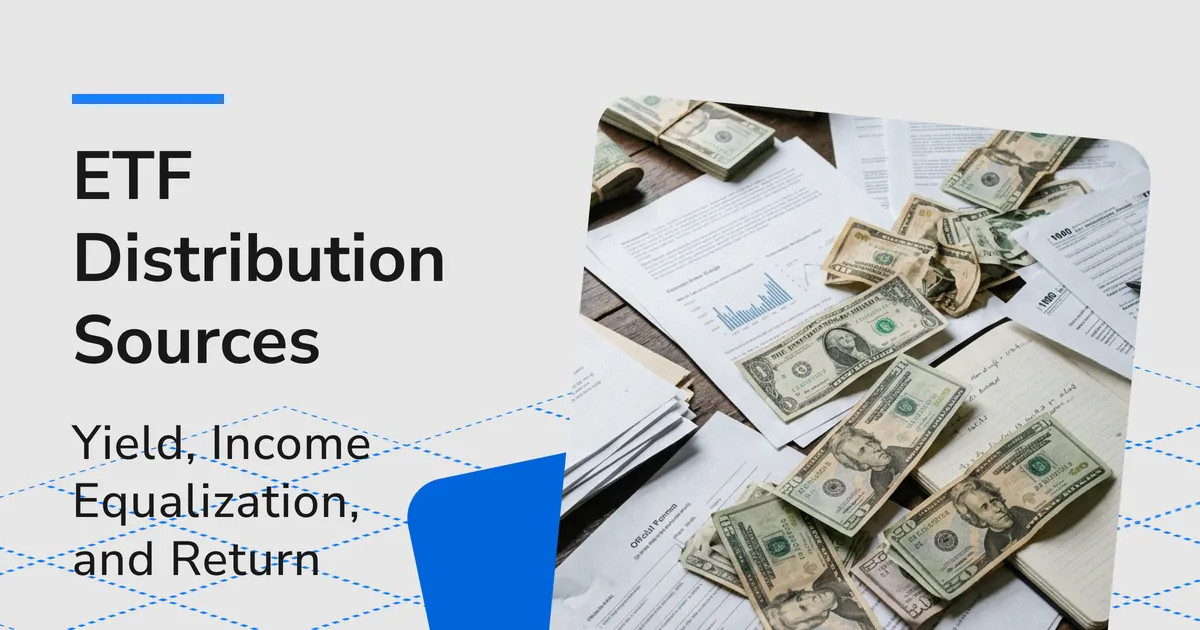
An ETF distribution does not necessarily come from stock dividends alone. Depending on the assets held, the fund trust agreement, and the distribution notice, it may include dividends, interest, realized capital gains, income equalization, and other items. To understand what a distribution means, look beyond the cash amount to its composition, the effect of the ex-distribution date, and total return over a comparable period.
Yield is the ratio of distributions from a stated period to an ETF’s market price at a point in time. It can help describe cash distributions, but it is not a promise of future return. Changes in market price, distribution policy, or the source of distributable income can all change the number investors see.
Looking to diversify your portfolio?
You can start small to explore crypto assets—get started easily with just NT$10 a day!
Download ZONE Wallet NOW!What Can an ETF Distribution Consist Of?
Start with what the ETF holds. An equity ETF may receive cash dividends from its constituents, while a bond ETF may receive interest. When a fund sells holdings and realizes capital gains, those gains may also be part of distributable income where permitted by the fund’s governing documents and applicable rules. Distribution policies vary by asset class and fund, so one ETF’s breakdown should not be assumed to apply to another.
In Taiwan, ETF distribution announcements disclose the categories and proportions that make up a distribution. Investors can use the Market Observation Post System to review items such as dividend income, interest income, income equalization, realized capital gains, and other income. This is more informative than looking only at the cash amount per unit. The Taiwan Stock Exchange explanation of income equalization is a useful starting point for reading those disclosures.
What Is Income Equalization?
Income equalization is an accounting mechanism, not a new source of investment profit. For an ETF that uses this mechanism, a proportion of subscription money may be recorded as income equalization based on the accumulated income, net of expenses, already embedded in the fund’s per-unit net asset value. Redemptions are adjusted on the same basis.
Its purpose is to reduce the dilution or distortion of a distribution rate that can arise when investors subscribe to or redeem ETF units. The Taiwan Stock Exchange explains that income equalization is used to stabilize, rather than increase, a fund’s distribution rate. Treat it as one part of the disclosed distribution composition and review it alongside the fund’s distribution history, distributable income, and prospectus.
What Happens on an Ex-Distribution Date?
When an ETF makes a cash distribution, part of the fund’s assets is distributed to unitholders. The reference price on the ex-distribution date will normally reflect that cash distribution. Receiving cash therefore does not automatically mean investors have received an additional return that leaves the rest of their holdings unchanged: the cash received and the ETF’s price or net asset value should be viewed together.
The opening price and subsequent market price may still be affected by supply and demand, as well as the performance of the underlying assets. When comparing ETFs, use the same measurement period and check whether distributions are included and whether reinvestment is assumed.
How Should You Read ETF Yield?
Yield is often estimated by dividing distributions from a stated period by market price. Both sides of that calculation can change. If market price falls while distributions stay the same, the calculated yield may rise; if the fund changes its policy or the income generated by its assets changes, future distributions may also differ.
Before using yield to compare ETFs, ask four questions:
- Which distribution period is being used: the latest payment, trailing twelve months, or an annualized estimate?
- What is the distribution made of, and have you read the disclosure?
- Does the ETF’s strategy and risk exposure match your investment objective and ability to tolerate volatility?
- Does the comparison account for fees, price changes, and whether distributions are reinvested?
A high yield is not, by itself, a conclusion that an ETF is better or worse. It may reflect cash distributions, price movements, asset characteristics, or market risk. Review the investment objective, prospectus, and complete return record instead.
Why Total Return Matters More Than Distribution Yield Alone
Total return considers price or net asset value changes during an investment period together with cash distributions received. For long-term comparisons, it is also important to state whether distributions are assumed to be reinvested. This gives a more complete picture of an investor’s holding-period result than a distribution rate alone, because two ETFs can distribute similar amounts while their prices and net asset values perform differently.
The Taiwan Stock Exchange likewise notes that ETF performance should not be judged solely by dividend yield and that total return is an important reference. Total return does not predict future outcomes; it simply helps investors assess cash-flow needs, price volatility, time horizon, and reinvestment plans in one framework.
A Practical Order for Checking ETF Distributions
- Find the fund’s official distribution announcement. Do not rely only on a social post or a single distribution headline.
- Review the composition and proportions. Check dividends, interest, realized capital gains, income equalization, and other disclosed items.
- Confirm frequency and fund rules. Monthly or quarterly evaluation does not guarantee a fixed amount every time.
- Put the ex-distribution date and total return in the same period. Consider cash received, price or NAV changes, and any reinvestment assumption together.
- Return to your own use of the money and risk tolerance. If the money may be needed soon, do not overlook market and liquidity risk simply because an ETF distributes cash.
For ETF fundamentals, see What Is an ETF?. For ownership costs, see ETF Internal Costs. For a basic discussion of dividends and profits, see Dividends and Profits. After publication, this page can also link to market-cap-vs-high-dividend-etf for a strategy-level comparison.
ETF Distribution FAQ
Where can I check an ETF’s distribution sources?
Start with the fund company’s distribution announcement and prospectus. For Taiwan-listed ETFs, the Market Observation Post System also provides distribution composition information. Review the amount, component categories, proportions, frequency, and fund rules together.
Does more income equalization mean an ETF is better?
No. Income equalization is designed to reduce the effect of subscriptions and redemptions on distribution rates; it does not create additional investment return. Consider the strategy, distribution composition, risks, and total return together.
Does a monthly-distribution ETF guarantee fixed monthly income?
No. A monthly or quarterly schedule generally means the fund evaluates distributions at a regular frequency. Whether it distributes, and how much, depends on its assets, income, and distribution policy. Past distributions do not guarantee future results.
Does a lower price after an ex-distribution date mean I lost money?
Do not judge from one price point alone. The ex-distribution reference price reflects cash that has been distributed, so assess the cash received and changes in price or NAV over the same period. Subsequent market movements still affect the outcome.
Does higher ETF yield always mean higher total return?
No. Yield describes cash distributions relative to market price and does not capture all price or NAV changes. Compare the investment objective, risk, fees, distribution sources, and total return over the same period.
Conclusion: A Distribution Is Information, Not a Complete Investment Answer
ETF distributions can support cash-flow needs, but they should not be assessed separately from their source, ex-distribution effect, and total return. Reading the distribution announcement, confirming the time period, and considering cash together with asset prices can help investors understand the product beyond a single yield figure.
This article is for general information and education only. It is not investment or product-specific advice. ETFs can involve market, liquidity, tracking-error, and other risks; read the prospectus and assess your own circumstances before investing.
What is ZONE Wallet?
ZONE Wallet is a Taiwan-based virtual asset exchange, allowing beginners to buy and sell easily with a single click. Combined with our dollar-cost averaging (DCA) feature, you can enjoy flexible, value-driven investment results!
ZONE Wallet also offers corporate account services with a fast and secure onboarding process. We help startups and enterprises leverage stablecoins to optimize cross-border payment workflows and reduce transaction costs. ZONE Wallet makes asset allocation more reliable for both personal financial management and corporate treasury strategies—helping you effortlessly navigate the future of Web3!
Start small to get comfortable with the process and risks.
Ready to dive into crypto?
[download-app]