Leveraged Token Decay and Trading Guide: Pionex as an Example

If you want to amplify investment gains and losses with leverage but find the costs of futures contracts confusing, leveraged tokens may be an option. These products are often described as having no liquidation.
In this article, CryptoRich explains how leveraged tokens work, their advantages and disadvantages, and the risks of holding them over time. Using Pionex leveraged tokens as an example, I also walk through buying and selling.
If you prefer to start with spot purchases and regular investing, ZONE Wallet offers another way to build familiarity with crypto.
Ready to start investing in crypto?
Join ZONE Wallet and get started easily with just NT$3 a day!
Download ZONE Wallet NOW!
Leveraged token concept
What is a leveraged token?

What is a leveraged token?
A leveraged token packages positions in perpetual futures into a token. Margin, funding costs, leverage adjustments and liquidation exposure are handled within the product and reflected in its price, while you can buy and sell the token much like a spot asset.
Think of a leveraged token as a restaurant set meal: rather than preparing the ingredients yourself or managing the kitchen, you pay for a packaged experience.
Packaging and periodic adjustments create costs. Even when the underlying coin makes little progress, these costs can erode the token price over time, making leveraged tokens unsuitable for long-term holding.
How leveraged tokens work

Leveraged token mechanics
The issuer holds cryptocurrency futures positions and issues tokens that track the gains and losses of those positions.
To maintain the intended leverage, the issuer adjusts the underlying positions according to its rules.
For example, suppose the platform uses 100 USDT of equity for a 2x long position in coin A. If A rises 10%, the position gains 20%. Effective leverage becomes 110 × 2 ÷ 120 = 1.83x, below the original 2x.
To restore 2x leverage, the product rebalances and increases its position. In other words, gains result in a larger underlying position.
If the price instead falls 10%, the position loses 20% and effective leverage becomes 90 × 2 ÷ 80 = 2.25x. The product then reduces its position to restore the intended leverage.
Platforms generally rebalance when leverage moves outside a specified range. Rebalancing itself also incurs trading costs.
My view is that people choosing leveraged tokens often want a simpler trading experience. Keep these three points in mind:
- They are suited to sustained upward or downward trends.
- If the underlying coin, such as Bitcoin, first gains and then loses, the leveraged token can incur substantial losses; a loss followed by a gain may produce only a small gain.
- Frequent rebalancing generates ongoing costs, making these products unsuitable for long-term holding.
Further reading: What is crypto leverage, and how does Bitcoin leverage work?
Leveraged tokens vs. margin and futures trading
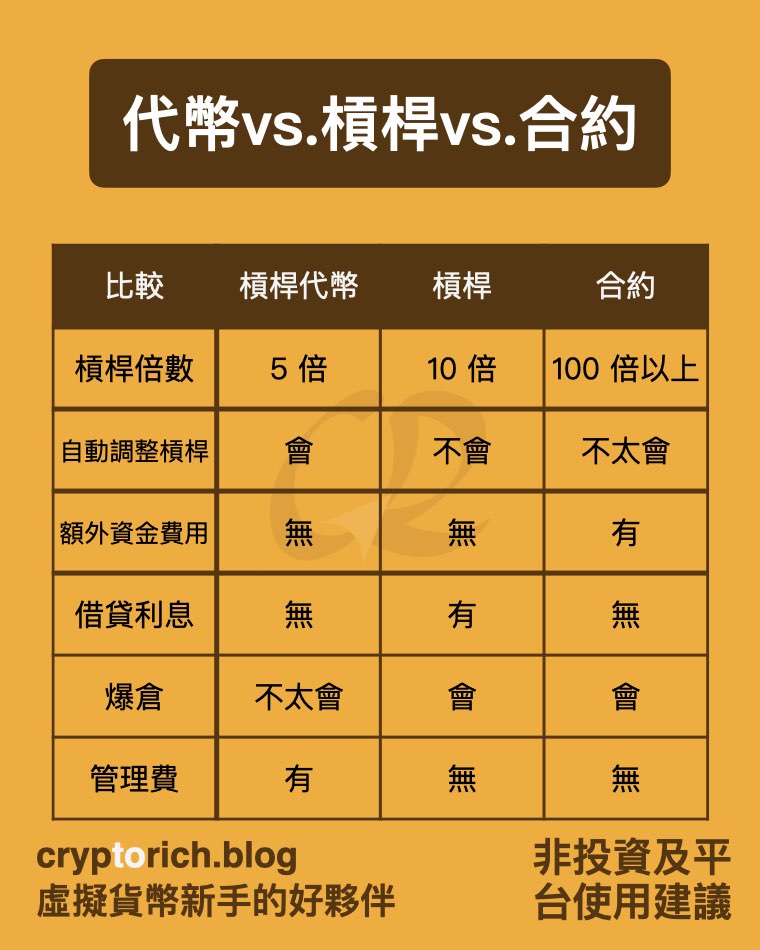
Comparison of leveraged tokens, margin and futures
Leveraged tokens are backed by futures positions. How do they differ from trading futures directly, and from margin trading? CryptoRich compares them below.
| Comparison | Leveraged tokens | Margin trading | Futures trading |
|---|---|---|---|
| Common maximum leverage | 5x | 10x | 100x |
| Automatic rebalancing | Yes | No | Usually no |
| Funding payments | No | No | Yes |
| Borrowing interest | No | Yes | Yes |
| Collateral (margin) | No | Yes | Yes |
| Liquidation | Unlikely | Yes | Yes |
| Management fee | Yes | No | No |
Comparison of leveraged tokens, margin and futures trading
Buying a leveraged token requires fewer operational concepts, but its path can differ substantially from the underlying coin. If the coin doubles, a 3x token will not necessarily triple, because costs and rebalancing also affect performance.
Margin and futures trading expose leverage more directly, but you must monitor funding costs, borrowing interest and other charges. A sufficiently adverse price move can wipe out the committed capital, so understanding the costs and mechanics matters.
For the differences between margin and futures trading, see the comparison in my margin trading guide.
Advantages of leveraged tokens

Advantages of leveraged tokens
Simple operation
You can trade based on buying low and selling high without directly managing the underlying positions. The token generally moves more sharply than the underlying coin, which can make the trading approach feel straightforward.
Very limited direct liquidation exposure
The platform's rebalancing mechanism means these products do not behave like a direct margin or futures position that is liquidated at a specific threshold.
However, the token price can still fall dramatically and approach zero even when the token balance remains in your account.
Short exposure
If you expect the underlying price to fall, buying an inverse leveraged token may benefit from that decline. You trade the token through a familiar buy-and-sell process rather than borrowing a coin to sell it.
Compounding effects
When prices trend upward, rebalancing can reinvest gains into larger positions, producing a compounding effect.
Disadvantages of leveraged tokens

Disadvantages of leveraged tokens
Effective leverage varies
Effective leverage changes as prices move and trading costs accumulate, so the multiple of the underlying return is not fixed over your entire holding period.
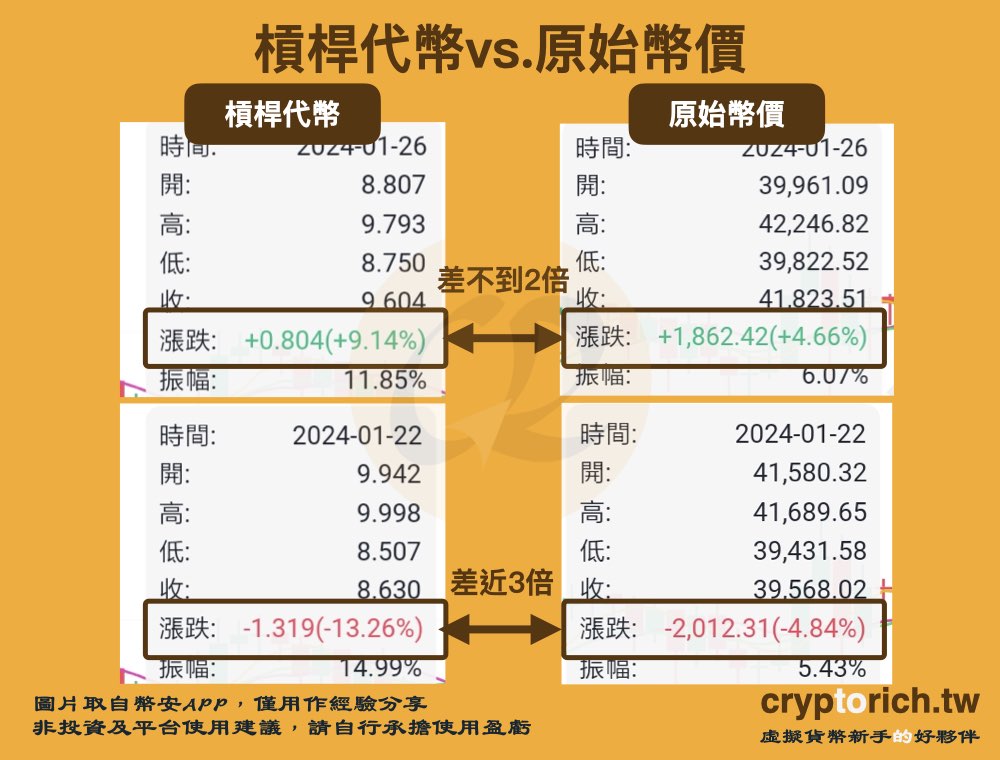
Leveraged token vs. underlying price
The chart illustrates that a token and its underlying coin can have very different percentage moves over the same period. On one day the difference may be around one multiple, and on another it may exceed two, making the effective multiple difficult to anticipate.
High management fees
Using Pionex as the article's example, a daily management fee of 0.03% of token value adds up to roughly 10% over a year. The return must cover these ongoing costs before the investment breaks even.
Limited uses
Leveraged tokens are generally traded on their issuing platform. Their uses are limited compared with withdrawable coins or assets used in services such as Binance Earn.
Lower liquidity
Leveraged tokens are a relatively niche product. Even if the displayed market price reaches your target, there may be no matching counterparty, resulting in a less favorable execution price.
On PTT, the comments discussed in this article are generally skeptical: many contributors prefer margin trading to leveraged tokens.
Traditional leveraged and inverse ETFs share some related ideas and are more widely used. CryptoRich suggests that investors may turn to those packaged products because ordinary ETF trading does not directly provide the same leverage.
Risks of leveraged tokens

Leveraged token risks
The main risks discussed here are the rebalancing mechanism and management fees. Maintaining target leverage requires changes to the underlying futures positions, which creates decay and costs.
For example, a rising underlying price can lead the product to increase its futures position. If the price then falls, the larger position loses more, so a round trip in the underlying can still leave the token with a loss.
Management fees also accumulate with time, much like steadily losing health points in a game. Over a long holding period, they can consume much of the price gain.
Which platforms offer leveraged tokens, and how do token names work?
Binance, Pionex and Bybit have offered leveraged tokens in the past. Based on CryptoRich's checks described in the source article, Binance no longer offered them, while Pionex remained available.
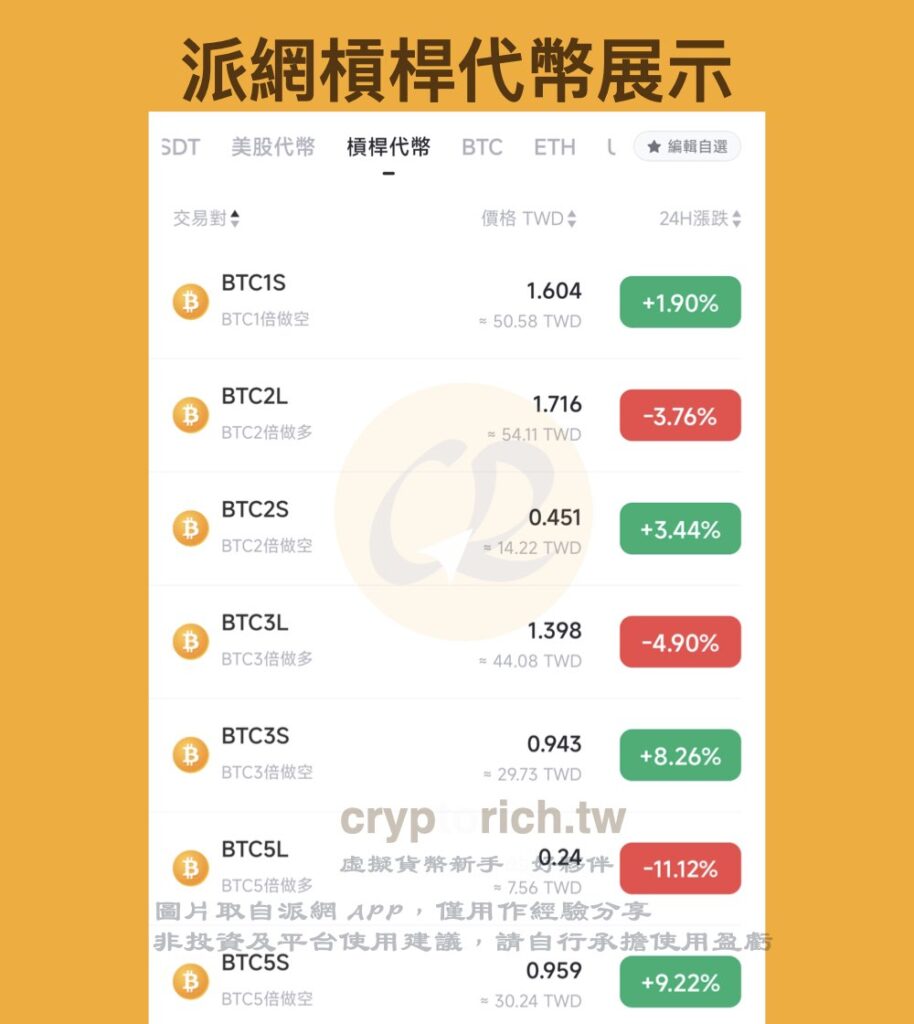
Pionex leveraged token listings
The article describes Pionex tokens with leverage up to 5x. In the naming convention, the number indicates leverage, while L means long and S means short.
For example, BTC2L represents a 2x long Bitcoin token. Its intended exposure means that Bitcoin price increases are amplified approximately twofold over the relevant measurement interval.
You may also see BTC1S, which moves in the opposite direction to Bitcoin. Even without an amplified multiple, management fees and rebalancing mean its path will not simply be a perfect mirror image of Bitcoin.
Platforms differ mainly in their rebalancing mechanisms. In the Pionex example, positions are adjusted back toward target leverage when price movements take leverage outside the permitted range.
How to trade leveraged tokens on Pionex
Step 1: Register and fund a Pionex account
Start by registering a Pionex account. The author's Pionex referral-code guide explains the referral offers, and the registration tutorial covers the process.
Next, fund the account. My usual approach is to buy USDT with TWD through MAX Exchange, then transfer funds to Pionex using a process similar to the MAX transfer guide. For other methods, see the Pionex deposit tutorial.
Step 2: Find a leveraged token and place an order
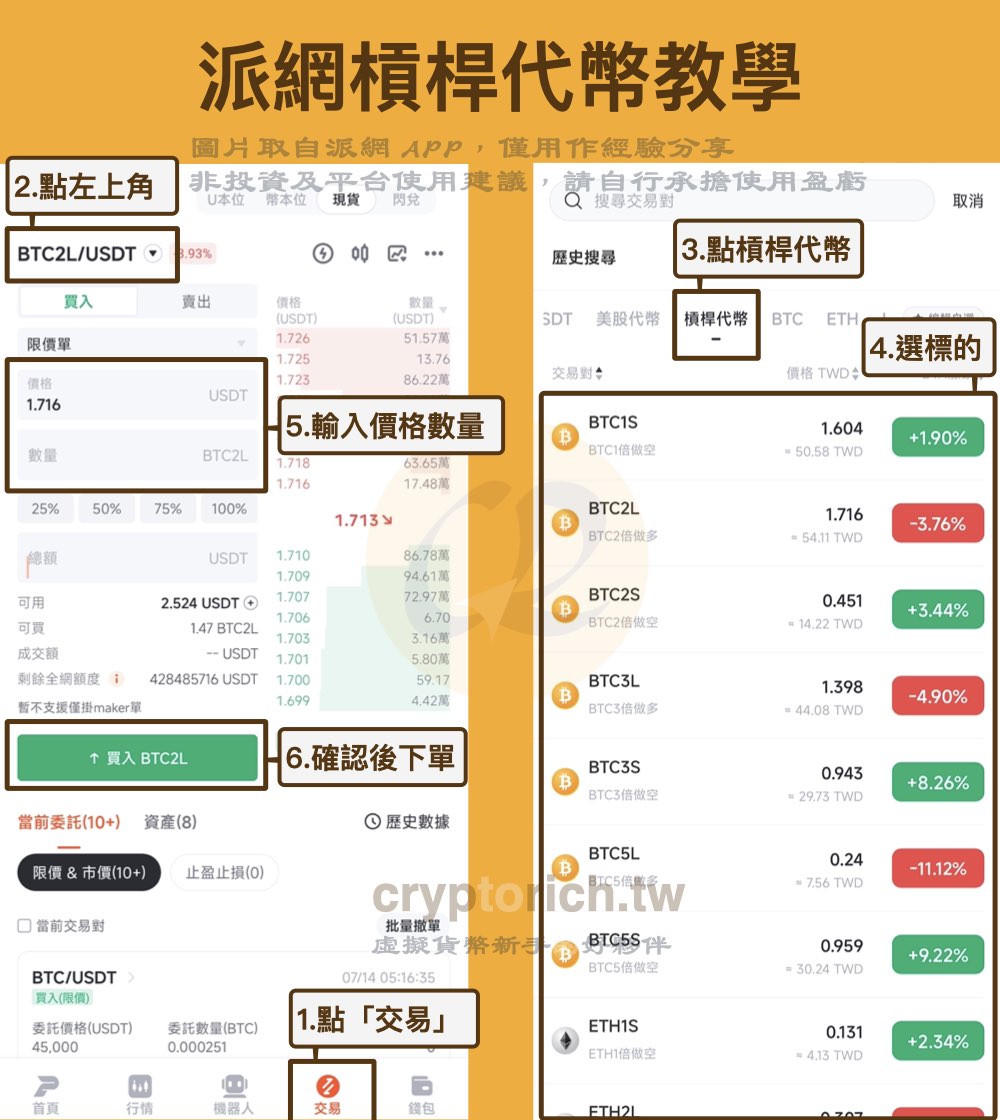
Buying and selling Pionex leveraged tokens
In the Pionex app, open Trading, then the menu in the upper-left corner, and select Leveraged Tokens to view the available products.
You can also search by coin name followed by the leverage number and L for long or S for short.
The process resembles spot trading: enter your purchase price and quantity and submit the order. It fills when a matching trade is available at your chosen price.
Step 3: Manage or sell the token
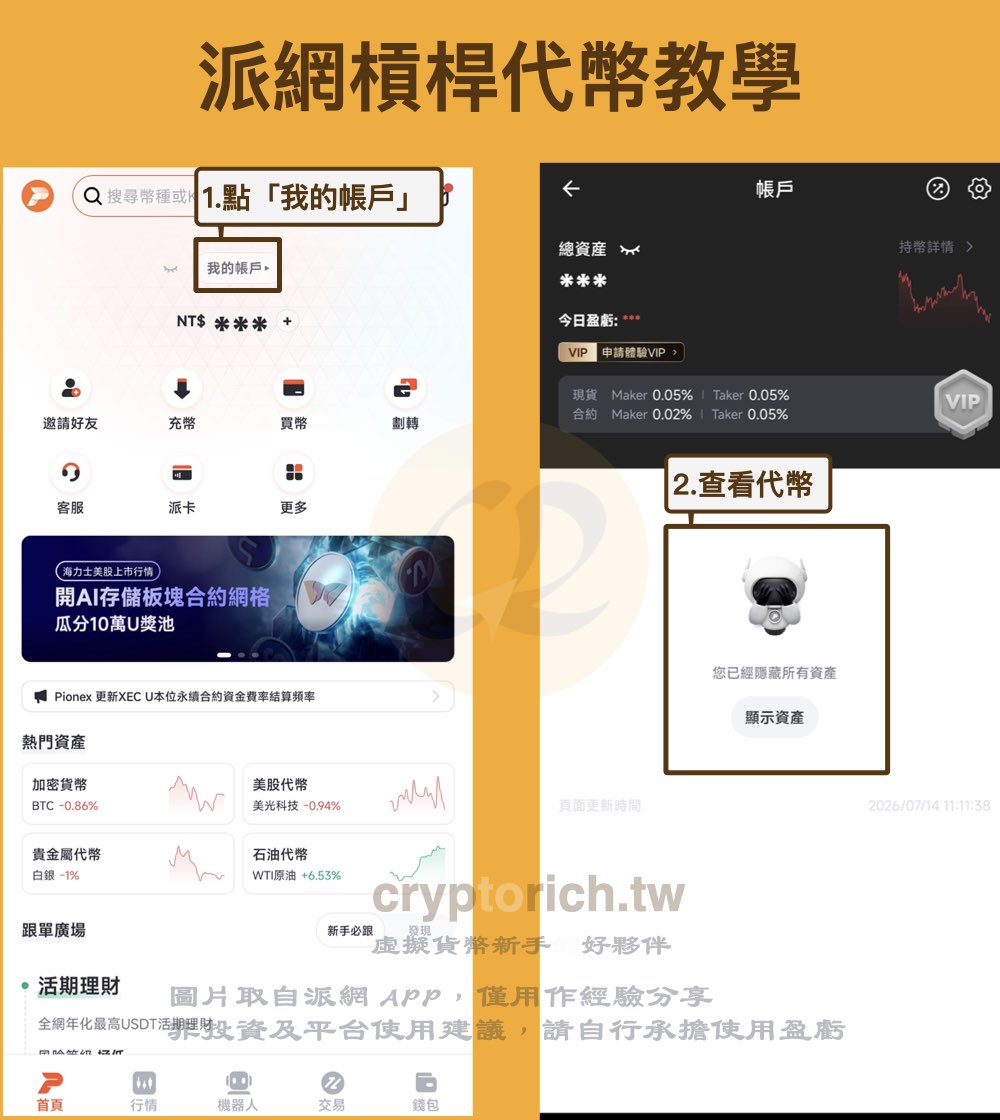
Managing Pionex leveraged tokens
After buying, select My Account at the top of the app home screen to view your tokens. To sell, return to the trading page in step 2 and select Sell.
https://www.youtube.com/shorts/M3ze0JZZXPc
Leveraged token video tutorial
Pionex leveraged token fees
- Trading fee: 0.1%.
- Management fee: 0.03% per day, reflected in net asset value at midnight.
- Funding and other costs: reflected in net asset value according to the applicable conditions.
The source article lists leveraged-token trading fees above ordinary spot fees: spot trading is quoted at 0.05%, with fee discounts available through VIP levels, while leveraged tokens are quoted at 0.1% even for VIP 8.
A daily fee of 0.03% totals 10.95% when simply multiplied by 365. This is high relative to many ETF fees and helps explain why the author does not recommend long-term holding.
Leveraged token FAQ
What market conditions suit leveraged tokens?
Sustained upward or downward trends are the intended setting described in this article: gains can be reinvested automatically through the rebalancing process, creating a compounding effect.
Should beginners choose leveraged tokens?
The interface may look as simple as spot trading, with no direct management of margin calls or funding payments. Making a profit can still be difficult, so the author suggests that beginners start with ordinary coin purchases.
Why avoid holding leveraged tokens for a long time?
Rebalancing generates trading costs and management fees accrue daily. These costs and the token's return path can create substantial divergence from the underlying coin over time.
What does a leveraged token consolidation mean?
A consolidation combines several low-priced tokens into a smaller number of higher-priced tokens. For example, 100 old tokens may become one new token. The token count falls, while the consolidation itself does not reduce the total asset value.
Key takeaways
A leveraged token is a packaged futures product for people familiar with buying and selling crypto who prefer not to manage each aspect of a futures position directly. Rebalancing and management costs make it unsuitable for long-term holding; its intended use is sustained directional markets.
Further reading: What is DCA, and how can you buy crypto regularly?
Source: Leveraged Token Decay and Trading Guide: Pionex as an Example
What is ZONE Wallet?
ZONE Wallet is a Taiwan-based virtual asset exchange, allowing beginners to buy and sell easily with a single click. Combined with our dollar-cost averaging (DCA) feature, you can enjoy flexible, value-driven investment results!
ZONE Wallet also offers corporate account services with a fast and secure onboarding process. We help startups and enterprises leverage stablecoins to optimize cross-border payment workflows and reduce transaction costs. ZONE Wallet makes asset allocation more reliable for both personal financial management and corporate treasury strategies—helping you effortlessly navigate the future of Web3!
Start small to get comfortable with the process and risks.
Ready to dive into crypto?
[download-app]
This article is for educational purposes only and is not investment advice; leveraged tokens and crypto assets can experience significant price swings and loss of principal.