Market-Cap vs. High-Dividend ETFs: Goals, Total Return, and Risk
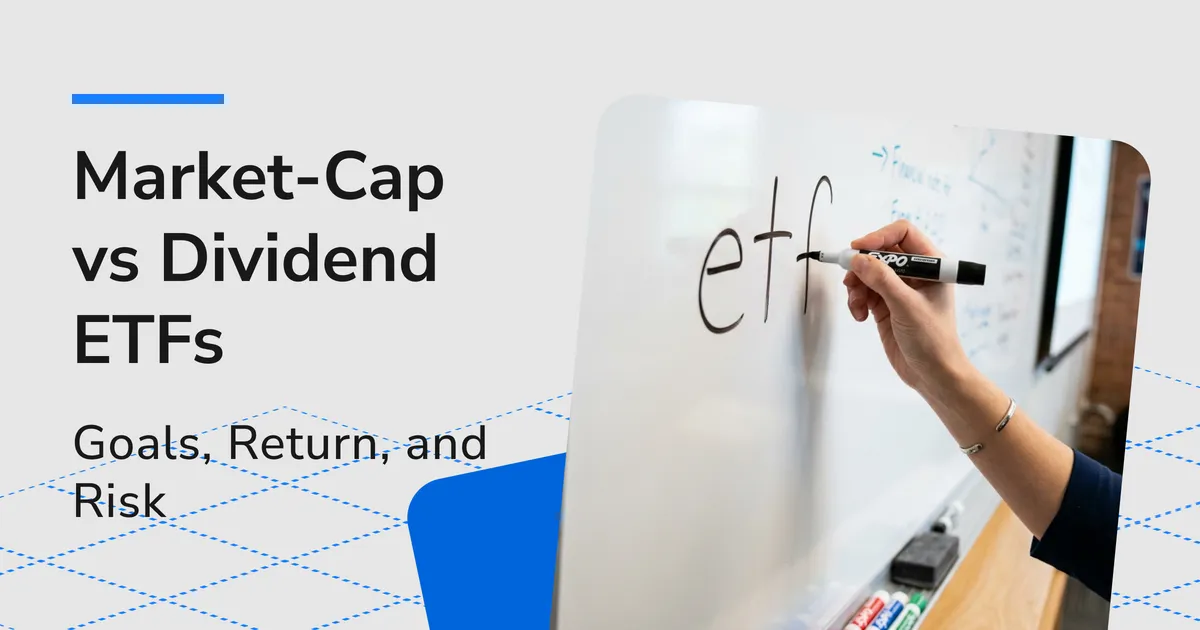
Market-cap and high-dividend ETFs are notinherently better or worse than one another. A market-cap ETF generally gives larger companies a larger index weight. A high-dividend ETF adds dividend yield, dividend history, or dividend-quality criteria to its selection rules. The useful question is not which label is more popular, but whether you need portfolio cash flow now, when you expect to use the money, and how much market volatility you can accept.
Investors focused on long-term accumulation should not judge an ETF only by the cash it distributes. Investors who need recurring cash should not choose only by past return either. Separating a cash-flow need from a long-term growth goal is a more useful first step than starting with a fund label.
Looking to diversify your portfolio?
You can start small to explore crypto assets—get started easily with just NT$10 a day!
Download ZONE Wallet NOW!The key difference is the index rule
Market-cap ETFs commonly weight holdings by company size. When a company becomes larger, its weight in the index usually rises; when it becomes smaller, its weight usually falls. This approach does not try to predict the next winner. Instead, it follows a rule-based representation of larger companies in a chosen market. Before investing, look beyond the words “market cap” and check the market covered, the number of holdings, and whether a few companies or sectors dominate the index.
High-dividend ETFs are not simply lists of the highest yields. Their methodologies may screen for projected or historical dividends, profitability, dividend consistency, volatility, liquidity, or sector limits. Some emphasize income, while others include different quality or price-recovery rules. Those differences can lead to different sector exposures, economic sensitivity, and stock style. Read the index methodology and prospectus to understand the strategy you are actually buying.
Distributions are not the whole return
Cash distributions can make a high-dividend ETF feel like it is producing income, but a distribution is not automatically an additional return. On an ex-dividend date, net asset value or market price may adjust. Investment results should be considered through total return: price change plus distributions received, including whether those distributions are reinvested. The Taiwan Stock Exchange also notes that dividend yield alone is not an adequate basis for evaluating ETF performance and that total return matters.
That does not make distributions unhelpful. For investors with a genuine and planned need for periodic cash, distributions may reduce the frequency of selling units. But when cash is not needed, reinvestment decisions, costs, and discipline can affect long-term results. Distribution frequency alone does not reveal an ETF’s risk or suitability.
Compare concentration, sectors, and implementation risk
Both strategies can be concentrated. A market-cap ETF may be concentrated because very large companies receive large weights. A high-dividend ETF may tilt toward certain dividend-paying sectors or value-oriented stocks. Concentration is not automatically a problem, but investors should ask whether it duplicates risk already held elsewhere and how the portfolio may react to changes in rates, economic conditions, or industry cycles.
An ETF label also does not remove market, liquidity, or tracking-error risk. The Taiwan Stock Exchange lists these among common ETF risks, and ETFs holding overseas assets may additionally involve currency and time-zone risks. Compare the underlying index, holdings, fees, fund size, trading activity, and bid-ask spread—not only the distribution rate.
Five questions before choosing a strategy
1. Will I need this money in the near future?
If the money is needed for living expenses, education, or another defined goal, start with liquidity, safety, and a cash-flow plan. Do not let a higher distribution rate distract from possible principal volatility. If the money has no near-term use, focus instead on the long-term goal and the volatility you can tolerate.
2. Is my priority cash flow or long-term portfolio growth?
Investors who need regular cash can study distribution policies and whether the expected cash flow fits their spending plan. Investors focused on accumulation can compare total return, reinvestment, and costs. The goals can coexist, but one should be identified as the primary objective.
3. Can I explain the index methodology?
At a minimum, check the eligible universe, weighting method, rebalancing schedule, and removal rules. A strategy that can be explained simply is often easier to stick with when markets are volatile.
4. Does it duplicate risk I already hold?
Review the ETF’s largest holdings and sector allocation alongside your existing stocks and funds. Adding a different label does not necessarily add diversification if the underlying exposures are still similar.
5. Can I accept lower distributions or weaker relative performance?
Past yield, distributions, and performance do not guarantee future outcomes. If a lower distribution, falling price, or a period of underperformance would cause you to abandon the plan, reduce reliance on a single strategy or revisit your risk tolerance.
Frequently asked questions
Is a high-dividend ETF always better for retirement?
No. Retirement planning depends on a sustainable spending plan, total portfolio volatility, taxes, and liquidity—not only on a distribution label. A high-dividend strategy may create cash flow, but both distributions and prices can change.
Is a market-cap ETF always more diversified?
No. Diversification depends on the market tracked, number of holdings, and weighting limits. An index with many holdings can still be heavily influenced by its largest companies.
Does a higher distribution rate mean a higher return?
No. A distribution rate does not, by itself, show total return, risk, or future distribution capacity. Consider distribution sources, ex-dividend adjustments, fees, and total return over a relevant holding period.
Can I hold both strategies?
You can evaluate both, but different names do not automatically mean diversified exposure. Check overlap in holdings, sectors, and style before deciding on allocation and review rules.
Conclusion: choose the goal before the label
The difference between market-cap and high-dividend ETFs begins with the index rule and the need you are trying to meet. Investors who need cash flow should evaluate whether distributions support their plan and whether they can tolerate price changes. Investors focused on long-term accumulation should place total return, reinvestment, and concentration near the front of the decision. Understanding the rules and risks before choosing is more durable than chasing a single yield figure.
This article is for general information only and is not investment advice. ETF prices, distributions, and returns can fluctuate. Review the prospectus and assess your own risk tolerance before investing.
What is ZONE Wallet?
ZONE Wallet is a Taiwan-based virtual asset exchange, allowing beginners to buy and sell easily with a single click. Combined with our dollar-cost averaging (DCA) feature, you can enjoy flexible, value-driven investment results!
ZONE Wallet also offers corporate account services with a fast and secure onboarding process. We help startups and enterprises leverage stablecoins to optimize cross-border payment workflows and reduce transaction costs. ZONE Wallet makes asset allocation more reliable for both personal financial management and corporate treasury strategies—helping you effortlessly navigate the future of Web3!
Start small to get comfortable with the process and risks.
Ready to dive into crypto?
[download-app]