How Should You Allocate Your Salary? Use the 50/30/20 Rule for Needs, Wants, and Savings

What is the 50/30/20 rule?
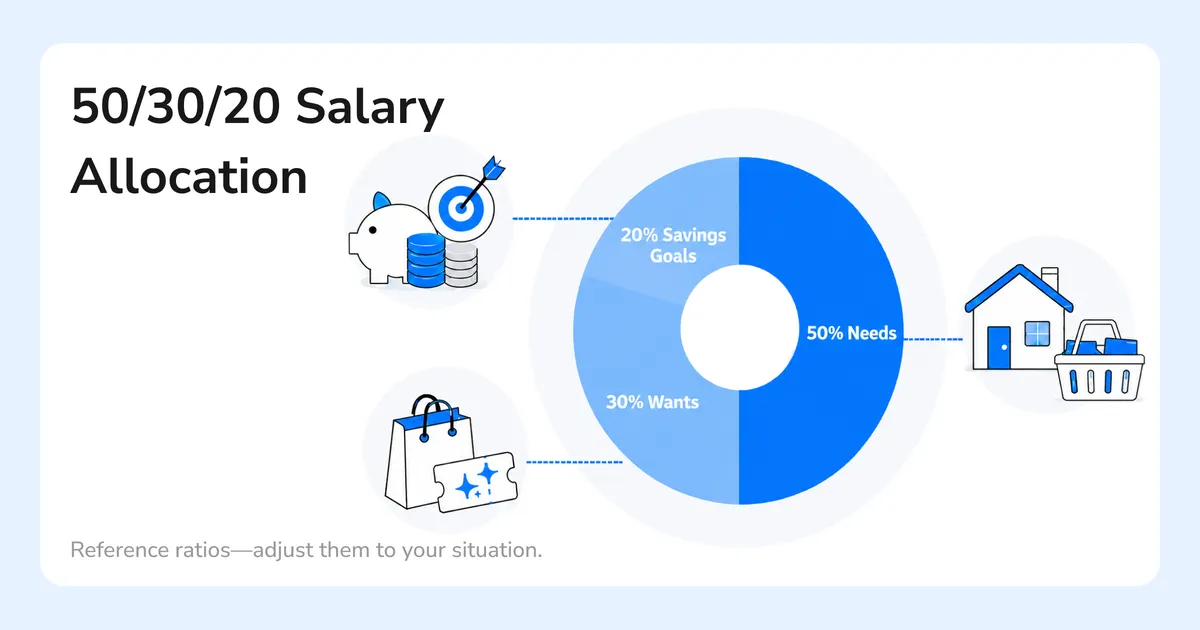
The 50/30/20 rule is a simplified budgeting method. It allocates approximately 50% of your monthly take-home income to needs, 30% to wants, and 20% to savings goals. Its purpose is to provide a quick view of where your money is generally going, not to require everyone to follow the same fixed percentages.
The U.S. Consumer Financial Protection Bureau (CFPB) uses after-tax net income as the basis for its calculation and places goals such as emergency savings, education, and retirement in the 20% category. Its materials also note that not everyone can live within these percentages and that you should create a workable rule based on your own financial circumstances. CFPB: Analyzing budgets
What goes into the 50%, 30%, and 20% categories?
50%: Needs
Needs are expenses required to maintain basic living conditions, work, and security. Examples include rent or mortgage payments, basic meals, utilities, communications, commuting, medical care, insurance, and minimum debt payments. The key question is not whether you strongly want something, but whether pausing the expense would directly affect your housing, health, work, or basic responsibilities.
30%: Wants
Wants are expenses that can improve your quality of life but whose amount or timing can be adjusted. Examples include discretionary dining, entertainment, travel, subscriptions, and nonessential purchases. Needs and wants are not always fixed categories: a phone may be necessary for work, while the extra cost of upgrading to a premium model may be a want. Food is a need, but frequent expensive meals may include a discretionary component.
20%: Savings goals, including extra debt repayment if appropriate
Under the CFPB framework, this category can include emergency savings, retirement, education, and other savings goals. In practice, some people also include debt payments above the required minimum in the 20% category because they likewise improve future financial health. This article uses the following convention: minimum required payments are needs, while additional principal repayments are part of the 20% category. Most importantly, use the same convention consistently so that the same expense is not counted twice.
How do you calculate the 50/30/20 rule? An example with NT$50,000 in monthly take-home pay
For monthly take-home pay of NT$50,000:
- Reference ceiling for needs: NT$50,000 × 50% = NT$25,000
- Reference ceiling for wants: NT$50,000 × 30% = NT$15,000
- Reference amount for savings goals: NT$50,000 × 20% = NT$10,000
Base the calculation on the income you can actually use after taxes and required payroll deductions, not your nominal annual salary. If bonuses or freelance income are irregular, use a conservative monthly average to plan fixed needs, then allocate additional income after it arrives. Do not rely on money you have not yet received to support current living expenses.
These figures are only a diagnostic benchmark. If rent and commuting already total NT$30,000, that does not mean you have “failed” at budgeting. It means the percentages have revealed that your essential cost structure is relatively heavy. In the short term, you could reduce wants, review housing or transportation costs, or use a transitional ratio such as 60/20/20 that better reflects your current circumstances. Do not miss required payments simply to force needs into the 50% category.
Five expenses that are most often misclassified
- Rent: Basic housing is a need, but paying a premium for more space or a more expensive location beyond what you can afford may include a discretionary component.
- Insurance: Basic protection can be classified as a need. Duplicate coverage or portions with stronger savings or investment features should be reviewed separately.
- Debt payments: Minimum required payments are generally needs. Accelerated principal repayment can be included in the 20% category.
- Transportation: Commuting to work is a need, while a more expensive vehicle, frequent ride-hailing, or other upgrades beyond that need may be wants.
- Subscriptions: Tools required for work may be needs, while infrequently used streaming, gaming, or software subscriptions are usually closer to wants.
Classification is not a moral judgment. Categorizing entertainment as a want does not mean you must eliminate it. The purpose is to identify which expenses can be adjusted first if your income declines.
How should you adjust the percentages if rent is high, you support a family, or you have debt?
Protect basic needs and minimum payments first, then determine which percentages can be adjusted. Use these three steps:
- Classify your actual figures from the past three months. Do not begin with idealized amounts.
- Set transitional percentages. If your current ratio is 65/25/10, for example, begin with a goal of 60/25/15 instead of demanding 50/30/20 next month. The three categories should still add up to 100%.
- Adjust one major expense each quarter. Housing, transportation, interest, and insurance usually have more impact on the percentages than small discretionary purchases.
It is common for needs to exceed 50% when income is lower or housing costs are higher. In this situation, the priority is not to force essential spending below an arbitrary percentage. Focus on avoiding persistent negative cash flow, establishing a minimum buffer, and gradually increasing your savings rate.
Should the 20% go to savings, debt repayment, or investing first?
You can allocate it in order of financial risk. First, cover upcoming bills and create a minimum cash buffer. If you have high-cost debt such as revolving credit, prioritize reducing the known interest cost. Next, build an emergency fund. Finally, direct money that can tolerate volatility and will not be needed soon toward long-term goals.
The 20% does not have to be invested in full. Savings and investments have different time horizons and risks. If you will need the money for tuition or a move in six months, it may still fall within the 20% category, but taking excessive short-term volatility in pursuit of returns would be inappropriate.
How do you create your own budget percentages?
Start with How to Calculate Your Personal Cash Flow to identify your actual income, essential expenses, and irregular costs. Then set three ranges rather than three rigid cutoffs that can never be crossed:
- Needs: a reasonable ceiling for basic living expenses and responsibilities
- Wants: the range you can spend freely without compromising your goals
- Savings goals, including extra debt repayment when appropriate: the minimum amount you commit to setting aside
If your income is irregular, replace a pure percentage system with a “baseline plus allocation” approach. Use a conservative income baseline to cover needs, set a sustainable minimum savings amount, and then allocate income above the baseline by percentage. This is easier to maintain than recalculating every expense whenever monthly income changes.
The 50/30/20 rule answers how income should be allocated, while your savings rate tracks how much you actually keep. The two can work together, but do not count the same extra debt payment as both savings and spending. If fixed percentages do not suit your current income, compare other ways to save money, such as setting aside a fixed amount, using automatic transfers, or separating money into dedicated accounts.
Frequently asked questions about the 50/30/20 rule
Should the 50/30/20 rule use gross or net income?
It is generally more useful to calculate the percentages from the take-home income you can actually allocate because this better reflects your daily budget.
Is mortgage principal a need or savings?
For simplicity and to avoid double counting, you can classify the entire required monthly mortgage payment as a need. If you choose to separate principal and interest in greater detail, use a consistent convention and make sure the principal is not counted as both a need and savings.
Can my savings rate exceed 20%?
Yes. The 20% is a reference starting point, not a ceiling. You can increase it based on your goals as long as you are not sacrificing basic living expenses, insurance, health, or essential responsibilities.
What should I do if my needs exceed 50%?
Accept the actual figures first, then review major categories such as housing, transportation, and interest, and set gradual targets. Do not miss essential payments or use new debt to cover living expenses just to fit the formula.
Should a credit card bill be classified as a need or a want?
Do not classify the entire bill as a single category. Return to the underlying purchases: basic meals may be needs, while entertainment purchases may be wants. Revolving interest and minimum required payments should be listed separately. This prevents the payment method from distorting your budget percentages.
Conclusion
The greatest value of the 50/30/20 rule is that it provides a quick map of your budget structure. Begin by dividing take-home income among needs, wants, and savings goals, then adjust the percentages for your housing, family responsibilities, debt, and income stability. The right percentages are the ones you can maintain over time while gradually improving your cash flow.
Sources
What is ZONE Wallet?
ZONE Wallet is a Taiwan-based virtual asset exchange, allowing beginners to buy and sell easily with a single click. Combined with our dollar-cost averaging (DCA) feature, you can enjoy flexible, value-driven investment results!
ZONE Wallet also offers corporate account services with a fast and secure onboarding process. We help startups and enterprises leverage stablecoins to optimize cross-border payment workflows and reduce transaction costs. ZONE Wallet makes asset allocation more reliable for both personal financial management and corporate treasury strategies—helping you effortlessly navigate the future of Web3!
Disclaimer: This article is for general financial education only and does not constitute investment, credit, tax, or legal advice.