What Are the Best Ways to Save Money? From Salary Allocation to Automatic Transfers

What are the best ways to save money? Start with one method you can sustain
Common ways to save money include paying yourself first, setting up automatic transfers, separating money by purpose, saving a fixed amount or percentage, and trying challenges such as the 52-week savings challenge. There is no single best method for everyone. What matters is confirming your available monthly income, essential expenses, and savings goal, then choosing an approach you can repeat without leaving yourself short for bills.
If you often run out of money before payday, the first step is not to set an ambitious savings target. Start by reviewing your personal cash flow to see when money comes in and when expenses are due. If your income still exceeds your expenses, turn saving from “whatever is left at the end of the month” into a plan with a goal, timeline, and recurring action.
Saving means setting money aside for future use, while investing involves price fluctuations. The two should not be treated as the same thing. Tuition, taxes, travel costs, and other funds you know you will need in the short term should not be placed in assets that could decline just when you need the money simply because you want to pursue a return.
The first step is not choosing a method but setting a savings goal
An actionable savings goal should answer at least four questions: what the money is for, how much you need, when you will need it, and how much you will set aside each period. Financial education materials from the Federal Deposit Insurance Corporation (FDIC) likewise recommend defining the purpose, required amount, timeline, and actions for a goal. FDIC: Goals and Saving
You can begin by breaking it down with a simple formula:
> Monthly target = Amount still needed ÷ Number of months until the money is needed
Suppose you want to have NT$60,000 ready in 10 months and already have NT$10,000. You still need NT$50,000, so your monthly target is NT$50,000 ÷ 10 = NT$5,000. After calculating the target, compare it with your actual income and expenses. If you can consistently keep only NT$3,000 a month, extend the timeline, reduce the target, or increase your income instead of borrowing to cover the difference.
If you have several goals at once, start by dividing them into three groups:
- Certain expenses with known dates: Annual insurance premiums, taxes, tuition, moving costs, or travel.
- Expenses without fixed dates that still require preparation: Repairs, medical deductibles, or appliance replacement.
- Longer-term goals: Further education, a home down payment, or other major plans.
How much to keep in an emergency fund and where to hold it should be assessed separately based on its purpose and liquidity. See How Much Emergency Savings Do You Need?. This article focuses only on turning saving into an action you take whenever income arrives.
How do six common savings methods work?
1. Pay yourself first: Set aside the target amount as soon as income arrives
Paying yourself first means treating savings as a regular allocation each period instead of waiting until all spending is finished to see whether anything remains. You might move the planned amount to a dedicated account on payday or the following day, then organize your living expenses with the money left over.
This method suits people with stable income and predictable paydays who tend to spend their remaining balance by the end of the month. Test the amount against your actual cash flow first. If moving the money leaves you unable to pay rent, transportation costs, or minimum debt payments, reduce the amount instead of adding credit card debt or borrowing merely to maintain your record.
2. Automatic transfers: Make saving a recurring process
Automatic transfers turn paying yourself first into a fixed process. For example, you can automatically move a specified amount into a savings or dedicated-purpose account one or two days after your salary arrives. The FDIC identifies automatic deposits into a savings account as one way to save consistently. FDIC: Starting Small Can Lead to Big Savings Before setting one up, ask your bank whether a transfer with insufficient funds will be canceled, retried, or subject to a fee.
Check these items first:
- Whether your salary consistently arrives on the same date.
- Whether rent, credit card bills, or other priority payments are due before the transfer date.
- Whether the bank will cancel or retry the transfer, or charge a fee, if your balance is insufficient.
- How you will pause the transfer or reduce the amount if your income falls.
People with irregular income may not be suited to an automatic transfer on a fixed date. Instead, transfer a portion manually or according to a set rule whenever income arrives.
3. Separate accounts and dedicated funds: Keep money for different purposes from being mixed
Separating funds means organizing money by purpose, such as everyday expenses, annual costs, travel, and other goals. You can use different accounts, subaccounts offered by your bank, or a clear spreadsheet within a single account. The point is to know what each amount is for, not to open as many accounts as possible.
When all your money sits in the account you use for daily payments, it is easy to mistake funds reserved for an annual insurance premium or tuition for money available to spend. Separating funds reduces this risk, but check minimum-balance requirements, interbank transfer fees, withdrawal convenience, and management effort before opening accounts or moving money.
4. Fixed-amount method: Save the same amount each period
The fixed-amount method means setting aside the same sum every week or month, such as NT$2,000 a month. It is easy to understand and works well with automatic transfers, making it suitable for beginners with relatively stable income.
Its limitation is that the amount does not adjust automatically when your income changes. If you keep the same amount after a raise, the share of income you retain may gradually decline. If your income falls temporarily, the original amount may become too high. Review it every three months or whenever your income changes rather than leaving it unchanged forever.
5. Fixed-percentage method: Adjust savings as income rises or falls
The fixed-percentage method means setting aside a certain percentage whenever you receive income, such as 5%, 10%, or another percentage you can afford. It suits freelancers and people whose income is not completely stable or includes substantial bonuses because the actual savings amount changes with income.
A higher percentage is not automatically better, and no single standard fits everyone. To review your overall budget by needs, wants, and savings goals, read How Should You Allocate Your Salary? Use the 50/30/20 Rule. That page covers salary allocation, category percentages, and adjustments; this article does not present 50/30/20 as a mandatory answer.
6. The 52-week savings challenge and other challenges: Add engagement with short-term tasks
The 52-week savings challenge usually divides a year into 52 deposits, with a different amount saved each week according to a set rule. Other variations include daily spare-change challenges, no-spend days, and saving particular denominations. Clear progress makes these challenges easy to start and appealing to people who enjoy check-ins or gamification.
Challenges have three limitations: the required amount may rise rapidly toward the end, weekly actions can become cumbersome, and finishing one challenge does not mean you have built a lasting system. List the highest weekly amount before you begin and confirm that you can still afford it during high-expense months. If you are paid monthly, a fixed monthly amount may be simpler and less likely to interfere with essential living expenses.
How should you choose a savings method? Match it to your income and habits
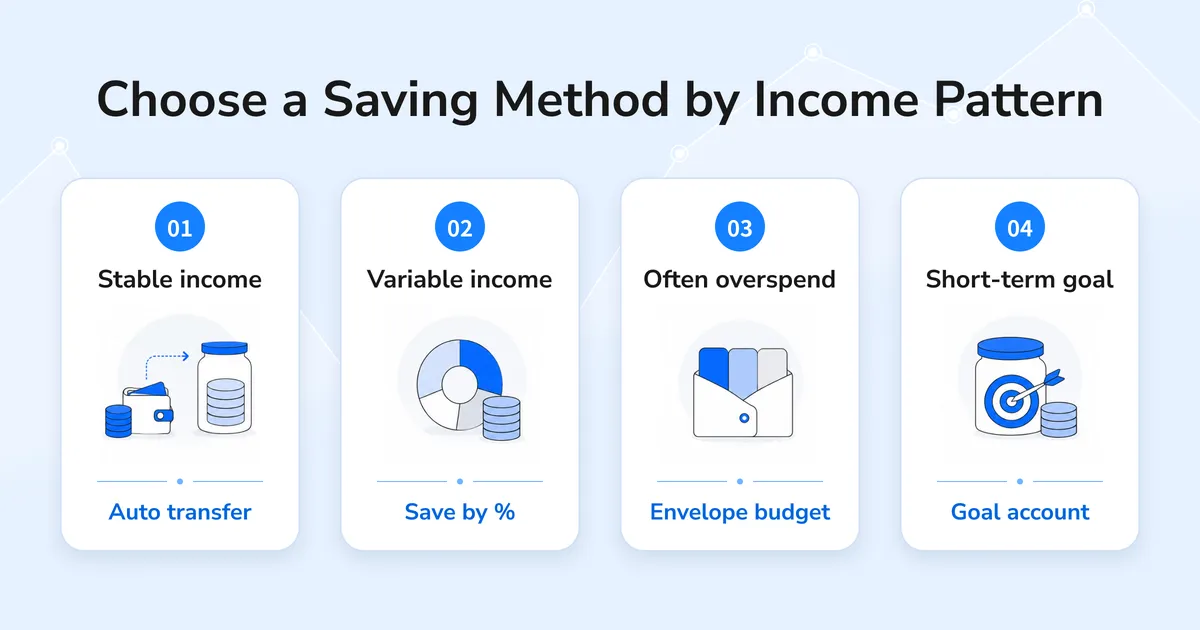
- Current situation:You receive a fixed monthly salary but tend to spend everything by month-end;Method to consider first:Pay yourself first plus automatic transfers;Why it may work:The recurring action happens before discretionary spending;What to check first:Schedule the transfer after your salary is confirmed and retain enough for essential payments
- Current situation:You have a goal with a specific date and amount;Method to consider first:Dedicated funds plus a fixed amount;Why it may work:The target is easy to divide by the months remaining;What to check first:Do not mistake earmarked funds for money you can freely spend
- Current situation:Freelance work, commissions, or bonuses make up a large share of income;Method to consider first:Minimum amount plus a percentage of income;Why it may work:It preserves flexibility in lower-income months and increases savings in higher-income months;What to check first:Allocate money only after it arrives; do not spend income in advance
- Current situation:You are just starting and can save only a small amount;Method to consider first:Small fixed amount;Why it may work:It is easy to test without complex calculations;What to check first:Focus on consistency first, then adjust gradually
- Current situation:You enjoy check-ins and short-term tasks;Method to consider first:The 52-week challenge or another savings challenge;Why it may work:Progress is visible and engaging;What to check first:Confirm that you can afford the later amounts and high-expense months
- Current situation:You often use money intended for one purpose on another;Method to consider first:Separate accounts and dedicated funds;Why it may work:They distinguish spendable money from funds that should not be touched;What to check first:Avoid creating too many accounts, adding fees, or losing track of them
You can combine two methods, such as automatically transferring a fixed amount each month and setting aside an additional percentage when a bonus arrives. Too many rules at once can make it easier to give up, so start with one primary method and follow it for two to three months before deciding whether to add another.
Irregular expenses are not surprises: Set money aside for them each month
Annual insurance premiums, taxes, tuition, vehicle maintenance, holidays, and recurring travel may not occur every month, but they are usually predictable. If you look only at the current month’s bills, ordinary months can make it seem as if you have saved a large amount, only for a payment month to force you to draw from another goal.
Divide the estimated amount by the number of months until the payment is due and set that amount aside each month. For example, if an NT$24,000 insurance premium is due in eight months, reserve NT$3,000 a month. This is money earmarked for a known expense, not new savings that can also be counted toward another goal.
The U.S. Consumer Financial Protection Bureau (CFPB) also recommends reviewing several months of expenses so that you do not overlook less frequent items such as insurance, medical costs, tuition, seasonal expenses, gifts, and travel. CFPB: Assess your spending
How can you start saving on a lower salary?
If your income is lower and essential expenses take up a larger share, you do not need to pursue a specific percentage first. Confirm whether your income covers housing, basic food, transportation, medical care, and minimum debt payments. If expenses already exceed income, prioritize stopping the shortfall from growing and return to your cash flow statement to identify major categories you can adjust.
If a small amount remains each month, begin with a fixed amount you know you can afford. Set aside a small sum whenever income arrives, and increase it gradually only after you have left it untouched for two to three consecutive months. The CFPB’s savings-rule worksheet likewise allows people to choose either a fixed amount or a percentage of income according to their circumstances rather than imposing one standard. CFPB: My savings rule to live by
If cutting small discretionary purchases no longer creates meaningful room, review larger categories such as housing, transportation, interest, insurance, and communications, or assess feasible ways to increase income. A savings plan should not depend on missing bills, postponing necessary medical care, or continually relying on credit cards.
For fluctuating income, use a “minimum amount plus a percentage of extra income”
Monthly income from freelance work, shifts, commissions, or seasonal employment can vary. If you set a fixed transfer based on your highest-income month, you may run short in a lower-income month. Use a conservative income baseline for essential expenses, then establish a two-part rule:
- Minimum amount: A small savings amount you can still afford in a lower-income month.
- Percentage of extra income: Once income exceeds the baseline, allocate a chosen percentage of the excess to your goal.
For example, suppose your conservative monthly income baseline is NT$35,000 and your minimum monthly savings amount is NT$1,000. If you actually receive NT$50,000 that month, apply your own rule to a portion of the NT$15,000 above the baseline. This illustrates the structure only and is not a recommendation for a particular percentage.
Consumer.gov suggests that people who are not paid every month can use income over a longer period to calculate a monthly average for budgeting. Consumer.gov: Making a Budget In practice, wait until the income reaches your account before moving it. Do not treat unconfirmed freelance payments or bonuses as available funds.
Why can’t you seem to save money? Seven common reasons
1. Your goal is only to “save more”
Without an amount and deadline, you cannot translate the goal into a recurring action. Turn the wish into a measurable target first, then check whether it is realistic for your income.
2. You rely only on what is left at the end of the month
When spending has no limit, saving will always come last. You can set aside money after income arrives, but the amount must still account for essential expenses.
3. You set the initial target too high
An overly ambitious target often leads you to transfer the money back at month-end or use credit for living expenses. Reduce it to an amount you can complete consistently, then increase it gradually.
4. You overlook irregular expenses
Without monthly provisions for annual bills, repairs, and holiday expenses, your savings progress will repeatedly be interrupted. List predictable costs separately.
5. You keep savings in the same account as daily spending money
A healthy-looking account balance can make you overestimate what is available to spend. Use dedicated funds or clear records so that money for different purposes remains identifiable.
6. You treat the market value of investments as cash you have saved
Investment prices fluctuate, and unrealized gains are not savings from the current period. Evaluate short-term goals and readily available reserves separately from investments.
7. Your method is too complicated, but you do not review it regularly
Using several accounts, challenges, and percentages at once adds administrative effort. At the end of each month, check only three things: whether you followed the rule, whether it left you short, and whether you should adjust it next month.
A four-week starter plan: Build one repeatable process
Week 1: Review your actual numbers
Organize your take-home income, essential expenses, and irregular costs from the past one to three months without trying to make the figures look better. For your first full review, use How to Start Managing Your Money together with How to Calculate Your Personal Cash Flow.
Week 2: Choose one goal and one method
Write down the target amount, deadline, and amount needed each month, then choose one primary approach from a fixed amount, fixed percentage, automatic transfer, or dedicated fund.
Week 3: Make the first transfer
Wait until the income has actually arrived, then move the amount specified by your rule to its designated purpose. If this prevents you from paying essential expenses, reduce it immediately rather than trying to hold out until month-end.
Week 4: Reconcile and adjust
Check whether the money is still reserved for its original goal, whether you missed any major expenses, and whether the method is too complicated. Repeat the review every month, then use your savings rate every three months to see whether your actual results are improving.
Frequently asked questions about ways to save money
How much should you save each month?
There is no fixed amount or percentage that works for everyone. Subtract essential living costs, minimum debt payments, and predictable expenses from your take-home income, then choose an amount you can set aside consistently. To review your budget categories, see Salary Allocation and the 50/30/20 Rule, but do not force the formula onto your situation.
Is a fixed amount or fixed percentage better?
A fixed amount is usually easier for beginners with stable income, while people with fluctuating income can use a minimum amount plus a percentage of extra income. Review either method after a significant change in income or expenses.
Must an automatic transfer be scheduled for payday?
No. First confirm when your salary actually arrives and which priority bills are due. Leaving a one- or two-day buffer is often sensible. If your income is irregular, wait for the funds to arrive before applying your rule to avoid an insufficient balance.
Is the 52-week savings challenge suitable for everyone?
No. It is better suited to people who enjoy progress-based challenges and can afford the amounts required later in the challenge. A fixed monthly amount may be simpler for people paid monthly, those with fluctuating expenses, or anyone who does not want to make weekly transfers.
Do you need many accounts to save money?
No. Separate accounts or subaccounts can make purposes easier to distinguish, but they can also add fees and management effort. If you can clearly track dedicated funds and avoid treating goal money as spendable, a simpler setup may be enough.
Does dollar-cost averaging count as saving money?
This article does not treat dollar-cost averaging into investments as a savings method. Investment principal can decline when markets fall. Keep funds for definite short-term uses, essential expenses, and known future costs separate based on when you need them and how much risk you can bear.
If you miss your goal for one month, must you start over?
No. Determine whether the cause was a one-time expense, delayed income, or a target that has been consistently too high, then adjust the amount or deadline for the following month. Do not miss essential bills or borrow just to catch up.
Conclusion
An effective way to save money is not the strictest-looking rule but a process you can repeat with your actual income and expenses. Define the purpose, amount, and deadline, then start with one method: paying yourself first, automatic transfers, separate accounts, a fixed amount, a fixed percentage, or a savings challenge. If your income is low or fluctuates, adjust the amount and transfer timing.
After following the method for a while, use your savings rate to assess the actual result. A method truly fits you when it no longer requires a fresh struggle every month and does not crowd out essential living expenses or bills.
Sources
- FDIC: Chapter 2 — Goals and Saving
- FDIC: Starting Small Can Lead to Big Savings
- Consumer Financial Protection Bureau: My savings rule to live by
- Consumer Financial Protection Bureau: Assess your spending
- Consumer.gov: Making a Budget
What is ZONE Wallet?
ZONE Wallet is a Taiwan-based virtual asset exchange, allowing beginners to buy and sell easily with a single click. Combined with our dollar-cost averaging (DCA) feature, you can enjoy flexible, value-driven investment results!
ZONE Wallet also offers corporate account services with a fast and secure onboarding process. We help startups and enterprises leverage stablecoins to optimize cross-border payment workflows and reduce transaction costs. ZONE Wallet makes asset allocation more reliable for both personal financial management and corporate treasury strategies—helping you effortlessly navigate the future of Web3!
Disclaimer: This article is for general financial education only and does not constitute investment, credit, tax, or legal advice. The savings methods described here are not investment recommendations. Investment products can fluctuate in price and cause a loss of principal, so funds for definite short-term uses and essential living expenses should be kept separate from investment funds. Income, family responsibilities, debt, and risk tolerance vary by individual. Assess your decisions based on your own circumstances.