Smart Contract Platforms: Evolution, Competition, and the Web3 Future

In the course of the development of cryptocurrencies and blockchain, if we say that the emergence of Bitcoin (Bitcoin) is to achieve “decentralized transfer of value”, thenPublic Chain with Smart Contract It was born that was the key turn in transforming blockchain from “digital ledger” to “global decentralized computing”.
Ready to start investing in crypto?
Join ZONE Wallet and get started easily with just NT$3 a day!
Download ZONE Wallet NOW!A smart contract is a piece of code stored on a blockchain that automatically executes the terms of a contract when certain conditions are met. The popularity of this technology, which directly gave rise to decentralized finance (DeFi), non-denominated tokens (NFTs), decentralized autonomous organizations (DAOs), and various types of blockchain games (GameFi), make up the Web3 ecosystem we are familiar with today.
1. THE BIRTH OF ETHEREUM: THE BEGINNING OF THE BLOCKCHAIN 2.0 ERA
BEFORE THE ADVENT OF ETHEREUM, BITCOIN WAS HIGHLY SECURE AND DECENTRALIZED, BUT ITS SCRIPTING LANGUAGE WAS EXTREMELY LIMITED, MAKING IT DIFFICULT TO DEVELOP COMPLEX APPLICATIONS. Introduced in 2015 by Vitalik ButerinEther (Ethereum) It changed the situation completely.
Ethereum introduced the Ethereum Virtual Machine (EVM), which allows developers to write code in a language that is complete with Turing. This means developers can build almost any app imaginable on the blockchain without worrying about review or intermediary intervention. As a result, Ethereum has also become the founder and leader in the blockchain space.
According to the current inventory of market data, Ethereum (ETH) has a market value of around $2,680 billion, with a market share of 16.8%, making it the second largest crypto asset behind only Bitcoin. While it faces many competitors, its ecological depth, number of developers, and security remain industry benchmarks.
2. the revolution of consensus mechanism: the transition from PoW to PoS
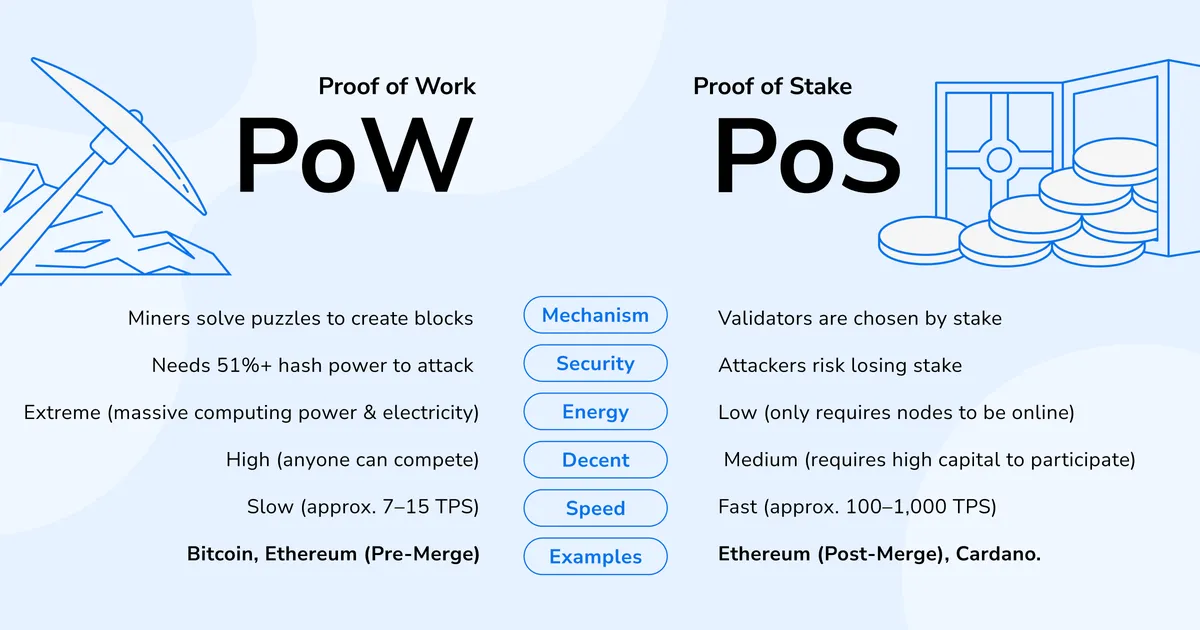
How a public chain achieves “consensus” is at the heart of its stable operation. This is not only about security, but also directly affects the energy efficiency and scalability of the public chain.
1. Proof of Work (PoW)
Early Ethereum, like Bitcoin, adopted a PoW mechanism. While PoW is extremely safe and has stood the test of time, its drawbacks are also obvious: extremely high energy consumption and difficult to improve transaction processing speed (TPS). As the application scene explodes, Ethereum has frequent problems with network congestion and skyrocketing Gas Fee.
2. Proof of Stake (PoS) and “Merger”
In September 2022, Ethereum completed a historic upgrade —“The Merge”, officially switched from PoW to PoS mechanism.
- Low Carbon Eco-Friendly: Energy consumption has been reduced by more than 99.95%, solving the dispute over environmental sustainability.
- Secured income: Users can stake 32 ETH as a verification node, participate in maintaining network security and receive an annualized return of 4% to 6%. This gives ETH properties similar to digital bonds.
- Shanghai Upgrade: The Shanghai upgrade in April 2023 opened the withdrawal function of pledged assets, further refining the PoS economic model.
3. the blockchain war: who is the Ethereum killer?
Faced with the high thresholds and lows of early Ethereum, many challengers with different technical frameworks flooded the market. These chains are collectively known as “Ethereum Killers” and are mainly divided into two major factions that are EVM-compatible and non-EVM.
1. EVM Compatible Link Chain: Continued Ecological Inertia
This kind of blockchain uses the same standards as Ethereum, making it easy for developers to migrate applications.
- BNB Chain (BNB): Backed by Binance, the current market capitalization is about $370 billion (2.3% market share). Its core advantage is that it relies on massive user traffic and extremely low Gas Fee, making it the preferred choice for many retail users.
- Avalanche (AVAX): Known for its unique Avalanche consensus mechanism, extremely high transaction confirmation speed and Subnet scalability, with a current market capitalization of approximately $150 billion.
2. Non-EVM Links: Pursuing Ultimate Performance
In order to break through the architectural limitations of EVM, some public chains choose to redesign the underlying code.
- Solana (SOL): The current market capitalization is about $320 billion (2% market share). Solana uses a Proof-of-History (PoH) mechanism to pursue ultimate throughput with TPS of thousands or even higher, targeting high-performance financial transactions and gaming scenarios.
- Cardano (ADA): Led by a team of scientists, emphasizing the rigor of academic audits and systems, with a market capitalization of approximately $210 billion.
4. the competitive landscape after 2023: the heavens of expansion with Layer 2
The current cross-chain competition has evolved from “Who is stronger in Layer 1” to “How Layer 2 Scales Ethereum”. This is also the core direction of the Ethereum Roadmap: a Rollup-centric future.
1. Ethereum's Expansion Strategy
Ethereum does not intend to process all bulk transactions directly at Layer 1 (bottom), but instead places L1 as a Settlement Layer and a Data Availability Layer (DA Layer), handing specific operations to Layer 2.
2. Industry Benchmark: Polygon (MATIC)
Polygon is one of the most successful representatives in the current cross-chain extension program.
- 2021-2022 Rise: Becoming the most popular expansion sidechain with its extremely high TVL (Total Lock Stock) skyrocketed.
- Polygon 2.0 vs ZkEVM: In 2023, Polygon will be launched ZkEVM(Zero-Knowledge Proof Ethereum Virtual Machine), designed to provide unlimited scalability and unified liquidity.
- POL Token Upgrade: Upgrade the existing MATIC to POL tokens to support a larger multi-chain grid architecture.
3. opBNB: Enter Web3 Application Scenario
Launched by BNB Chain OpBnB Built to improve performance with OP Stack technology architecture. Its TPS is up to 4,000+ and the average Gas Fee is just $0.005 USD. This high-performance, low-cost environment is the cornerstone of Web3 social and gaming popularity.
5. Briefly talk about the future path of the Ethereum Roadmap
The Ethereum upgrade program is a series of complex developmental processes, mainly consisting of the following stages:
- The Surge: Increase TPS to over 100,000 with Sharding and Rollups.
- The Scourge: Resolves MEV (Maximum Withdrawable Value) issues that arise in auditing impedance and decentralized finance, ensuring network equity.
- The Verge: Introduced Verkle tree technology to make node authentication easier, enabling ordinary devices and even mobile phones to run nodes.
- The Purge: Simplify protocols, clear historical redundant data, and reduce storage burden on validators.
VI. Conclusion: The future of multi-chain coexistence and interoperability
Looking back at the history of the blockchain, we can see technology constantly finding a balance between security, decentralization, and efficiency. The Blockchain World of the Future Will Most Likely Not Be “Winners Eat”, ButMulti-chain parallel, professional splitThe layout.
Ethereum will continue to be the most secure underlying base, with Layer 2 such as Polygon and opBNB responsible for driving high-frequency consumer-level applications; and a cross-chain like Solana taking a foothold in the high-performance space. For users and investors, how to cross the barriers of different chains and enjoy a smooth on-chain experience will be the next technological breakpoint.
ZONE Wallet It was born against such a background. As Taiwan's leading compliant banking APP, ZONE Wallet offers the most intuitive interface that integrates mainstream blockchain assets, allowing users to own their first crypto asset in one click without having to understand the complicated terms “Layer 2” or “consensus mechanism”. While pursuing innovation, we place greater emphasis on security and compliance, because every transaction is truly secure only in a regulated and technically protected environment.
What is ZONE Wallet?
ZONE Wallet is a Taiwan-based virtual asset exchange, allowing beginners to buy and sell easily with a single click. Combined with our dollar-cost averaging (DCA) feature, you can enjoy flexible, value-driven investment results!
ZONE Wallet also offers corporate account services with a fast and secure onboarding process. We help startups and enterprises leverage stablecoins to optimize cross-border payment workflows and reduce transaction costs. ZONE Wallet makes asset allocation more reliable for both personal financial management and corporate treasury strategies—helping you effortlessly navigate the future of Web3!
Start small to get comfortable with the process and risks.
Ready to dive into crypto?
[download-app]
Disclaimer
Cross-chain technology is developing rapidly, involving high technical risks and market volatility. This information is for educational purposes only and does not constitute investment advice. Before investing in cryptocurrencies, be sure to consult a professional financial advisor and choose ZONE Wallet Compliance platforms that are protected by the HKMA's statutory compliance declaration.