A Complete Guide to the Use of Stable Coins: Exploring the Key Applications of Digital Currency in Modern Finance
With the rapid development of the digital currency market, the use of stablecoins has become the focus of many businesses and individuals.
As a bridge connecting traditional finance and digital assets, stablecoin has the characteristics of price stability, ease of trading, and is widely used in many areas such as payments, investments, and cross-border transfers.
This article will take an in-depth look at the various application scenarios for stablecoins to help you understand how this innovative financial tool is transforming our economic activity.
Stable Currency Types and Basic Concepts Analysis
Before we discuss the role of stablecoins, we need to understand the basic concepts of stablecoins. A stablecoin is a digital currency whose value is usually tied to a specific asset, such as the dollar, euro, or gold.
This design aims to reduce the price volatility of traditional cryptocurrencies while preserving the convenience and efficiency of digital currencies.
ZONE Wallet Provides Enterprise-Grade Stablecoin Payment Solutions
Streamline workflows and reduce transaction costs.
Fill Out the Consultation FormMajor stablecoin classifications
- French mortgage-backed stablecoins: Using traditional currencies as reserve assets, such as USDT, USDC, USAT, is the most common and widely used type
- Cryptocurrency collateralized stablecoins: Collateral with other cryptocurrencies, such as DAI, to keep prices stable through an overcollateralization mechanism
- Algorithmic stablecoin: Controlling the supply balance through algorithmic mechanisms, such as FRAX, without the need for actual collateral
- Commodity collateralized stablecoins: WITH PHYSICAL COMMODITIES (GOLD, OIL) AS SUPPORT, SUCH AS PAXG, XAUT
Each type of stablecoin has its own unique mechanism of operation and risk characteristics. FRANCO-BACKED STABILIZERS ARE OFTEN CONSIDERED THE MOST STABLE AND RELIABLE OPTION BECAUSE OF THEIR ACTUAL ASSET SUPPORT AND ARE THE MOST WIDELY USED TYPE ON THE MARKET TODAY.
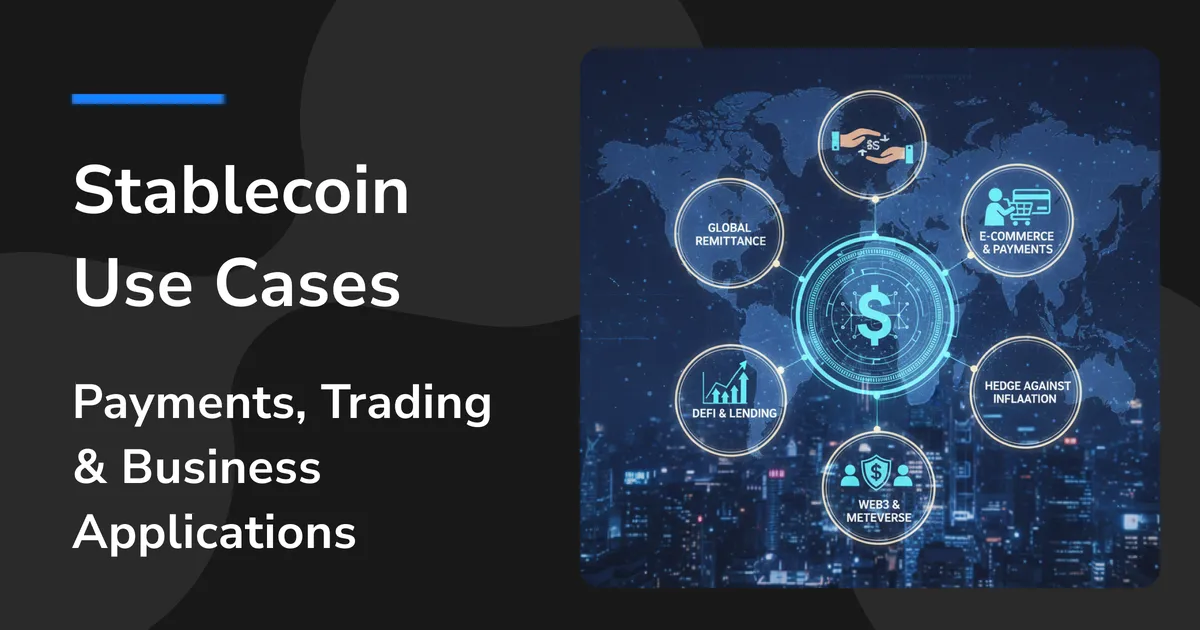
What Stable Coins Are Used For: Six Core Application Areas
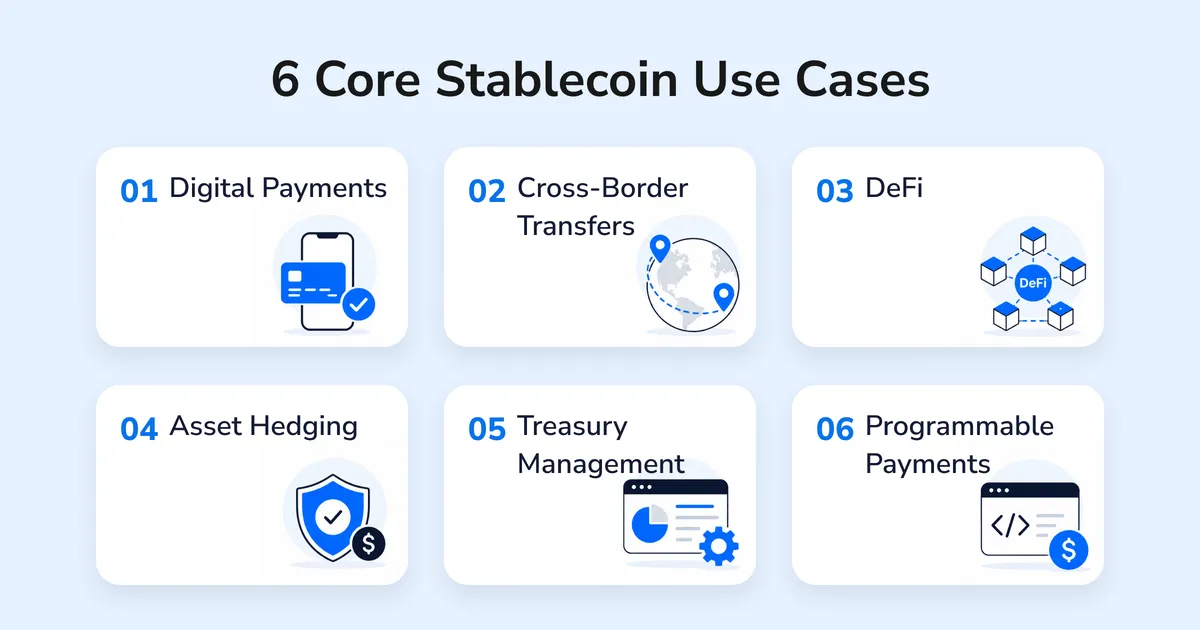
Stable coins have a wide range of applications, from personal daily payments to corporate financial management. Below we will detail the specific applications of stablecoins in various fields.
1. DIGITAL PAYMENTS AND E-COMMERCE TRANSACTIONS
The application of stablecoins in the field of payments is increasing in popularity.
Compared to traditional bank transfers, stablecoin payments have the advantages of low processing fees, fast processing, and 24 hours non-stop.
Many e-commerce platforms have begun to accept stablecoin payments, especially in cross-border e-commerce. Stable currency can effectively reduce exchange rate risk and transaction costs.
Users simply have a digital wallet to complete payments without relying on traditional financial institutions.
2. Cross-border remittances and international trade
Traditional cross-border remittances often need to go through multiple intermediaries, which are expensive and time-consuming.
Stablecoin provides a more efficient solution where businesses and individuals can make cross-border transfers directly over the blockchain network, greatly reducing settlement time (from a few days to minutes) and reducing costs (saving 50-80% of processing fees).
This is especially valuable for businesses that need to trade internationally frequently.
3. The underlying currency of the DeFi ecosystem
In the field of decentralized finance (DeFi), stablecoins play the role of the base currency.
Users can use stablecoin for various DeFi activities such as lending, liquidity mining, yield farms, etc.
The price stability of stablecoins makes the risks of these financial activities more manageable and more traditional investors willing to participate in the DeFi ecosystem.
For example, users can earn interest by depositing stablecoins into loan agreements or earning a profit on transaction fees as a liquidity provider.
4th. Hedging Tools for Portfolios
For cryptocurrency investors, stablecoins are an important hedge.
When the market is highly volatile, investors can temporarily convert assets to stablecoins to hedge their value and wait for better investment opportunities.
This strategy both avoids losses from market falls and keeps funds liquid in the digital currency ecosystem, giving investors flexibility to respond to market changes.
5. Corporate Financial Management
More and more businesses are starting to incorporate stablecoins into their financial management strategies.
Stable coins can be used to pay suppliers, issue employee salaries, manage cash flows, and more.
ESPECIALLY FOR MULTINATIONAL ENTERPRISES, STABLE CURRENCIES CAN SIMPLIFY MULTI-CURRENCY FINANCIAL OPERATIONS AND IMPROVE THE EFFICIENCY OF USING FUNDS.
In addition, the programmability of stablecoins creates new possibilities for automated financial management.
6. Programmatic Payments and Smart Contracts
The combination of stablecoins and smart contracts creates the possibility of programmatic payments.
Businesses can set up automated payment conditions, and when certain conditions are met, the system automatically completes payments using stablecoins.
This application has great potential in scenarios such as insurance claims, supply chain management, copyright margin, subscription services, and more to significantly reduce operating costs and improve efficiency.
What Are Stable Coins: Market Mainstream Selection Analysis
There are dozens of different stablecoins on the market today, but a few of them occupy the vast majority of the market share.
Understanding the characteristics of these mainstream stablecoins helps users make smarter choices.
| Stablecoin Name | Issuer | Collateral Type | Key Features |
|---|---|---|---|
| USDT | Tether | Fiat-Collateralized | Highest liquidity, most widely used |
| USAT | Tether (Issued by Anchorage Digital) | Fiat-Collateralized | US federally regulated, compliant with GENIUS Act |
| USDC | Circle | Fiat-Collateralized | High transparency, favored by institutions |
| DAI | MakerDAO | Crypto-Collateralized | Decentralized, strong censorship resistance |
| BUSD | Binance | Fiat-Collateralized | Regulated, integrated with Binance ecosystem |
| PAXG | Paxos | Gold-Collateralized | Backed by physical gold |
As the earliest and most widely used stablecoin, USDT has good liquidity on both exchanges and DeFi platforms.
USDC is well liked by institutional investors for its transparent audit system and compliance.
As a representative of decentralized stablecoin, DAI offers higher anti-censorship and decentralized characteristics for users who value privacy and self-control.
Real Case Studies of Stable Coins in Different Industries
The practical application of stablecoins has been spread across multiple industries, enabling a better understanding of its practical value and development potential through specific scenarios.
Financial Services Industry
Many financial institutions are starting to integrate stablecoins into their services.
For example, JPMorgan leverages stablecoin technology to provide faster cross-border transfer services to enterprise customers, dramatically reducing settlement time and saving up to 50% of costs from traditional SWIFT systems.
Investment management companies also use stablecoins for asset allocation and risk management, increasing the flexibility of their portfolios.
E-Commerce & Retail
By accepting stablecoin payments, the ecommerce platform is able to attract a larger group of customers with digital assets.
At the same time, the instant and low transaction features of stablecoin payments also enhance the user's shopping experience.
Major ecommerce platforms like Shopify, Overstock have started accepting stablecoin payments, and more retailers are expected to follow in the coming years.
Supply Chain Management
In supply chain finance, stablecoins simplify complex multi-party payment processes.
Through smart contracts, when goods arrive and pass acceptance, the system can automatically release stablecoin payments to suppliers, greatly improving the efficiency and transparency of the supply chain.
Large companies such as IBM, Walmart have experimented with stablecoin applications in supply chain management.
Risk Considerations and Considerations for Using Stable Coins
While stablecoins have many advantages, users still need to be aware of the risks involved when using them. Understanding these risks helps to make more prudent decisions.
- Regulatory Risks: Regulatory policies for stablecoins by country may change at any time, affecting transaction legality and availability
- Technical Risks: Smart contracts may be compromised or hacked, resulting in asset loss
- Liquidity risk: Some stablecoins may face a lack of liquidity in extreme market conditions, making it difficult to trade smoothly
- Collateral risk: The value of a collateralized stablecoin depends on the security of the underlying asset, and a problem with the collateral could lead to a disconnect
- Operational risk: The operating situation of the issuer may affect the stability of the stablecoin, including financial problems or poor management
Users are advised to learn more about their operating mechanisms, audit reports, and regulatory status before using stablecoins.
At the same time, risk should be spread out, not concentrating all assets on a single stablecoin, and keeping a regular eye on relevant market dynamics and regulatory changes.
Future trends and prospects for stablecoins
The stablecoin market is in a phase of rapid development and will welcome more innovation and expansion of application scenarios in the coming years.
The development of central bank digital currencies (CBDCs) will form a competitive and cooperative relationship with private stablecoins, driving the evolution of the entire digital payment ecosystem.
As the regulatory framework is gradually perfected, stablecoin compliance and transparency will continue to improve, which will enhance the confidence of institutional investors and corporate users.
At the same time, technological innovation will drive stablecoin applications in more scenarios, including emerging areas such as IoT payments, micropayments, programmatic commerce and more.
The development of cross-chain interoperability will also enable stablecoins on different blockchain networks to work better together to improve overall efficiency and user experience.
It is expected that stablecoins will become an important part of the digital economy infrastructure, providing important support for the digital transformation of the global financial system.
Conclusion: How to get started with stablecoins
For users who are just coming into contact with stablecoins, the following suggestions can help you get started safely and effectively:
- Choose the right platform: Prioritize regulated, reputable exchanges or wallets
- Start with a small amount: Familiarize yourself with the operating process and market reaction of stablecoins in advance
- Understanding Usage Scenarios: Choose the right stablecoin type according to your needs
- Be good at risk management: Distributed allocation without concentrating all funds in a single stablecoin
- Continuous learning: Follow market dynamics and regulatory changes, constantly update knowledge
The diverse applications of stablecoins offer unprecedented financial innovation opportunities for individuals and businesses.
If you are considering incorporating stablecoins into your financial strategy, we recommend starting with a small trial and understanding their operating patterns and risk characteristics step by step.
Stay tuned to our analysis articles for the latest stablecoin market dynamics and application guides.
Read More: Stable Currency Related Articles
What is ZONE Wallet?
ZONE Wallet is a Taiwan-based virtual asset exchange, allowing beginners to buy and sell easily with a single click. Combined with our dollar-cost averaging (DCA) feature, you can enjoy flexible, value-driven investment results!
ZONE Wallet also offers corporate account services with a fast and secure onboarding process. We help startups and enterprises leverage stablecoins to optimize cross-border payment workflows and reduce transaction costs. ZONE Wallet makes asset allocation more reliable for both personal financial management and corporate treasury strategies—helping you effortlessly navigate the future of Web3!
Corporate Stablecoin Payment & Settlement Consulting
If your business is evaluating stablecoins for collections, payouts, cross-border settlements, or corporate account fiat onboarding/offboarding, feel free to fill out our consultation form. The ZONE Wallet team will assess the best integration approach tailored to your transaction scenarios, payment destinations, token types, and compliance requirements.
Tailored for Taiwan exporters and cross-border e-commerce to settle global trades anytime.
Enterprise Stablecoin Solutions
[blog-corporate-consultation]