Full Analysis of the USD Stabilization Bill: New Regulations on Cryptocurrency Regulation for Beginners to Understand

With the rapid development of the cryptocurrency market, the US dollar stablecoin bill has become the focus of global investor attention.
This bill not only affects the future development of stablecoins, but also potentially changes the regulatory landscape of digital assets as a whole.
This article will detail this important regulation for novice investors to help you understand its far-reaching impact on the market.
What is USD stablecoin? Basic Concepts Analysis
The USD stablecoin is a digital currency anchored to the value of the US dollar and aims to maintain a relatively stable price.
Unlike cryptocurrencies that fluctuate wildly in price like Bitcoin, stablecoins through various mechanisms ensure that their value is close to the dollar-equivalent ratio.
The main USD stablecoins on the market today include USDT, USDC, BUSD, etc., which play an important intermediary role in cryptocurrency trading.
Ready to start investing in crypto?
Join ZONE Wallet and get started easily with just NT$3 a day!
Download ZONE Wallet NOW!The principle of operation of stablecoins is mainly divided into three types: fiat mortgage-type, crypto-asset mortgage-type, and algorithm-type.
France-backed stablecoins are the most common type, and issuers hold equivalent dollar reserves to support the value of stablecoins.
This mechanism allows users to exchange stablecoins back to USD at any time, ensuring price stability.
The First US Stable Currency Bill: Background to the Birth of the Genius Bill
The first US dollar stablecoin bill, formally known as the Stablecoin Transparency of Reserves and Uniform Safe Transactions Act.
Abbreviated as the TRUST Act or the GENIUS Act.
The bill was proposed due to regulators' concern about the rapid growth of the stablecoin market and the need to protect investors.
The impetus for the Genius Bill comes mainly from several important events:
The TerraUSD (UST) crash in 2022 exposed the risks of algorithmic stablecoins and the controversy over the lack of transparency in the reserves of many stablecoin issuers.
These events prompted the U.S. Congress to recognize the need for a clear regulatory framework to protect investors and maintain the stability of the financial system.
Timeline and key figures of the bill
The Genius Bill was originally proposed by the House Financial Services Committee in 2023 with cross-party support.
Key promoters include committee chairmen and several members from different political backgrounds, suggesting that stablecoin regulation has become a bipartisan issue.
The bill has undergone several rounds of amendments and a public hearing to refine its content gradually.
Core Content and Key Provisions of the Stable Currency Act
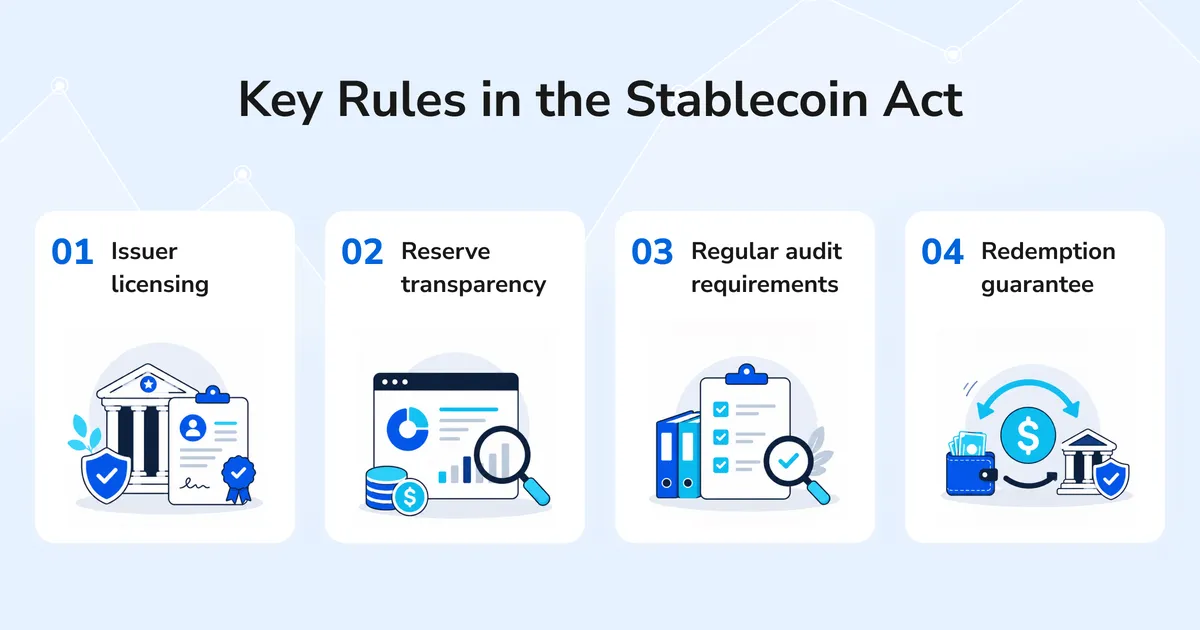
The Stable Currency Act contains several important provisions aimed at establishing a comprehensive regulatory framework.
First, the bill requires that all U.S. stablecoin issuers must obtain a federal or state government operating license and undergo regular regulatory inspections.
This rule ensures that only qualified institutions can issue stablecoins, enhancing the overall security of the market.
- Issuer licensing system: Require stablecoin issuers to obtain federal or state government-issued operating licenses
- Reserve Capital Transparency: Issuers must disclose the detailed composition and custody arrangements of their reserve assets
- Periodic Audit Requirements: Third party accounting firms are required to conduct regular audits of reserves and publish results
- Redemption Guarantee Mechanism: Ensure that holders can redeem stablecoins at face value at any time
- Risk Management Standards: Establish a thorough risk control and internal governance mechanism
Detailed provisions for reserve management
The Act sets strict standards for reserve management.
Issuers must hold reserve assets in a qualified trust and reserve assets can only be invested in high-liquidity, low-risk assets such as US Treasury bonds, bank deposits, etc.
In addition, reserves must not be used for lending or other investment activities to ensure the safety of assets.
Analysis of the Potential Impact of the Genius Bill on the Market
The implementation of the Genius Bill will have a profound impact on the stablecoin market.
In the short term, some small stablecoins that do not meet regulatory requirements may exit the market, leading to further market concentration.
However, in the long run, a clear regulatory framework will boost investor confidence and promote mainstream adoption of stablecoins.
For existing major stablecoin issuers, implementation of the bill may increase operating costs, including compliance costs, audit costs and reserve management fees.
However, a regulatory-approved stablecoin will have higher market confidence and may gain an advantage over the competition.
In addition, the bill provides a clear legal framework for traditional financial institutions to enter the stablecoin market.
Differentiation effects on different types of stablecoins
| Stablecoin Type | Compliance Difficulty | Expected Impact | Market Outlook |
|---|---|---|---|
| Fiat-Collateralized | Medium | Requires reserve management adjustments | Relatively Favorable |
| Crypto-Collateralized | Higher | Requires mechanism redesign | Facing Challenges |
| Algorithmic | Extremely High | May be prohibited | Uncertain Outlook |
Global Stable Currency Regulatory Trends and Comparisons
The Stable Currency Act in the United States is not an isolated phenomenon, and major economies such as the EU, UK, Singapore are also developing relevant regulatory frameworks.
The EU's “Crypto Asset Market Regulation” (MiCA) has been implemented in 2024 and has developed detailed rules for stablecoin issuance and operations.
While these regulations vary in detail, the core goals are to improve transparency and protect investors.
Differences in regulatory approaches are mainly reflected in regulatory bodies, licensing systems and reserve requirements.
The US tends to incorporate stablecoins into the existing banking regulatory framework, while the EU has created a dedicated digital asset regulatory regime.
This discrepancy can lead to complex compliance challenges for cross-border stablecoin businesses.
How Investors Should Respond to the New Stable Currency Regulations
For general investors, the implementation of the Stable Currency Act is a positive development overall.
Regulation will improve market transparency and reduce investment risk.
However, investors still need to pay attention to choosing stablecoin products that meet regulatory requirements and pay attention to the issuer's financial condition and reserve asset quality.
- Select Regulated Regulated Currency Products
- Regular attention to reserve audit reports published by issuers
- Diversify investments in stablecoins from different issuers to reduce risk
- Avoid stablecoins with uncertain investment regulatory status
- Focus on the potential impact of regulatory changes on stablecoin holdings
Strategic Adjustments for Institutional Investors
Institutional investors need to evaluate stablecoin investment strategies more cautiously.
Regulatory implementation may change the risk-return characteristics of different stablecoins, and institutions will need to re-evaluate their portfolio allocations.
At the same time, institutions should also establish a thorough due diligence process to ensure that the stablecoins invested comply with regulatory requirements.
Future Developments and Challenges of the Stable Currency Bill
While the Genius Bill provides an important framework for stablecoin regulation, implementation challenges remain.
Rapid changes in technology development can cause existing regulations to lag behind market innovation, requiring constant updates and adjustments.
In addition, cross-border regulatory coordination is also a major challenge, and differences in national regulations may affect the development of the global stablecoin market.
In the future, stablecoin regulation may evolve in a more nuanced and internationalized direction.
Regulators may develop differentiated specifications for stablecoins for different purposes, while strengthening international cooperation to establish uniform regulatory standards.
The development of central bank digital currencies (CBDCs) may also affect the regulatory policies of private stablecoins.
Conclusion: The coming of a new era of stablecoin regulation
The US dollar stablecoin bill marks the entry of cryptocurrency regulation into a new phase. While it may bring market adjustments in the short term, it will promote the healthy development of the stablecoin market in the long term.
Investors should actively understand the relevant regulations, choose compliant investment products, and keep an eye on regulatory developments.
As the regulatory framework is gradually perfected, stablecoins are expected to become an important part of the digital economy infrastructure.
Core advice for novice investors:
- Prioritize Compliant Stable Coins: Select regulated stablecoin products
- Focus on Transparency Information: Regularly review Issuer's published Reserve Audit Reports
- Diversified Investment Risk: Do not concentrate all your funds in a single stablecoin
- Continuous Learning Updates: Stabilized Currency Regulation Continues to Evolve, Stay Focused on the Latest Moments
- Rational risk assessment: Understand the technical and operational risks of stablecoin, and manage risk
*This article is for educational reference only and does not constitute investment or business advice.
Virtual currency trading is risky and businesses and users should assess their own risk tolerance and consult professional legal and accounting advisors.
ZONE Wallet has completed the HKMA Compliance Statement, but digital asset investment remains risky. Please read the relevant regulations carefully and understand the product mechanisms before using it.
What is ZONE Wallet?
ZONE Wallet is a Taiwan-based virtual asset exchange, allowing beginners to buy and sell easily with a single click. Combined with our dollar-cost averaging (DCA) feature, you can enjoy flexible, value-driven investment results!
ZONE Wallet also offers corporate account services with a fast and secure onboarding process. We help startups and enterprises leverage stablecoins to optimize cross-border payment workflows and reduce transaction costs. ZONE Wallet makes asset allocation more reliable for both personal financial management and corporate treasury strategies—helping you effortlessly navigate the future of Web3!
Start small to get comfortable with the process and risks.
Ready to dive into crypto?
[download-app]