What Are U.S. Dollar Stablecoins? USDT, USDC, and DAI/USDS Compared
U.S. dollar stablecoins are crypto assets designed to stay near one dollar. They are not bank deposits, and the price is not guaranteed. USDT and USDC rely mainly on issuer-managed reserves and eligible redemption, while DAI/USDS rely on the Sky Protocol’s collateral, governance, and smart contracts.
The key differences are who issues or governs the token, what supports it, who can redeem directly, where liquidity exists, and how a depeg could happen. For broader context, read what stablecoins are and the four stablecoin categories.
What is a U.S. dollar stablecoin?
It is an on-chain digital asset intended to represent a unit close to one U.S. dollar. It is commonly used for trading, transfers, payments, and DeFi, but it is neither cash nor a bank deposit and usually has no deposit insurance.
How do dollar stablecoins aim to stay near $1?
- Issuer reserves and redemption: USDT and USDC rely on reserve assets, issuance, and redemption arrangements, with eligibility and minimum requirements.
- Crypto collateral, liquidation, and governance: DAI/USDS use protocol collateral and governance.
Arbitrage and redemption can help restore a peg, but they may fail during a liquidity, banking, custody, protocol, or confidence crisis.
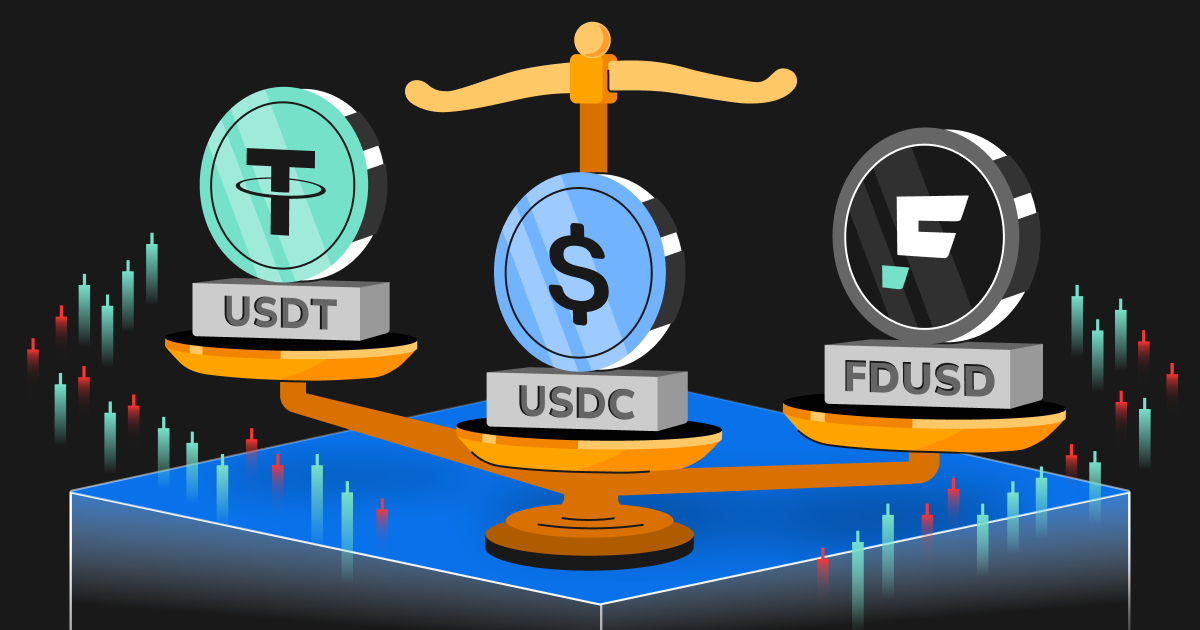
USDT, USDC, and DAI/USDS comparison
| Item | USDT | USDC | DAI/USDS |
|---|---|---|---|
| Issuer or governance | Tether | Circle | Sky Protocol governance and smart contracts |
| Support | Issuer-managed reserves | Issuer-managed reserves | Crypto collateral, protocol mechanisms, governance |
| Direct redemption | Subject to Tether eligibility and terms | Circle Mint mainly serves eligible institutions | Protocol and interface dependent |
| Disclosure | Reserve reports and third-party assurance | Reserve disclosure and third-party assurance | On-chain collateral, governance, protocol data |
| Key risks | Issuer, reserves, freezing, regulation | Issuer, bank/custodian, freezing | Collateral, liquidation, governance, smart contracts |
USDT: liquidity and multi-network support
USDT is issued by Tether and widely used across exchanges and blockchains. Review current reserve reports, third-party assurance, redemption requirements, network support, and market liquidity. See our complete USDT guide.
USDC: reserve disclosure and issuance structure
USDC is issued by Circle. Circle publishes reserve and third-party assurance information, but not every individual can redeem through Circle Mint; retail users usually trade through exchanges, wallets, or other service providers.
DAI/USDS: protocol governance and collateral risk
Maker rebranded to Sky, and Sky describes USDS as an upgraded version of DAI. The system involves collateral, governance, smart contracts, and supported interfaces rather than a simple claim of being fully ETH-backed or entirely free of centralized risks.
What about other dollar stablecoins?
PYUSD, USA₮, and other tokens differ by issuer, regulation, networks, redemption, and liquidity. USA₮ is issued by Anchorage Digital Bank in collaboration with Tether and should not be treated as proof that USDT itself automatically meets U.S. federal requirements.
How should Taiwan users compare dollar stablecoins?
- Define the purpose: trading, transfers, payments, or DeFi.
- Check platforms, pairs, and supported networks.
- Estimate transfer cost, slippage, and on/off-ramp costs.
- Understand direct redemption and service-provider routes.
- Review reserves or collateral and the type of reporting.
- Consider custody, freezing, regulation, and tax.
See how to read stablecoin reserve evidence.
Ready to start investing in crypto?
Confirm the token, network, price, and fees, then start small. ZONE Wallet provides a TWD entry point for exploring crypto assets.
Download ZONE WalletWhat risks do dollar stablecoins carry?
- Depegging and insufficient liquidity
- Runs, redemption limits, and asset-sale risk
- Reserve, banking, custody, and issuer risk
- Protocol, collateral, governance, and smart-contract risk
- Freezing, regulation, network, and platform risk
Read more about stablecoin depegging.
U.S. and Taiwan regulatory context
The U.S. GENIUS Act became law on July 18, 2025, but implementation follows its statutory timetable and agency rulemaking. Taiwan promulgated the Virtual Asset Service Act on July 22, 2026, and some or all provisions have not yet taken effect. Neither framework means a government guarantees any stablecoin’s value or reserves.
See Taiwan stablecoin regulation.
Dollar stablecoin FAQ
Is holding a dollar stablecoin the same as holding dollars?
No. It is an on-chain asset with different legal status, redemption access, and risks from a bank deposit.
What is the biggest difference between USDT and USDC?
They differ by issuer, disclosure, direct-redemption conditions, networks, and liquidity. A single “most compliant” label is not enough.
Are DAI and USDS the same token?
No, but both belong to the Sky ecosystem, and Sky describes USDS as an upgraded version of DAI.
Do dollar stablecoins have deposit insurance?
Generally no. Holding a stablecoin is not the same as holding a bank deposit.
Conclusion: compare risk structures, not just names
USDT, USDC, and DAI/USDS all aim to stay near the dollar, but their issuance, reserves, collateral, governance, redemption, and liquidity differ.
What is ZONE Wallet?
ZONE Wallet is a Taiwan-based virtual asset exchange that helps beginners buy and sell with ease. Its dollar-cost averaging feature offers a more flexible way to build familiarity with digital assets.
ZONE Wallet also supports corporate clients, helping startups and businesses use stablecoins for cross-border payments and treasury workflows.
Start small to get comfortable with the process and risks.
Ready to dive into crypto?
[download-app]
Risk notice: Dollar stablecoins can move away from $1 and cause losses because of reserve, redemption, liquidity, issuer, protocol, regulatory, or technical events. This material is for education only and is not investment advice or a promise of returns. Assess your finances carefully and use only funds you can afford to lose.