Blockchain Payments vs Traditional Banking: A Complete Comparison of Speed, Cost, Security
Preamble: The choice of two major money flow systems
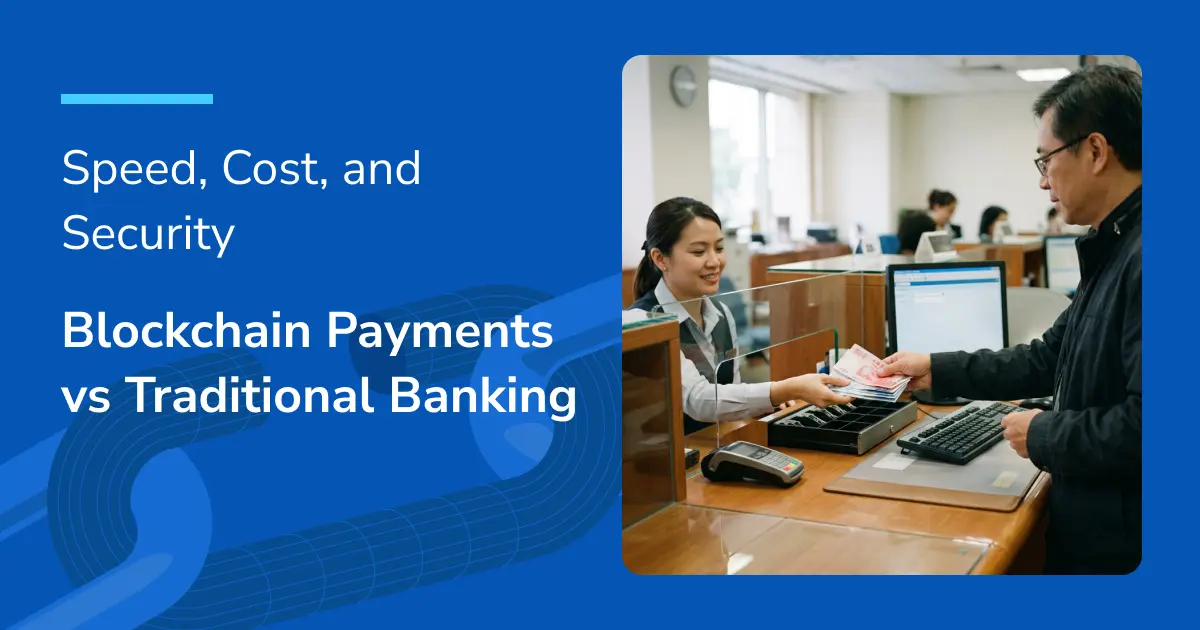
With the development of the digital economy and globalization,Cross-border paymentsIt has become an integral part of the daily life of businesses and individuals. In addition to the traditional banking system,Blockchain PaymentsRising fast. Many people question:
- Is Blockchain Really Faster Than Banking?
- How much is the cost of the procedure?
- Who is more secure?
- When should I use the bank? When to use blockchain?
This article will be fromSpeed, Cost, Security, Usage ScenarioEquivalent in-depth analysis to help you choose the most suitable payment method.
1. Traditional bank payment: stable but tedious
Operation Mechanism
Banks act as intermediaries to transfer funds. Cross-border transfers must go through: Export Bank → Intermediary Bank (1~3) → Receipt Bank.
superiority
- ✅ Centralized management: Clear attribution of responsibility
- ✅ Regulatory completeness: Financial Regulated, AML Regulation, Deposit Insurance
- ✅ Suitable for large transactions: Corporate Trade, Real Estate, Payroll
disadvantaged
- ❌ Slow speed: Cross-border remittance 1~5 days, limited to holidays
- ❌ High cost: 3~ 7% handling fee+brokerage+brokerage fee
- ❌ LOW ELASTICITY: Operated during business hours only, small amount is not discounted
Second, blockchain payment: fast and low cost
Operation Mechanism
No intermediaries are required through decentralized peer-to-peer (P2P) transfers. PROCESS: WALLET A → BLOCKCHAIN NETWORK AUTHENTICATION → WALLET B.
Common Forms
- Cryptocurrencies: Bitcoin (BTC), Ethereum (ETH)
- Stabilized currency: USDT, USDC (Anchor USD, avoid volatility)
- DeFi Payments: Automated execution of smart contracts
superiority
- ✅ Fast speed: Completed in seconds to a few minutes, 24/7 all year round
- ✅ Extremely low cost: Less than 0.1% in most cases
- ✅ Global General: Just network, no forex controls
- ✅ Transparent and not tampered with
disadvantaged
- ❌ Technology Thresholds: Need to understand private key, wallet, operation error cannot be recovered
- ❌ Price Fluctuations(Cryptocurrencies): Reliance on Stable Coins Solved
- ❌ Unregulated: Tax and Legal Status Still Developing
- ❌ Irreversible: Wrong address cannot be undone
3. Comparison table of seven core differences
Speed Example
- Bank: Taiwan Transfer to USA on Friday → Fastest Tuesday Checkout
- Blockchain (USDT/TRC20): 3 minutes complete
Cost Example (NT$100 million)
- Bank: Processing fee 800 yuan+brokerage fee 2,000 yuan+margin 15,000 yuan = 17,800 yuan
- Blockchain (TRC20):About 1 USDT ($30) → Save 99.8%
Fourth, stablecoins: the bridge between blockchain and real finance
Why do you need stablecoins?
Bitcoin, Ethereum prices fluctuate widely and are not suitable for everyday payments.Stabilized currency(e.g. USDT, USDC) 1:1 anchors the USD for efficiency and stability.
BUSINESS APPLICATION SCENARIOS
- Cross-border eCommerce Receipts
- Freelancers take up overseas cases
- Corporate Trade Quick Settlement (T+0)
- Multinational Company Payroll Distribution
✅ Stablecoin has become the core tool for enterprise-class blockchain payments.
5. Which one should I choose? Scenario Guide
Suitable for traditional banking
- Requires regulatory protection (large amounts, real estate)
- Corporate Financial Audit Requirements
- The other party accepts bank transfers only
- Not familiar with blockchain technology
SUITABLE FOR BLOCKCHAIN PAYMENTS
- Cross-border e-commerce, freelancer payments
- Need urgent, fast checkout
- Looking to significantly reduce handling fees
- 24/7Operational requirements
6. FAQ Q&A
Q1: Is blockchain payment secure?
- TECHNICALLY SAFE: Encryption is unbreakable, cannot be tampered with
- The risk lies with the user: Lost private key, wrong address cannot be revoked
- suggests: Small amount test, backup private key, use legitimate wallet
Q2: Is it legal? Want to file a tax?
- Legal in most countries (including Taiwan)
- Transaction profit is subject to tax return and keep records
- Exchanges are required to complete VASP registration
Q3: Is stablecoin really stable?
- Most of the time is stable, but sometimes there is a risk of disengagement (such as the USDC event in 2023)
- suggests: Choose USDC, USAT with high transparency, distributed holding
Q4: How to start using?
- Choose a legitimate exchange (such as ZONE Wallet in Taiwan, just as an example)
- Complete KYC and purchase a small amount of USDT (about $1,000)
- Test Transfer to a Friend
- Step-by-step application for cross-border payment collection
7. Future trend: Will blockchain replace banking?
It does not replace in the short term, but coexists with fusion.
- Banks Implement Blockchain Technology (Internal Liquidation)
- Stable Currency and Central Bank Digital Currency (CBDC) Coexist
- Web3+ DeFi integration with traditional finance
- 2026~2030: Enterprise dual tracks and blockchain is more accepted by the younger generation
Conclusion:Not to replace, but to create a more flexible global money flow system.
Summary: Choosing the right payment method is key
✅ Best Strategy:Mix flexibly by scene, improve the efficiency of funds.
Disclaimer: This article is for educational reference only and does not constitute investment or financial advice. Blockchain payments involve technical and market risks, so please be fully informed before using them. The cost/speed data in the text is just an example, and the actual situation may vary by platform and network.