How to Assess ETF Liquidity: Volume, Bid-Ask Spreads, and Fund Size
How to Assess ETF Liquidity: Volume, Bid-Ask Spreads, and Fund Size
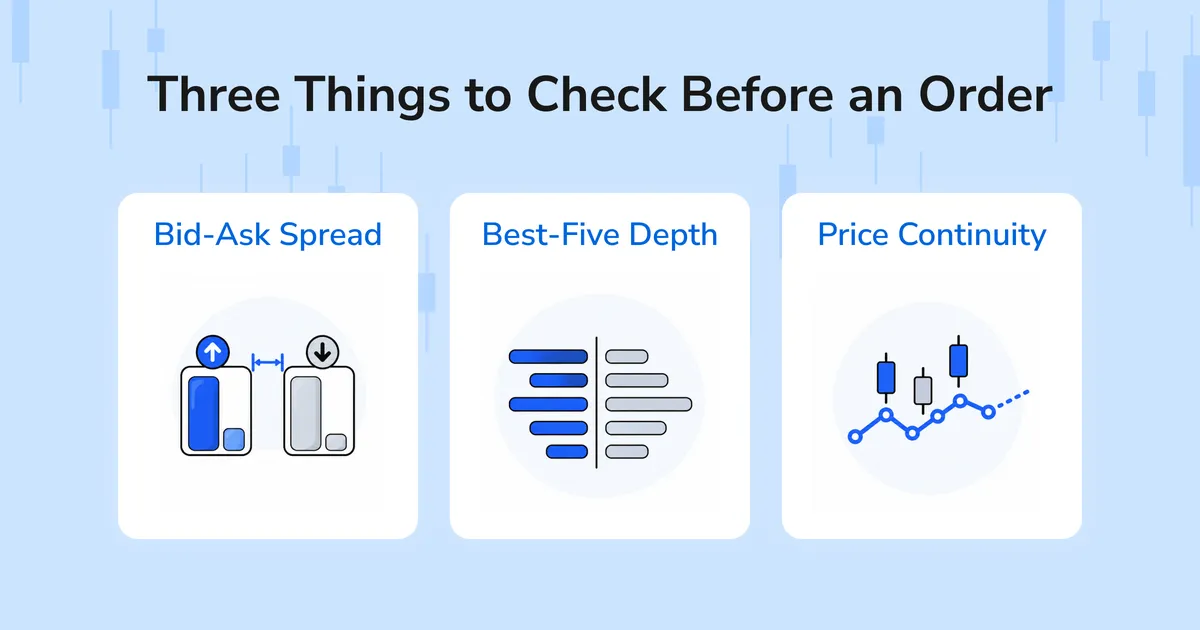
ETF trading volume can be useful context, but it cannot by itself answer whether you can buy or sell now at a price close to what you expect. A more practical pre-trade check combines the bid-ask spread, quoted depth in the best five price levels, price continuity, and the fund’s premium or discount in current market conditions. Fund size is a separate clue about operating conditions and possible closure risk—not a guarantee of intraday execution quality.
Taiwan Stock Exchange investor education material explains that investors can use the best five price-and-volume quotes to assess the bid-ask spread, quoted size, and price continuity. When quotes are dense and reasonable, trading volume does not have to be the first measure of liquidity. That is why lower daily volume alone does not prove that an ETF cannot be bought or sold, or that it is unsuitable for every investor. Read the TWSE ETF liquidity and market-making guide.
Looking to diversify your portfolio?
You can start small to explore crypto assets—get started easily with just NT$10 a day!
Download ZONE Wallet NOW!This article does not set a universal “safe” volume or spread threshold. ETF holdings, prices, trading hours, order size, and market conditions vary. Instead of applying one cutoff, use the same method to assess the live quotes before you place an order.
What is the difference between ETF volume, liquidity, and fund size?
These figures often appear together on a market screen, but they answer different questions.
- Measure:Trading volume;What it mainly tells you:How many units have already traded during a period; a clue about market activity.;What it cannot tell you on its own:Whether your next order can execute at a price you consider reasonable.
- Measure:Liquidity;What it mainly tells you:Whether a specific amount can be bought or sold under current conditions near an expected price.;What it cannot tell you on its own:Whether the ETF’s strategy fits your objective or risk tolerance.
- Measure:Fund size;What it mainly tells you:The fund’s assets under management and one input for evaluating its operating conditions.;What it cannot tell you on its own:That intraday spreads will always be narrow or that the fund cannot be merged or closed.
Volume shows completed trades—not all available trading capacity
Volume is the number of units that have traded over a period. It can help you understand whether a product normally attracts trading interest, but it is backward-looking. It does not fully show the prices and quantities buyers and sellers are willing to quote right now.
ETFs also differ from a single stock that relies only on secondary-market trading. ETFs use creation and redemption processes and liquidity providers that can help connect supply and demand for ETF shares and the underlying basket. This does not mean every size can trade smoothly at every moment. It means you should assess live quotes and the tradability of the underlying assets in addition to the cumulative volume on screen.
Liquidity is about the execution conditions for the order you are placing now
For an individual investor, liquidity is closest to this question: if I trade this quantity now, are the quotes reasonable, is there enough quoted depth, and do prices progress smoothly across levels? Liquidity is therefore contextual, not a permanent label. News, trading hours, whether the underlying market is open, and order size can all change the conditions for the same ETF.
Fund size describes fund conditions, not a promise of intraday execution
Fund size generally refers to the fund’s net assets. It can help you review a product’s operating background, together with the prospectus, issuer notices, and trust agreement provisions on mergers, liquidation, termination, or strategy changes.
A larger fund does not automatically ensure a narrow bid-ask spread for every order. A smaller fund does not automatically make an ETF impossible to trade. If a fund is eventually terminated or merged, an investor may need to handle the position at a time they did not choose. Fund size is therefore a long-term review item, not a replacement for a live liquidity check.
Three ETF liquidity checks to make before placing an order
1. Bid-ask spread: a potential cost of entering and exiting
The bid-ask spread is the difference between the highest quoted buy price and the lowest quoted sell price. If you buy immediately at market, your order will generally interact with the ask; if you sell immediately, it will generally interact with the bid. The farther apart those two prices are, the more noticeable the price difference may be if you entered and exited at the same time.
Interpret a spread in the context of the ETF’s price and current market conditions. Do not rely only on an absolute dollar amount or apply one fixed percentage threshold. The Taiwan Stock Exchange explains that a narrower spread means a smaller difference between buying and selling at the time, while actual quotes can still vary with the market and the product. TWSE ETF guide
2. Best-five quoted depth: how much size the market is showing now
The best five levels show the closest buy and sell quotes and the order size at each level. They help you ask whether your intended order is larger than the quantity at the first level, and whether it may need to trade through several price levels. They also show whether meaningful quoted size appears on both sides of the market.
The goal is not to look for a fixed number of shares or lots. Compare your intended order size with the depth currently displayed. If an order may consume multiple levels, its average execution price can differ from the first quote on screen. This is especially important for larger orders or when quotes look sparse.
3. Price continuity: whether quotes jump between levels
Price continuity refers to whether adjacent quoted levels progress smoothly. If buy or sell quotes are far apart, or the book has obvious gaps, a larger order may execute across multiple prices even when the ETF has recorded trading volume. TWSE places price continuity alongside spreads and quoted depth because these measures are closer to the conditions an actual order can face.
During sharp volatility, when the underlying market is closed, or near the market close, quotes may differ from normal conditions. Do not assume that recent volume guarantees the same execution quality today; check the live order book and quotes again.
The liquidity of an ETF’s underlying assets matters too
An ETF trades on an exchange, but the stocks, bonds, futures, or other assets it holds can affect its quotes. When the underlying market is trading and information is more complete, liquidity providers may be better able to estimate the fund’s value and quote continuously. When the underlying market is closed, volatile, or itself hard to trade, both spreads and premiums or discounts can widen.
That is why ETFs with different underlying exposures should not be compared by one historical-volume number. International-market, bond, sector, commodity, or other ETFs can have different quote conditions because their underlying markets have different hours and liquidity. FINRA likewise notes that ETF/ETP trading volume, market conditions, and bid-ask spreads can affect execution prices, and some products can have wider spreads or significant premiums and discounts. FINRA: Exchange-Traded Funds and Products
Liquidity and premiums or discounts are related, but not the same thing
Liquidity asks, “How might this order execute relative to the prices I see?” A premium or discount asks whether the ETF’s market price differs from its net asset value or intraday estimated value. They can influence each other, but neither is a substitute for the other.
Use two separate checks before trading: first, review the spread, quoted depth, and price continuity; then compare the market price with NAV or an estimated intraday value to understand the premium or discount. For that second question, read What Is an ETF Premium or Discount?.
ETF liquidity checklist before an order
This is not investment advice or a formula that guarantees execution. It is a way to turn “Does the volume look high enough?” into a more concrete pre-trade review.
- Confirm the product first. Review the tracked exposure, risks, fees, and fund notices. If you are still comparing ETF types, read How to Choose an ETF.
- Review live bid and ask quotes. Look at the highest bid, lowest ask, and the gap between them—not only the latest traded price.
- Compare the best-five depth with your order size. Understand whether your quantity could trade through multiple price levels instead of filling at the first quote.
- Check price continuity. If adjacent levels jump widely or quoted size disappears, recognize that execution prices can move quickly.
- Check premiums or discounts separately. Compare market price with NAV or estimated intraday value; do not treat lower volume as proof of a premium or discount.
- Understand order type and non-execution risk. A market order prioritizes immediate execution. A limit order defines a price boundary but may not execute, or may only partially execute. Understand your broker’s order settings and outcomes before using either.
- Return to current disclosures. Fund size, holdings, issuer notices, and market conditions can change. Review the latest information from the issuer and exchange.
ETF liquidity FAQ
Does low ETF volume mean I should never buy it?
No. Volume is one clue, but trading conditions also depend on the bid-ask spread, best-five depth, price continuity, liquidity providers, and the tradability of the underlying assets. Instead of relying only on daily or monthly volume, check the live quotes and premium or discount before placing an order.
Is a narrower ETF bid-ask spread always better?
A narrower spread generally means a smaller difference between buying and selling at that moment, but it still needs to be interpreted in the context of the product and market conditions. ETFs with different assets, prices, and trading hours can quote differently. The practical question is whether you understand the current price and execution risk for your order, not whether a spread passes one fixed cutoff.
Does a larger ETF fund size always mean better liquidity?
No. Fund size can help you assess operating conditions and possible closure risk, while intraday liquidity should be assessed from live spreads, quoted depth, price continuity, and the underlying assets. The two may be related, but they are not the same concept.
Why can an ETF with trading volume still execute at an unexpected price?
Cumulative volume shows past trades, not the depth available for your order now. When best-five depth is thin, spreads are wider, or quotes are not continuous, a larger order may trade through several levels. Conditions can also change when the market is volatile or the underlying market is closed.
Should I check liquidity or premium/discount first?
Check both because they answer different questions. Start with live quotes and quoted depth to understand possible execution; then compare market price with NAV or estimated intraday value to understand the premium or discount. Do not use either as a replacement for the other.
Conclusion: start with volume, but do not stop there
ETF liquidity is not one number. Volume is a useful starting point, but live bid-ask spreads, quoted depth, and price continuity are closer to the result an order may receive. Fund size is best used to understand operating and continuation conditions. Keeping those inputs separate can help you avoid basing a decision only on popularity or one ranking.
For ETF basics, ongoing costs, and trading-price concepts, also read What Is an ETF?, What Are ETF Embedded Costs?, and What Is an ETF Premium or Discount?. Investing involves risk. ETF prices and income can rise or fall; review current public disclosures and your own financial objective before building or changing a position.
What is ZONE Wallet?
ZONE Wallet is a Taiwan-based virtual asset exchange, allowing beginners to buy and sell easily with a single click. Combined with our dollar-cost averaging (DCA) feature, you can enjoy flexible, value-driven investment results!
ZONE Wallet also offers corporate account services with a fast and secure onboarding process. We help startups and enterprises leverage stablecoins to optimize cross-border payment workflows and reduce transaction costs. ZONE Wallet makes asset allocation more reliable for both personal financial management and corporate treasury strategies—helping you effortlessly navigate the future of Web3!
Start small to get comfortable with the process and risks.
Ready to dive into crypto?
[download-app]
Disclaimer: This article is for general information and educational purposes only and is not investment advice. ETF prices, liquidity, premiums or discounts, fund size, and holdings can change. Refer to the latest disclosures from the exchange, issuer, and prospectus, and make decisions based on your own financial circumstances and risk tolerance.