How to Choose an ETF: 4 Checks for Index, Fees, Size, and Liquidity
Choosing an ETF starts with more than asking which fund has risen the most recently. Check what it tracks, what it holds, whether its ongoing costs are acceptable, and whether you can trade it at a reasonable price. These four checks help turn product features into a decision that fits your investment goals.
This article does not recommend a ticker or judge an ETF by performance over one period. There is no single best ETF for everyone: a goal of long-term growth, a need for cash flow, a preference for lower concentration, and tolerance for price swings can each lead to a different comparison.
Looking to diversify your portfolio?
You can start small to explore crypto assets—get started easily with just NT$10 a day!
Download ZONE Wallet NOW!Before you compare: define what the money is for
Before the four checks, write one sentence about the purpose and time horizon for the money. Are you seeking long-term exposure to a market, or might you need the money soon? Do you place more weight on asset growth, cash flow, or lower volatility? This is not about predicting markets. It helps prevent a popular theme or high yield from becoming the reason to buy a product that does not fit your plan.
Also consider how much volatility and loss you can tolerate. ETFs can have very different sources of risk depending on whether they hold equities, bonds, a sector, a single country, use leveraged or inverse exposure, or follow an active strategy. If you are still building the basics, start with What Is an ETF? and How to Assess Your Risk Tolerance before comparing products.
The 4 checks for choosing an ETF
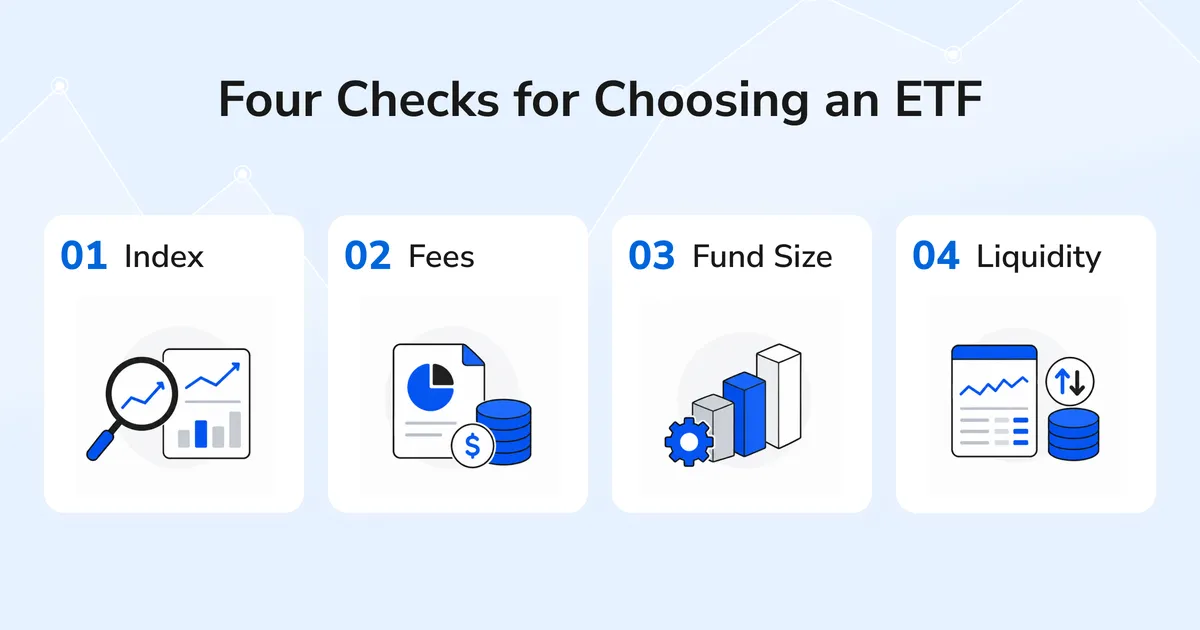
1. Check the index: what rules are you buying?
For a passive ETF, the index is more than a name. It defines the eligible holdings and the rules for changing them. Use the prospectus, fund factsheet, or official holdings information to answer a few questions:
- Which markets, countries, sectors, or asset classes does the index cover?
- Are constituents selected by market capitalization, dividends, quality, volatility, or another rule?
- How much weight sits in the largest holdings or a single sector?
- How often is the index rebalanced, and how are changes handled?
Diversification is not just a count of holdings. A fund can own many securities while remaining concentrated in a few companies, sectors, or countries. A focused ETF is not automatically unsuitable, but you should understand whether it is intended to be a core holding or a smaller satellite position in your broader allocation—rather than choosing it only because the theme is popular.
2. Check ongoing fees: are long-term costs clear and acceptable?
Management fees, custody fees, and other fund expenses are generally reflected in an ETF's net asset value rather than charged separately every time you trade. A lower expense ratio does not automatically make a fund better, but it is a practical comparison point when two ETFs offer similar exposure and tracking approaches.
Look beyond one headline fee. A fund that trades more frequently, invests in less readily traded assets, or uses derivatives may have different implementation costs and tracking risk. Read What Are ETF Embedded Costs? and rely on the latest prospectus and fund reports for the most current disclosures.
3. Check fund size and operating conditions: can the product continue to meet your needs?
Fund assets, launch date, and issuer disclosures can help you understand an ETF's operating conditions, but no single number is an absolute cutoff. A smaller ETF is not necessarily uninvestable, and a large one is not necessarily less risky. The question is whether the fund has conditions that support its stated strategy and day-to-day trading.
Review assets under management, inception date, issuer notices, and the rules for a merger, termination, liquidation, or strategy change. If a fund later closes or merges, you may need to deal with the position at a time you did not choose. Fund size should therefore be considered alongside the index, fees, and liquidity—not used alone as a label for safety or quality.
4. Check liquidity: can you trade near the price you expect?
Liquidity is more than one trading-volume number. In live trading, consider the bid-ask spread, quoted depth, the premium or discount between market price and net asset value, and how conditions can differ across the day. FINRA notes that exchange-traded products can carry varying liquidity risk, and trading volume, bid-ask spreads, and market conditions may affect execution prices. The Taiwan Stock Exchange investor education material also explains that ETF market prices can be affected by supply and demand in the secondary market.
When spreads are wide, intraday prices are moving sharply, or the market price has moved away from NAV, an urgent market order may be more likely to fill away from your expectation. Before placing an order, check current quotes and the premium or discount. For a closer look at the difference between market price and NAV, read What Is an ETF Premium or Discount?. A separate guide to ETF liquidity and trading volume is planned for this site.
Use the same comparison sheet instead of one headline number
Put candidate ETFs into the same comparison sheet. This makes it easier to evaluate them with consistent fields instead of choosing a favorite first and searching for numbers that support it.
- Investment purpose:Is the ETF intended for long-term growth, cash flow, diversification, or specific market exposure?
- Index or strategy:Do the index rules, holdings, and concentration match the purpose you set?
- Fees and tracking:Are ongoing costs, tracking method, and possible tracking differences clearly disclosed?
- Fund operations:What are the fund size, inception date, notices, and merger or termination rules?
- Trading conditions:Are spreads, quotes, trading activity, and premiums or discounts within a range you understand?
- Risks:What currency, interest-rate, sector, country, credit, or concentration risks are present?
Prospectuses, fund reports, holdings data, and exchange notices are a stronger starting point than social-media screenshots or a single ranking. The Taiwan Stock Exchange notes that ETF premiums and discounts can be influenced by market supply, demand, and liquidity, so trading decisions should account for the relationship between market price, NAV, and product risks. Read its ETF risk material.
A practical order for the four checks
First filter out types that do not fit your objective. Then compare the index, costs, fund conditions, and liquidity in that order. The goal is not to find a perfect ETF. It is to know why you chose it, which risks you are taking, and what information you will revisit later.
Performance, distribution policies, holdings, and fund information can change. Review the latest public information before investing and periodically afterwards. If you are unsure whether a product suits your financial circumstances, consult a qualified professional. Investing involves risk; ETF prices and income can rise or fall, and past performance does not guarantee future results.
ETF selection FAQ
Is a larger ETF always better?
No. Fund size can be a useful clue about operations and trading conditions, but it should be considered with the index, fees, concentration, and liquidity. A large fund may not fit your goals, while a smaller one is not automatically untradeable. Review current disclosures and understand any merger or termination rules.
Should I avoid an ETF with low trading volume?
Do not decide from trading volume alone. Execution quality also depends on bid-ask spreads, quoted depth, market-making arrangements, the liquidity of underlying assets, and premiums or discounts. With lower-volume products, it becomes even more important to check quotes and premiums or discounts before trading.
Is the lowest expense ratio always best?
The expense ratio is an important long-term cost, but it should not be separated from a product's strategy. When two ETFs provide similar exposure, a lower cost is often worth attention. If their underlying exposure, rebalancing, or risks differ, first confirm that they are genuinely comparable.
What do beginners most often overlook when choosing an ETF?
Many people focus on recent returns, distribution amounts, or popular themes without reading index rules, concentration, costs, and trading conditions. Writing down an objective first and using the same comparison sheet can be more useful than following a single ranking.
Further reading
- What Is an ETF?: ETF basics, potential benefits, and core risks.
- What Are ETF Embedded Costs?: How management fees, custody fees, and expense ratios affect fund value.
- What Is an ETF Premium or Discount?: Market price, NAV, and the risk of execution prices.
- How to Assess Your Risk Tolerance: Connect product choices with your goals, time horizon, and tolerance for volatility.
- Planned:
/en/article/etf-liquidity-volume, a deeper guide to ETF volume, bid-ask spreads, and liquidity.
What is ZONE Wallet?
ZONE Wallet is a Taiwan-based virtual asset exchange, allowing beginners to buy and sell easily with a single click. Combined with our dollar-cost averaging (DCA) feature, you can enjoy flexible, value-driven investment results!
ZONE Wallet also offers corporate account services with a fast and secure onboarding process. We help startups and enterprises leverage stablecoins to optimize cross-border payment workflows and reduce transaction costs. ZONE Wallet makes asset allocation more reliable for both personal financial management and corporate treasury strategies—helping you effortlessly navigate the future of Web3!
Start small to get comfortable with the process and risks.
Ready to dive into crypto?
[download-app]